
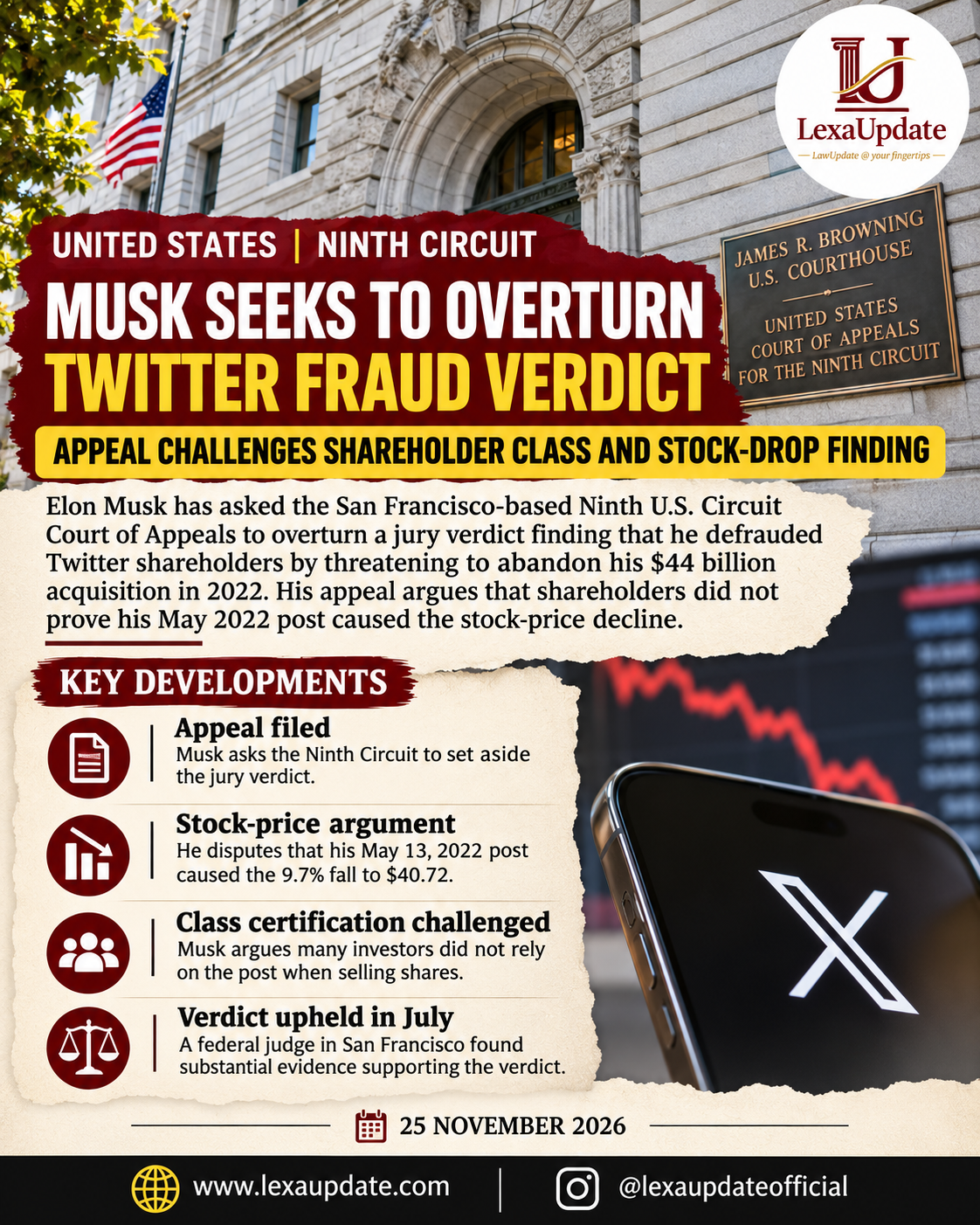
Elon Musk has filed an appeal before the San Francisco‑based 9th US Circuit Court of Appeals, seeking to overturn a jury verdict that found him liable for defrauding Twitter shareholders of approximately $2.6 billion. The lower‑court decision held that Musk’s May 13, 2022, tweet indicating the $44 billion takeover was "temporarily on hold" was materially false and caused a 9.7% drop in Twitter’s share price.
The appeal, lodged on 24 November 2026, challenges both the factual basis of the class‑action certification and the causal link between Musk’s statements and the stock‑price decline. If the appellate court upholds the verdict, Musk could face a multi‑billion‑dollar judgment plus interest; a reversal would restore the status quo ante for the billionaire’s holdings in X Corp (formerly Twitter).
Background and Facts
In April 2022, Elon Musk announced a $44 billion agreement to acquire Twitter, promising to address concerns about “spam and fake accounts” on the platform. On 13 May 2022, Musk posted on X (formerly Twitter) that the deal was "temporarily on hold" pending verification that the platform was not overrun by such accounts. The following day, Twitter’s share price fell from $40.72 to $36.85, a decline of roughly 9.7%.
Shareholders filed a securities‑fraud class action, alleging that Musk’s public statements were deceptive and that the price drop was a direct result of the alleged misrepresentation. A jury in the US District Court for the Northern District of California returned a verdict in July 2026, finding substantial evidence of falsity in Musk’s May 13 tweet and awarding the plaintiffs $2.6 billion in damages, pending interest.
Submissions & Proceedings
In its appellate brief, Musk’s counsel contended that the plaintiffs failed to demonstrate a causal nexus between the tweet and the share‑price movement, arguing that broader market forces and unrelated news items also influenced Twitter’s stock. The brief further asserted that the district court erred in certifying the case as a class action, noting that many investors likely sold shares without reliance on Musk’s statement.
The shareholders’ lawyers, representing the lead plaintiff, maintained that the tweet was a material misstatement that directly misled investors, satisfying the elements of securities fraud under the Securities Exchange Act of 1934. They emphasized the jury’s finding of “substantial evidence of falsity” and urged the appellate court to affirm both the verdict and the class‑action certification.
Court's Reasoning & Directions
As of the filing date, the 9th Circuit has not issued a written opinion. The appellate court’s standard of review will likely focus on whether the district court correctly applied the fraud‑in‑securities test, including the materiality and reliance requirements, and whether the certification of the class met the criteria of the Supreme Court’s Wal-Mart v. Dukes framework.
The court may also consider the “loss causation” issue – whether the alleged misstatement was a proximate cause of the price decline – a point that has generated considerable debate in securities‑fraud jurisprudence. The parties have been ordered to submit supplemental briefs on the loss‑causation question within 30 days.
Why This Case Matters
The dispute sits at the intersection of high‑profile corporate acquisitions, social‑media communications, and securities‑law enforcement. A ruling in favour of Musk could narrow the scope of what constitutes a material misstatement in the context of public statements by corporate leaders, potentially reshaping the landscape for future class actions involving social‑media disclosures. Conversely, an affirmation of the verdict would reinforce the principle that public statements by corporate insiders are subject to strict scrutiny under the Securities Exchange Act, underscoring the liability risks for high‑profile CEOs.
For investors, the case highlights the importance of scrutinising corporate communications, especially on platforms that blend personal and corporate messaging. For practitioners, it offers a live laboratory on the application of loss‑causation doctrine and class‑action certification standards in the digital age.
Key Takeaways
- Elon Musk has appealed a $2.6 billion securities‑fraud verdict to the 9th US Circuit Court of Appeals.
- The appeal challenges both the factual causation between Musk’s May 13 tweet and Twitter’s share‑price decline and the class‑action certification.
- The appellate court will assess materiality, reliance, and loss‑causation under the Securities Exchange Act of 1934.
- A decision favouring Musk could narrow the definition of material misstatement for public statements on social media.
- An affirmation would reinforce strict liability for misleading statements by corporate insiders.
Case Details
| Case Name | Twitter Shareholders v. Elon Musk |
| Court | 9th US Circuit Court of Appeals (San Francisco) |
| Bench | Panel of the 9th Circuit (judges not named) |
| Case Citation | N/A |
| Date of Order | 24 November 2026 |
| Relevant Provisions | Securities Exchange Act of 1934, Section 10(b) and Rule 10b‑5 |
| Next Hearing | Supplemental briefs on loss‑causation due within 30 days of filing |