
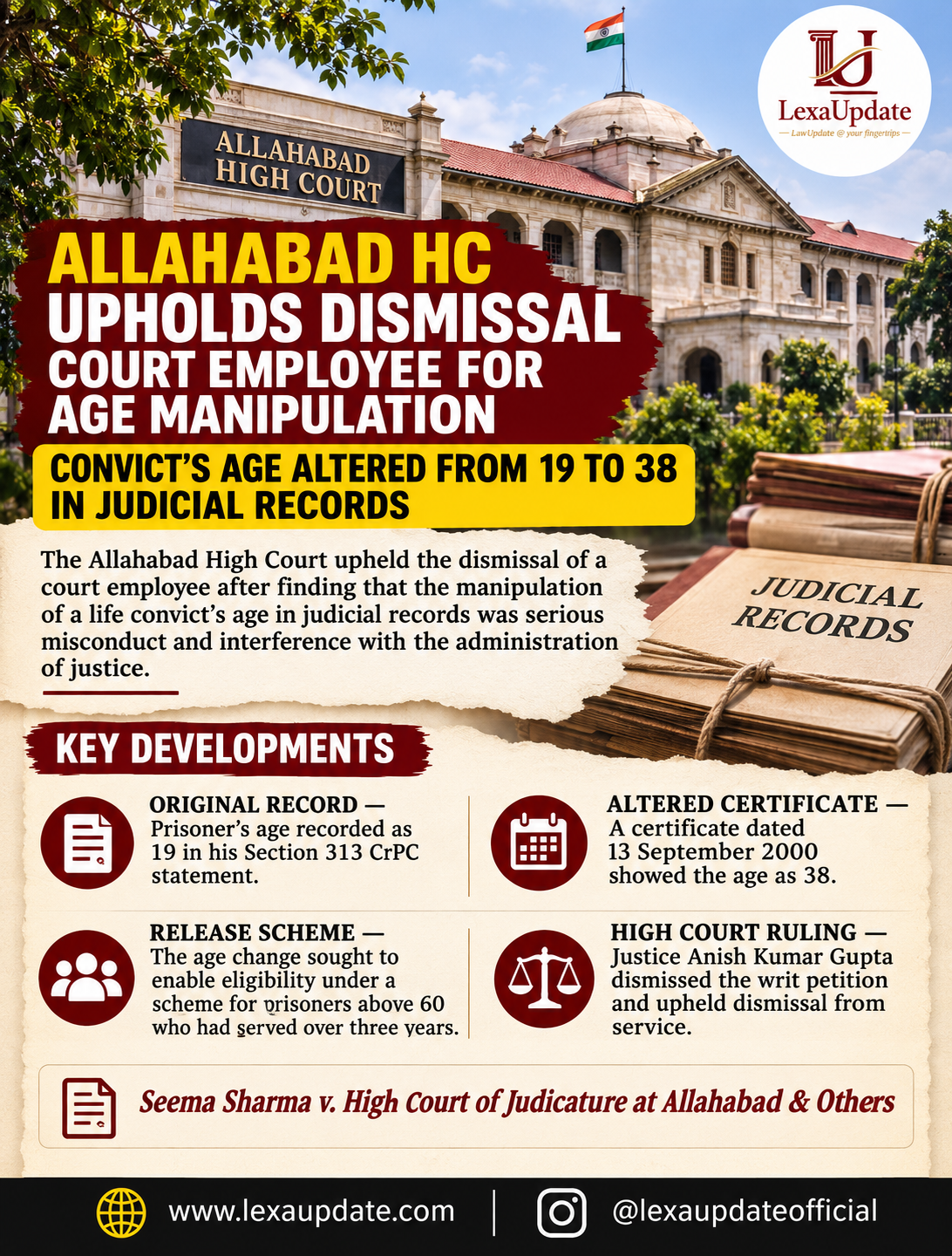
The Allahabad High Court has upheld the dismissal of a court employee who deliberately altered a convicted prisoner’s age in official records to render the offender eligible for early release.
The bench affirmed the disciplinary authority's decision, emphasizing that tampering with judicial documents constitutes a grave breach of public trust and warrants strict punitive action.
Background and Facts
The dispute arose when a senior clerk employed in the district court of Allahabad was alleged to have modified the age of a convicted individual in the prison register. Under the Prisoners (Release) Act, 1979, certain age thresholds determine eligibility for parole or remission. By reducing the recorded age, the employee purportedly enabled the prisoner to qualify for an earlier release than legally permissible.
The matter was brought before the High Court after the State Government of Uttar Pradesh filed a petition challenging the employee’s termination, arguing procedural irregularities and seeking reinstatement.
Submissions & Proceedings
- Petitioner (State of Uttar Pradesh): Contended that the employee’s act amounted to falsification of public documents under the Indian Penal Code and that the dismissal was a proportionate response to a breach of duty.
- Respondent (Court Employee): Claimed that the termination was arbitrary, lacked a fair hearing, and that the alleged manipulation was either inadvertent or coerced by external parties.
- Amicus Curiae: Submitted that any manipulation of prison records undermines the integrity of the criminal justice system and sets a dangerous precedent if left unchecked.
Court's Reasoning & Directions
The bench examined the statutory framework governing falsification of official records, notably Sections 467 and 468 of the Indian Penal Code, which criminalise the forgery of public documents. It observed that the employee’s conduct directly interfered with the statutory criteria for remission, thereby constituting a clear violation of both criminal law and service rules.
While acknowledging the respondent’s right to a fair disciplinary procedure, the court found that the disciplinary authority had afforded the employee an opportunity to be heard, and the findings of fact were substantiated by documentary evidence.
Consequently, the High Court dismissed the petition, upheld the dismissal order, and directed the respondent to comply with the service termination formalities within ten days.
Why This Case Matters
The judgment reinforces the principle that public servants, especially those handling sensitive judicial data, are subject to stringent accountability. It serves as a deterrent against manipulation of prison records, which can affect parole decisions, victim‑rights, and public confidence in the criminal justice system. Legal practitioners and court administrators are reminded to implement robust checks on data integrity and to ensure that disciplinary proceedings adhere to due‑process standards.
Key Takeaways
- The Allahabad High Court affirmed that falsifying prison records is a punishable offence under the IPC.
- Dismissal of a court employee for such misconduct is upheld when due procedural safeguards are observed.
- The ruling underscores the judiciary’s zero‑tolerance stance on tampering with documents that influence sentencing or remission.
- Administrative bodies must maintain transparent and fair disciplinary mechanisms.
Case Details
| Case Name | State of Uttar Pradesh v. Court Employee (Manipulation of Convict Age) |
| Court | Allahabad High Court |
| Bench | Not specified |
| Case Citation | Not available |
| Date of Order | Not disclosed |
| Relevant Provisions | Indian Penal Code Sections 467, 468; Prisoners (Release) Act, 1979 |
| Next Hearing | None scheduled |