
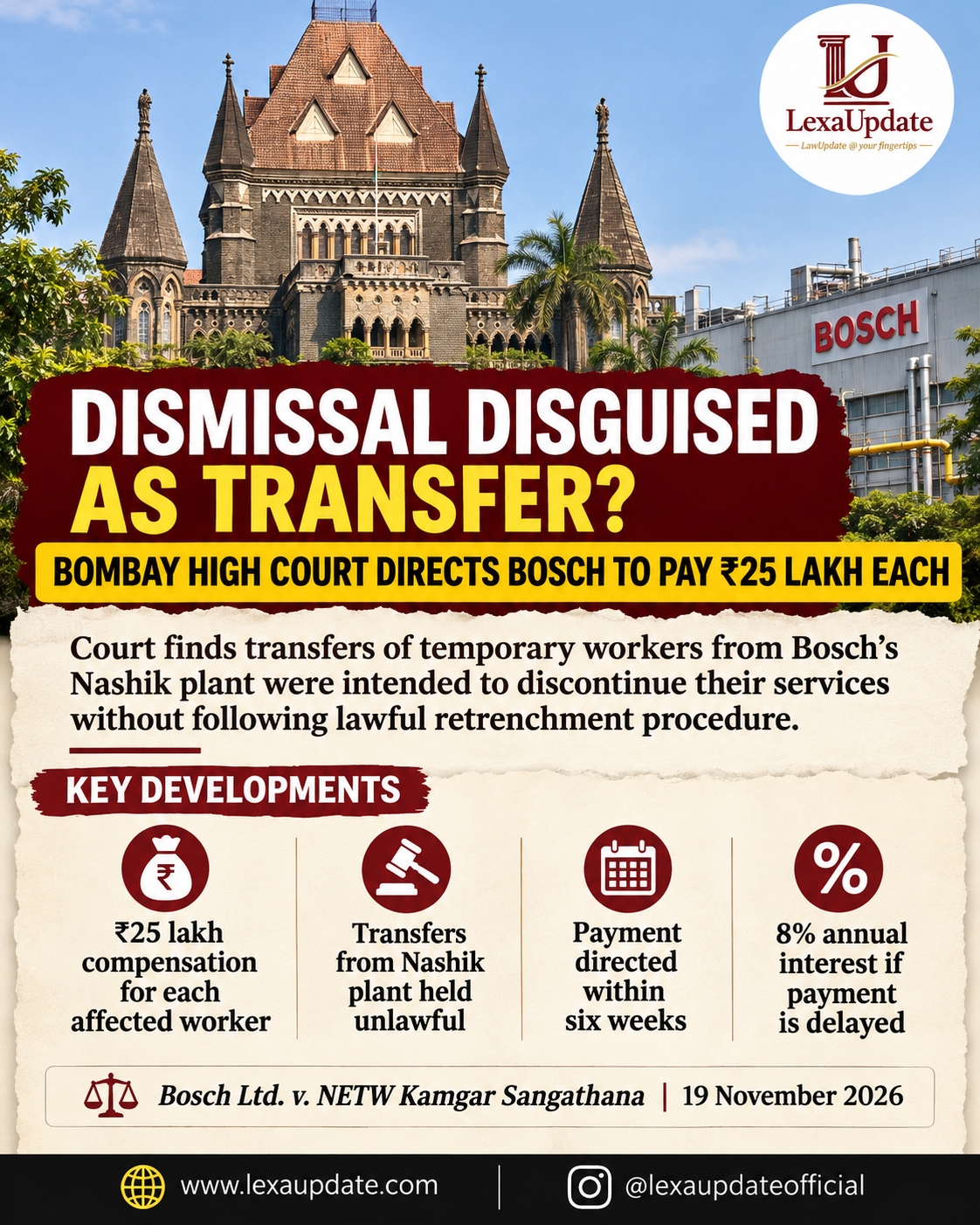
The Bombay High Court has delivered a significant ruling holding that automobile components manufacturer Bosch Limited utilized mass transfer orders as a device to remove surplus temporary workers without adhering to statutory retrenchment procedures. Setting aside an Industrial Court direction for reinstatement, Justice Sandeep V Marne ordered the company to pay a lump sum compensation of ₹25 lakh to each affected New Entrant Temporary Workman (NETW) at its Nashik plant.
Under the terms of the November 19, 2026 judgment, the compensation must be disbursed within six weeks, failing which the amount will attract an annual interest rate of 8 percent. The Court ruled that while the transfers constituted an unfair labour practice, physical reinstatement was unviable given the structural decline in manufacturing demand, opting instead for a financial settlement as full and final closure of the long-standing industrial dispute.
Background and Facts
The core dispute emerged from Bosch's manufacturing facility in Nashik, where production demands for diesel injectors faced a severe downturn due to stricter emission norms and major automotive manufacturers shifting away from diesel passenger vehicles. In response to surplus labor, Bosch initially implemented a 'Red-Light Activation' system, preventing workers from reporting for duty on days when work was unavailable. After the workers successfully challenged this mechanism up to the Supreme Court and secured wage protections, the company recalled them in August 2024.
Within weeks of their return, Bosch issued transfer orders relocating over 500 temporary workmen to various remote locations across India. When numerous workers failed to report to these distant posts, the company initiated disciplinary proceedings, eventually leading to the dismissal of approximately 235 workers. The respondent union, NETW Kamgar Sangathana, challenged these transfers before the Industrial Court in Nashik, which ruled in favor of the workmen on September 29, 2026, finding the transfers to be an unfair labor practice.
Submissions and Proceedings
Senior Advocates CU Singh and Kiran S Bapat, appearing for Bosch, defended the management's actions by pointing to genuine commercial exigencies, shrinking market demand, and the inherent managerial prerogative to transfer employees. The company argued that the transfers were administrative necessities rather than punitive measures.
Conversely, counsel for the workmen argued that the sudden, pan-India transfers were engineered specifically to induce defaults, enabling the management to bypass mandatory statutory retrenchment compensation and due process under labor legislation. During appellate proceedings, Bosch proposed various settlement figures, initially offering ₹14 lakh and later moving to ₹18 lakh per worker, before the matter reached final adjudication.
Court's Reasoning and Directions
Justice Sandeep V Marne strongly criticized the management's approach, observing that a prominent multinational organization is expected to act as a model employer rather than resort to devious administrative measures. The Court noted that the transfer mechanism was a calculated tool designed to ensure workers would fail to join distant stations, thereby achieving back-door dismissal.
While upholding the Industrial Court’s finding of unfair labor practices, the High Court modified the operative relief. Declining to order reinstatement to avoid prolonged friction and recognizing the verified drop in manufacturing activity, the Court balanced the equities by factoring in length of service and financial standing. It fixed the compensation at ₹25 lakh per worker, barring any further financial or service claims.
Why This Case Matters
This landmark judgment serves as a vital precedent on managerial prerogative versus worker protections in Indian industrial jurisprudence. It reinforces the principle that courts will pierce through administrative disguises such as mass transfers to uncover de facto retrenchments. For industrial employers, the ruling underscores the legal perils of utilizing operational restructuring to bypass statutory retrenchment mandates, while offering a pragmatic judicial framework for resolving workforce redundancy through substantial financial compensation.
Key Takeaways
- Unlawful Transfers: Mass transfers intended to frustrate workers into non-compliance constitute unfair labor practices.
- Piercing the Corporate Veil: Courts will look beyond the stated business reasons to examine the true underlying intent of mass workforce relocations.
- Compensation over Reinstatement: Where industrial harmony is compromised and manufacturing demand has structurally shifted, courts may substitute reinstatement with adequate monetary compensation.
- Strict Deadlines: Employers must settle awarded dues within specified timeframes to avoid statutory interest penalties.
Case Details
| Case Name | Bosch Ltd. & Ors. v. NETW Kamgar Sangathana & Anr. |
| Court | Bombay High Court |
| Bench | Justice Sandeep V Marne |
| Case Number | Writ Petition No. 13945 of 2026 |
| Date of Order | November 19, 2026 |
| Relevant Provisions | Industrial Disputes Act, Maharashtra Recognition of Trade Unions and Prevention of Unfair Labour Practices Act (MRTU & PULP Act) |