
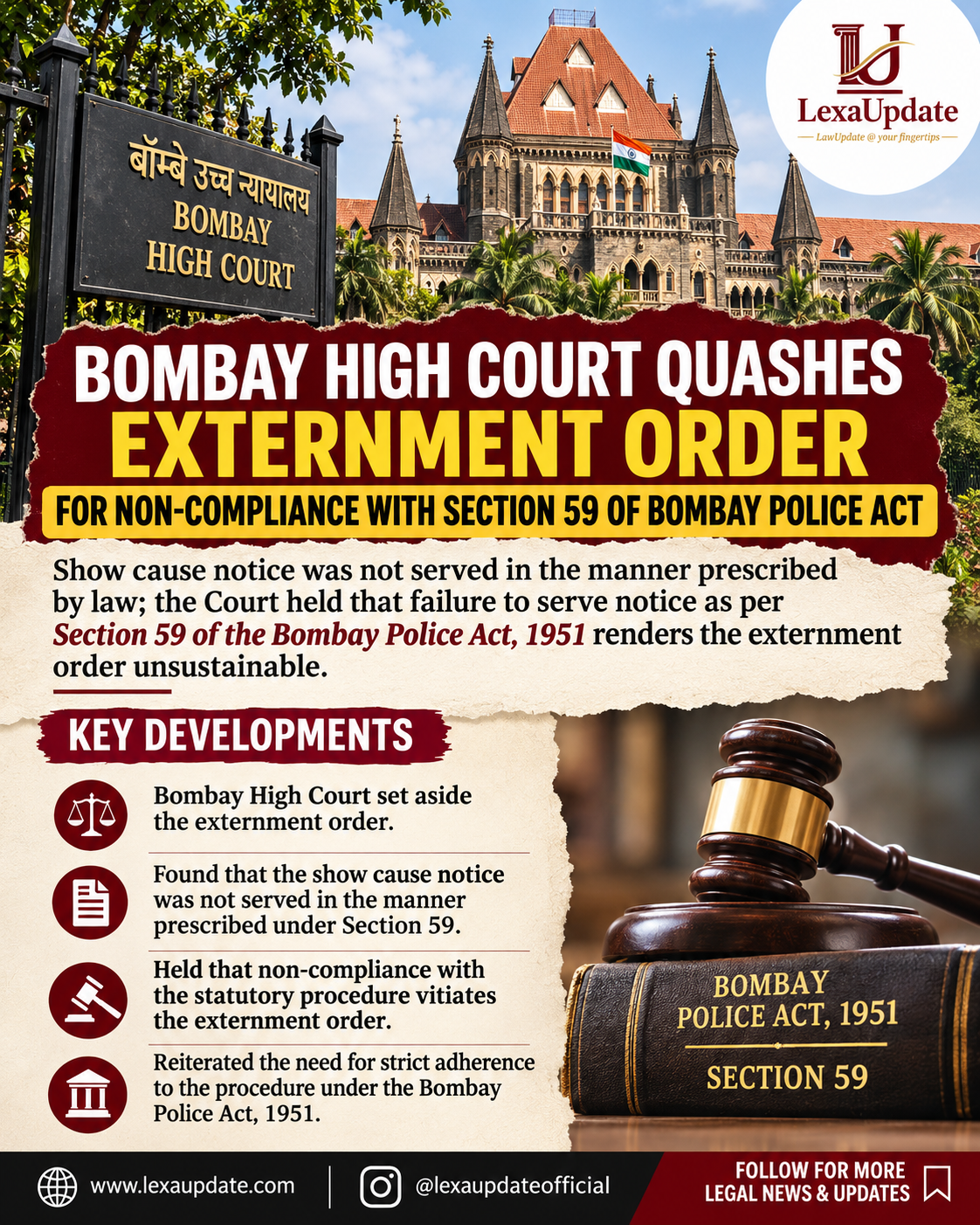
The Bombay High Court, Aurangabad Bench, has set aside a 2010 externment order issued against Radhakisan Waman Patol, holding that the show‑cause notice was not served in the manner prescribed by Section 59 of the Bombay Police Act, 1951. The court declared the order passed under Section 56(1)(a)(b) of the same Act void for procedural non‑compliance.
Petitioner Patol filed Criminal Writ Petition No. 335 of 2011 under Article 227 of the Constitution, challenging both the original externment order dated 22 October 2010 and the subsequent appellate order dated 24 February 2011. The High Court quashed both orders and made the ruling absolute, emphasizing that service by registered post alone does not satisfy the statutory requirement of personal delivery or affixation.
Background and Facts
The Deputy Commissioner of Police, Aurangabad, issued a show‑cause notice on 14 August 2010 under Section 59, alleging that Patol was involved in criminal activities and pending offences. The notice demanded that he show cause why he should not be externed from Aurangabad and Ahmednagar districts for two years under Section 56(1)(a)(b). Patol replied on 17 August 2010, denying the allegations and claiming that the cases against him were false. After a hearing, the Deputy Commissioner passed the externment order on 22 October 2010. Patol appealed to the Principal Secretary (Appeal and Security), who dismissed the appeal on 24 February 2011. The petitioner then approached the High Court.
Submissions & Proceedings
Patol contended that the show‑cause notice had been dispatched by registered post and that no attempt was made to serve it personally, nor was it affixed to his residence as mandated by Section 59. He argued that the statutory language requires either personal delivery or, if the person is not found, affixation on the outer door or a conspicuous part of the house followed by publication in the Official Gazette. The State of Maharashtra, on the other hand, maintained that service by registered post satisfied the requirement of “service” under the Act.
Court's Reasoning & Directions
The bench examined the literal wording of Section 59, which stipulates that a notice must be “delivered or tendered” to the person concerned, and if the person is not found, a copy must be affixed on the outer door or a conspicuous part of the house and published in the Official Gazette. The court observed that the record contained no evidence of personal delivery, nor any affixation or Gazette notification. Consequently, the method of service—mere posting of the notice—was held to be non‑compliant.
Relying on the principle of natural justice, the court held that a procedural defect of this nature vitiates the entire proceeding under Section 56. The bench therefore quashed both the 2010 externment order and the 2011 appellate order, making the decision absolute and directing the respondents to refrain from any further enforcement of the same.
Why This Case Matters
The judgment underscores the strict procedural safeguards embedded in the Bombay Police Act, particularly the mandatory service requirements for show‑cause notices preceding an externment. It reaffirms that procedural lapses cannot be cured by subsequent orders and that the courts will not permit the enforcement of punitive measures where statutory due‑process is ignored. For law students and practitioners, the case illustrates the interplay between statutory interpretation and constitutional safeguards under Article 227, reinforcing the doctrine that “procedure is of the essence” in criminal administrative actions.
Key Takeaways
- Service of a show‑cause notice must be personal or, failing that, affixed to the residence and published as per Section 59.
- Registered post alone does not satisfy the statutory service requirement.
- Non‑compliance with Section 59 renders an externment order under Section 56 void.
- The High Court can quash both the original and appellate orders when procedural defects are established.
- The ruling strengthens procedural fairness and natural justice in police‑initiated externments.
Case Details
| Case Name | Radhakisan Waman Patol v. State of Maharashtra & Ors. |
| Court | Bombay High Court, Aurangabad Bench |
| Bench | Not specified in the judgment |
| Case Number / Citation | Criminal Writ Petition No. 335 of 2011 |
| Date of Order | 16 November 2026 |
| Relevant Provisions / Statutes | Section 56, Section 59 of the Bombay Police Act, 1951; Article 227 of the Constitution of India |
| Next Hearing | None – order is absolute |