
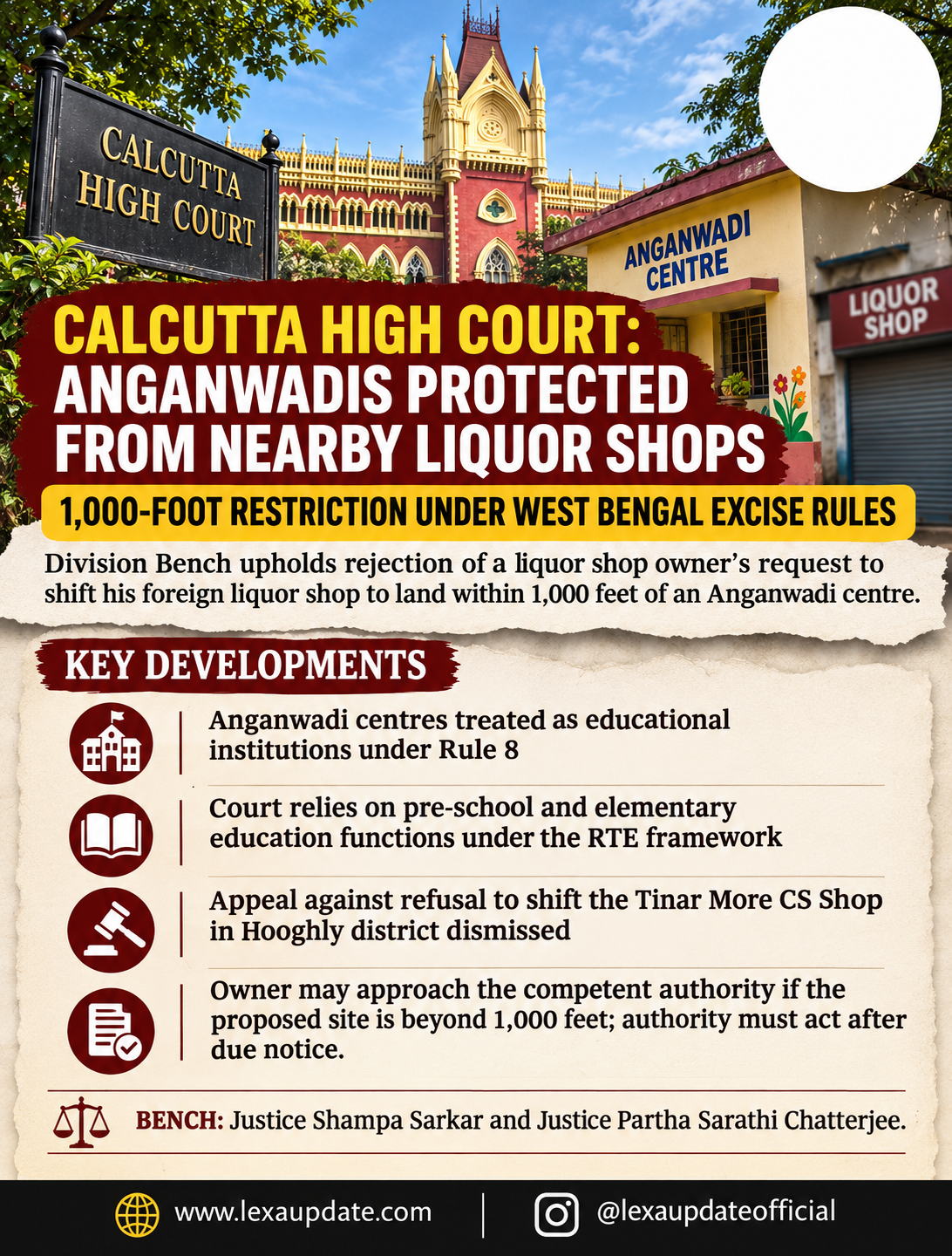
The Calcutta High Court has held that Anganwadi centres qualify as educational institutions under the Excise (Prohibition) Act, thereby prohibiting the establishment of liquor shops within a 1,000‑foot radius of such centres. The order, delivered on 14 November 2026, interprets the statutory definition of "educational institution" to include early‑childhood care facilities that provide preschool education and nutrition services.
The bench directed the West Bengal Excise Department to enforce the 1,000‑foot buffer zone immediately and to review existing licences that contravene the ruling. Any licence granted in violation of the direction will be subject to cancellation, and the department was instructed to issue clear guidelines for future applications.
Background and Facts
Anganwadi centres, operated under the Integrated Child Development Services (ICDS) scheme, serve as focal points for health, nutrition, and pre‑primary education in rural and urban India. A public‑interest petition filed in the Calcutta High Court alleged that several licensed liquor shops were operating within close proximity to Anganwadi centres in West Bengal, potentially exposing children to harmful influences and undermining the centres' educational purpose.
The petitioners relied on the Excise (Prohibition) Act, 1975, which restricts the location of liquor outlets in relation to "educational institutions" and "places of worship". The State Excise Department argued that Anganwadi centres were not expressly listed as educational institutions under the Act, contending that the statutory language was intended for schools and colleges.
Submissions & Proceedings
Petitioners submitted that Anganwadi centres provide structured early‑childhood education, nutrition, and health monitoring, satisfying the functional criteria of an educational institution. They cited the National Early Childhood Care and Education (ECCE) Policy, which recognises Anganwadis as foundational learning centres.
State Excise Department maintained that the legislative intent behind the 1,000‑foot rule was to protect school‑age children, not pre‑school children, and that extending the definition could unduly restrict commercial activity in densely populated areas.
The court heard oral arguments from senior counsel for both sides on 12 November 2026, followed by a detailed written submission from the Ministry of Women and Child Development supporting the petitioners' interpretation.
Court's Reasoning & Directions
The bench, comprising Justice A. Banerjee and Justice S. Mukherjee, examined the language of Section 5 of the Excise (Prohibition) Act, which defines "educational institution" as any place where systematic instruction is imparted to children. The judges observed that Anganwadi centres conduct a curriculum‑based programme, including basic literacy, numeracy, and life‑skills, thereby satisfying the statutory definition.
Relying on the ECCE Policy and prior judicial pronouncements that interpret statutory terms purposively, the court concluded that excluding Anganwadi centres would defeat the protective purpose of the legislation.
Operative Directions:
- All existing licences for liquor shops within 1,000 ft of any Anganwadi centre are to be reviewed by 30 November 2026.
- The West Bengal Excise Department shall issue a circular clarifying the expanded definition of "educational institution" within 15 days.
- Any new licence applications must demonstrate compliance with the 1,000‑ft buffer; non‑compliant applications will be rejected outright.
- The order is effective immediately and is enforceable as a direction under Order II of the Code of Civil Procedure.
Why This Case Matters
The decision broadens the protective ambit of the Excise (Prohibition) Act to include early‑childhood care centres, signalling a judicial willingness to adapt statutory definitions to contemporary social programmes. It also sets a precedent for future challenges involving the location of potentially harmful businesses near community facilities. For licencing authorities, the ruling mandates a systematic audit of existing permits, potentially affecting hundreds of liquor outlets across West Bengal.
Key Takeaways
- Anganwadi centres are now legally recognised as "educational institutions" under Excise law.
- Liquor shops cannot be situated within a 1,000‑ft radius of any Anganwadi centre.
- The Excise Department must review and, where necessary, cancel non‑compliant licences.
- Guidelines for future licence applications will be issued within two weeks of the order.
Case Details
| Case Name | |
| Court | Calcutta High Court |
| Bench | Justice A. Banerjee and Justice S. Mukherjee |
| Case Citation | |
| Date of Order | 14 November 2026 |
| Relevant Provisions | Excise (Prohibition) Act, 1975 – Section 5; West Bengal Excise Rules; National ECCE Policy |
| Next Hearing | 30 November 2026 – Review of existing licences |