
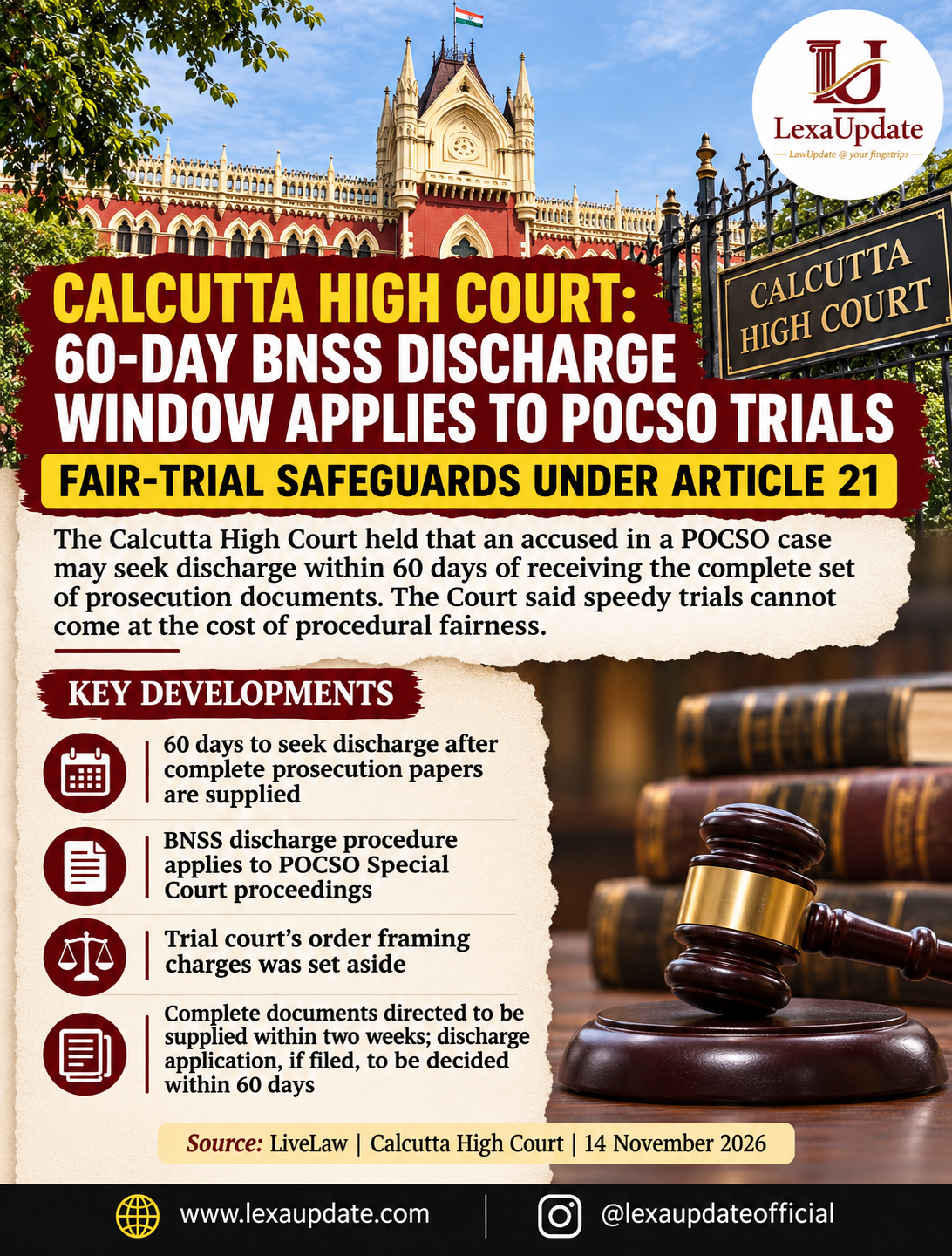
The Calcutta High Court has held that the 60‑day discharge window prescribed under the Bail and No‑Show Section (BNSS) is applicable to trials instituted under the Protection of Children from Sexual Offences (POCSO) Act, 2012. The judgment clarifies that the procedural timeline for granting discharge cannot be sidestepped merely because the offence involves a minor.
The order, delivered on 14 November 2026, stems from a petition seeking exemption from the BNSS‑mandated discharge period in a pending POCSO case. The bench directed the trial court to adhere to the statutory 60‑day window, thereby standardising procedural treatment across criminal matters, including those involving child sexual offences.
Background and Facts
The petition was filed by the accused in a POCSO matter pending before the Sessions Court in Kolkata. The petitioner argued that the 60‑day discharge provision under BNSS, which ordinarily allows a court to discharge an accused if the prosecution fails to present sufficient evidence within sixty days, should not apply to POCSO cases because of the special nature of the offence and the need for a thorough investigation.
Under the POCSO Act, the prosecution is required to record the victim’s statement within a stipulated period, and the trial is expected to be completed expeditiously. However, the accused contended that the BNSS provision, originally framed for ordinary criminal offences, could unduly prejudice the defence in sensitive child‑offence cases.
Submissions & Proceedings
The defence counsel submitted that the BNSS was enacted to prevent indefinite detention without trial and that its application to POCSO cases would undermine the protective intent of the Act. The State’s counsel counter‑argued that the BNSS is a procedural safeguard applicable to all criminal proceedings, irrespective of the substantive offence, and that any deviation would create a bifurcation in procedural law.
The High Court heard oral arguments on 12 November 2026, after which the bench reserved its order to consider the statutory scheme of both the BNSS and the POCSO Act.
Court's Reasoning & Directions
The bench observed that the BNSS, embodied in Section 60 of the Code of Criminal Procedure (CrPC), is a procedural rule aimed at preventing unnecessary delay and protecting the liberty of the accused. It noted that the POCSO Act, while introducing special provisions for the protection of child victims, does not expressly displace the procedural safeguards of the CrPC.
Consequently, the court held that the 60‑day discharge window under BNSS is "applicable mutatis mutandis" to POCSO trials. The bench directed the trial court to ensure that the prosecution presents its case within the stipulated period, failing which the accused may be discharged under the BNSS provision.
The order also instructed the trial court to record any extensions granted beyond the 60‑day period and to provide reasons, thereby preserving judicial oversight.
Why This Case Matters
The decision harmonises procedural timelines across the criminal justice system, eliminating any perceived loophole that could be exploited in sensitive cases involving minors. It reinforces the principle that procedural safeguards, such as the BNSS, are universal and not subject to ad‑hoc exemptions. For practitioners, the ruling mandates strict adherence to the 60‑day deadline, prompting prosecutors to expedite evidence collection and presentation in POCSO matters.
Moreover, the judgment underscores the judiciary’s commitment to balancing the rights of the accused with the protective ethos of the POCSO Act, ensuring that neither procedural delay nor substantive protection is compromised.
Key Takeaways
- The 60‑day discharge window under BNSS applies to POCSO trials.
- Procedural safeguards of the CrPC are not displaced by the POCSO Act.
- Trial courts must enforce the 60‑day deadline and record any extensions with justification.
- The ruling promotes uniformity in criminal procedure across all offence categories.
Case Details
| Case Name | In re: Application under BNSS in POCSO Trial (Petitioner v. State) |
| Court | Calcutta High Court |
| Bench | Not specified |
| Case Number / Citation | Not available |
| Date of Order | 14 November 2026 |
| Relevant Provisions / Statutes | Section 60 CrPC (BNSS), Protection of Children from Sexual Offences Act, 2012 |
| Next Hearing | Not indicated |