
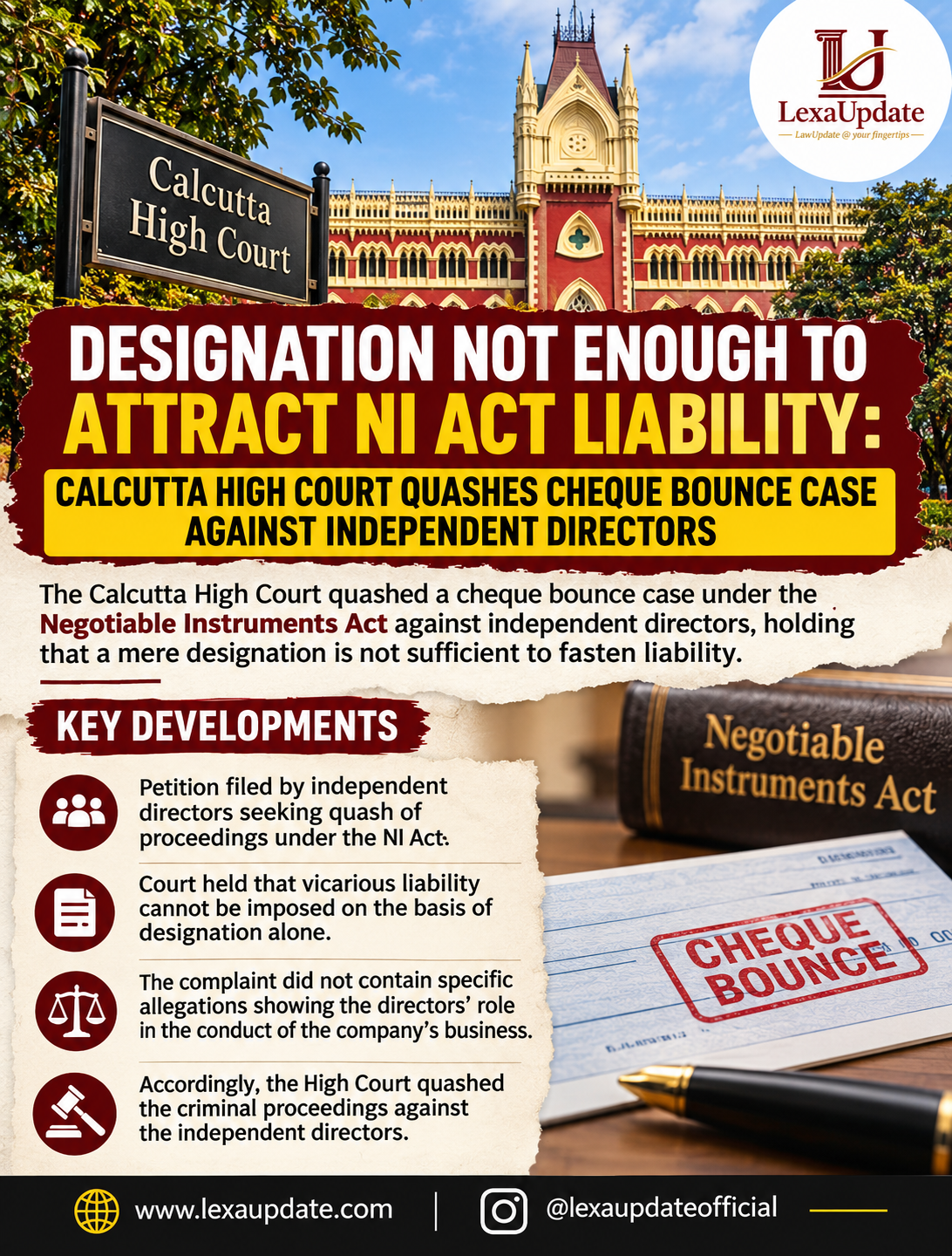
The Calcutta High Court has set aside a criminal complaint filed under Section 138 of the Negotiable Instruments Act, 1881, against the independent directors of a listed company. The bench ruled that mere designation as an independent director does not, by itself, make a person liable for the dishonour of a cheque issued by the company.
The order, delivered on 20 November 2026, dismissed the petition for criminal prosecution and directed the parties to pursue any civil remedies, if appropriate, before the appropriate forum. The judgment underscores the distinction between corporate governance responsibilities and personal criminal liability under the NI Act.
Background and Facts
The dispute originated when a cheque issued by the appellant company to a creditor was returned unpaid. The creditor invoked Section 138 of the NI Act, alleging that the directors, including two independent directors, had authorised the issuance of the cheque despite insufficient funds. The petitioner‑company argued that the independent directors were not involved in the operational decision‑making that led to the cheque issuance and therefore could not be held personally liable.
Independent directors in India are appointed under Sections 149 and 152 of the Companies Act, 2013 to provide oversight and protect minority shareholders. Their statutory duties are largely fiduciary and supervisory, rather than operational. The creditor, however, contended that the directors’ signatures on the cheque made them parties to the alleged offence.
Submissions & Proceedings
The petitioner‑company submitted that the independent directors had no knowledge of the financial position of the company at the time the cheque was issued and that they were not signatories to the instrument. It relied on the Companies Act provisions that limit the scope of an independent director’s authority to oversight functions.
The creditor’s counsel argued that the presence of the directors’ signatures on the cheque, irrespective of their internal role, satisfied the "participation" requirement under Section 138, thereby attracting criminal liability.
Court's Reasoning & Directions
The bench examined the language of Section 138, which penalises a person who, being drawn on a cheque, makes it dishonourable for lack of sufficient funds, and who fails to make payment within the stipulated period. It observed that the provision targets the drawer of the cheque or a person who has authorised its issuance.
Referencing precedent, the court noted that liability under the NI Act is predicated on a direct causal link between the accused’s act and the dishonour of the cheque. The judges held that independent directors, by virtue of their supervisory role, do not automatically become "authorisers" of every financial instrument issued by the company.
Consequently, the court quashed the criminal complaint, stating that the prosecution had not demonstrated that the independent directors had actively participated in the decision to issue the cheque. The bench directed the parties to resolve any outstanding monetary claim through civil proceedings, if any, before the appropriate civil court.
Why This Case Matters
The decision clarifies the legal boundary between corporate governance duties and personal criminal liability under the NI Act. It provides reassurance to independent directors that their statutory role does not expose them to criminal prosecution for corporate financial defaults unless they are directly involved in the transaction. The judgment also signals to creditors that civil remedies remain the appropriate avenue for recovering dues from companies, rather than resorting to criminal prosecution of board members without clear participation.
Key Takeaways
- Designation as an independent director alone does not attract liability under Section 138 NI Act.
- Criminal liability requires a demonstrable link between the accused’s act and the cheque’s dishonour.
- Courts will scrutinise the actual role and authority of directors before imposing criminal sanctions.
- Creditors should consider civil recovery mechanisms for corporate defaults.
Case Details
| Case Name | N/A |
| Court | Calcutta High Court |
| Bench | N/A |
| Case Number / Citation | N/A |
| Date of Order | 20 November 2026 |
| Relevant Provisions / Statutes | Negotiable Instruments Act, 1881 – Section 138; Companies Act, 2013 – Sections 149, 152 |
| Next Hearing | None (criminal complaint dismissed) |