
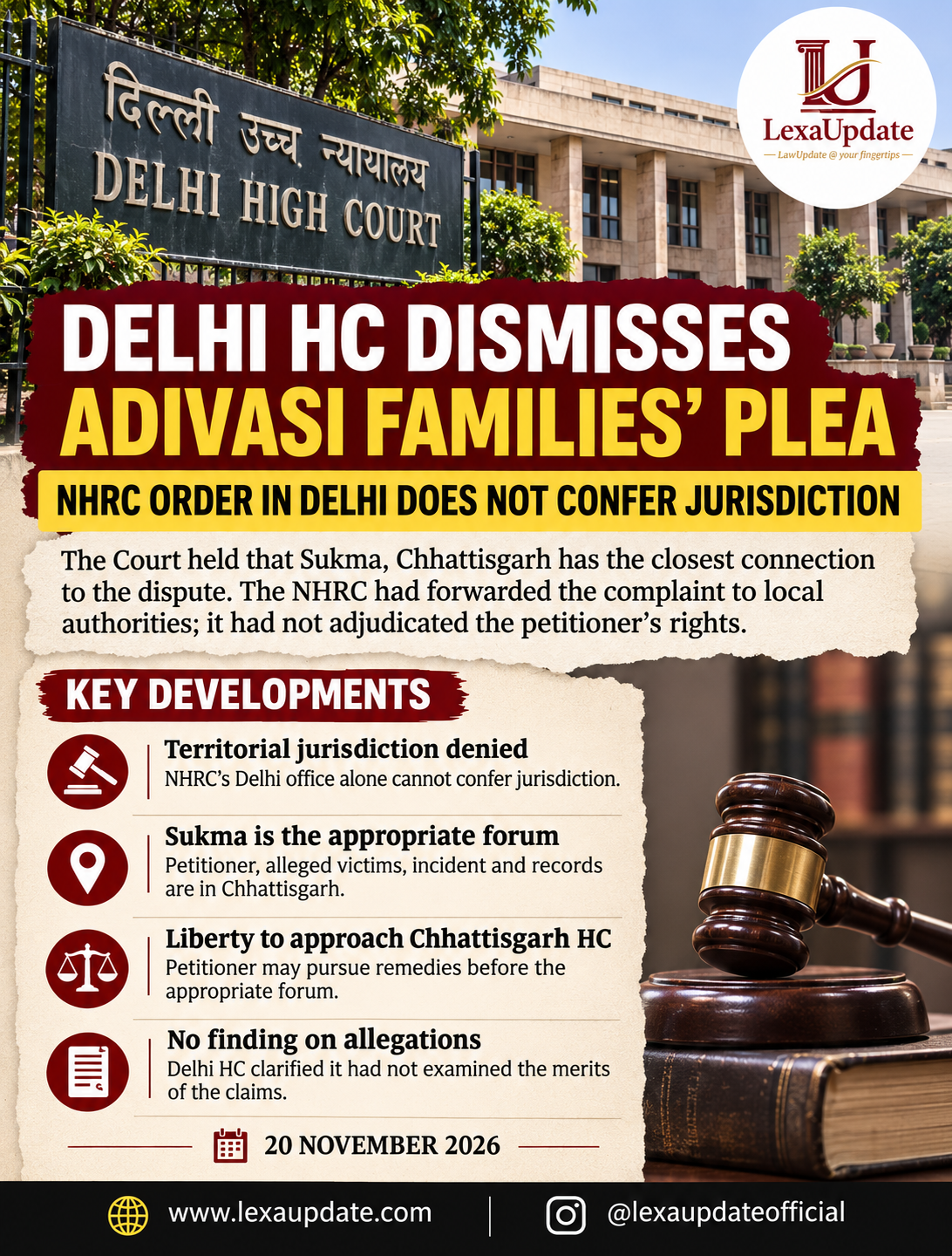
The Delhi High Court has held that the National Human Rights Commission's (NHRC) order issued from its New Delhi office does not confer territorial jurisdiction on the court to entertain a challenge concerning alleged human‑rights violations in Sukma district, Chhattisgarh.
Justice Swarana Kanta Sharma dismissed the petition filed by an Adivasi resident, directing the aggrieved parties to approach the Chhattisgarh High Court, which has the most direct connection with the facts and the authorities involved.
Background and Facts
The petitioner, a resident of Village Chitlanar in Sukma district, alleged that several Christian Adivasi families were threatened, assaulted and forced to abandon their homes after refusing to convert to Hinduism. The alleged mob attack occurred on 5 March 2026, with further threats reported on 17 March 2026. The families claimed police inaction and sought relief from the NHRC under Sections 12, 13, 17 and 18 of the Protection of Human Rights Act, 1993.
On 9 June 2026 the NHRC disposed of the complaint, directing the District Magistrate and Superintendent of Police, Sukma, to take appropriate action within eight weeks. Dissatisfied with what he characterised as a final disposal, the petitioner approached the Delhi High Court, arguing that because the NHRC order originated in Delhi, a material part of the cause of action lay within the court's territorial jurisdiction.
Submissions & Proceedings
The petitioner contended that the NHRC’s decision, being a substantive order issued from the capital, created a cause of action that could be adjudicated by the Delhi High Court. He sought a direction that the NHRC order be treated as an interim direction and that the Commission reconsider the matter.
The respondents – the NHRC and the unnamed district authorities – argued that the entire dispute, including the alleged offences, the victims, the alleged perpetrators and the relevant records, were situated in Sukma, Chhattisgarh. They further pointed out that parallel proceedings were already pending before the Chhattisgarh High Court.
Court's Reasoning & Directions
Justice Sharma observed that the NHRC had not adjudicated any substantive right of the petitioner; it merely referred the complaint back to the local authorities. Consequently, the NHRC’s order did not create a cause of action within Delhi’s territorial limits.
Relying on the Supreme Court’s decision in Kusum Ingots & Alloys Ltd. v. Union of India and earlier precedents such as Sterling Agro Industries Ltd. v. Union of India and Rishi Pal v. National Commission for Scheduled Castes, the bench reiterated that the mere location of a central authority does not automatically confer jurisdiction on a High Court. The principle of *forum conveniens* – the most appropriate forum – dictated that the Chhattisgarh High Court, having the closest nexus to the facts, should hear the petition.
The court also cautioned against a scenario where every NHRC order, irrespective of the place of the alleged violation, could be challenged in Delhi, which would lead to a flood of jurisdictional claims and potential parallel adjudication.
Accordingly, the petition was dismissed for lack of territorial jurisdiction. The court granted liberty to the petitioner to pursue appropriate remedies before the Chhattisgarh High Court, without expressing any opinion on the merits of the underlying human‑rights allegations.
Why This Case Matters
The judgment clarifies the territorial limits of writ jurisdiction for High Courts when dealing with orders of quasi‑judicial bodies headquartered in Delhi. It underscores that the locus of the grievance, not merely the seat of the issuing authority, determines the appropriate forum. This precedent will guide future petitions challenging NHRC or similar central commissions’ orders, preventing jurisdictional overreach and preserving the principle of judicial efficiency.
Key Takeaways
- The Delhi High Court cannot entertain challenges to NHRC orders merely because the Commission is based in Delhi.
- Territorial jurisdiction hinges on the location of the dispute, parties and evidence.
- The doctrine of *forum conveniens* remains pivotal in allocating cases to the most appropriate High Court.
- Petitioners must approach the High Court that has the closest connection to the facts – here, the Chhattisgarh High Court.
- The decision prevents a flood of jurisdictional claims against central bodies in Delhi.
Case Details
| Case Name | Adivasi Families of Sukma v. National Human Rights Commission |
| Court | Delhi High Court |
| Bench | Justice Swarana Kanta Sharma |
| Case Citation | Not reported |
| Date of Order | 20 November 2026 |
| Relevant Provisions | Protection of Human Rights Act, 1993 – Sections 12, 13, 17, 18 |
| Next Hearing | Petitioner may file fresh petition in Chhattisgarh High Court |