
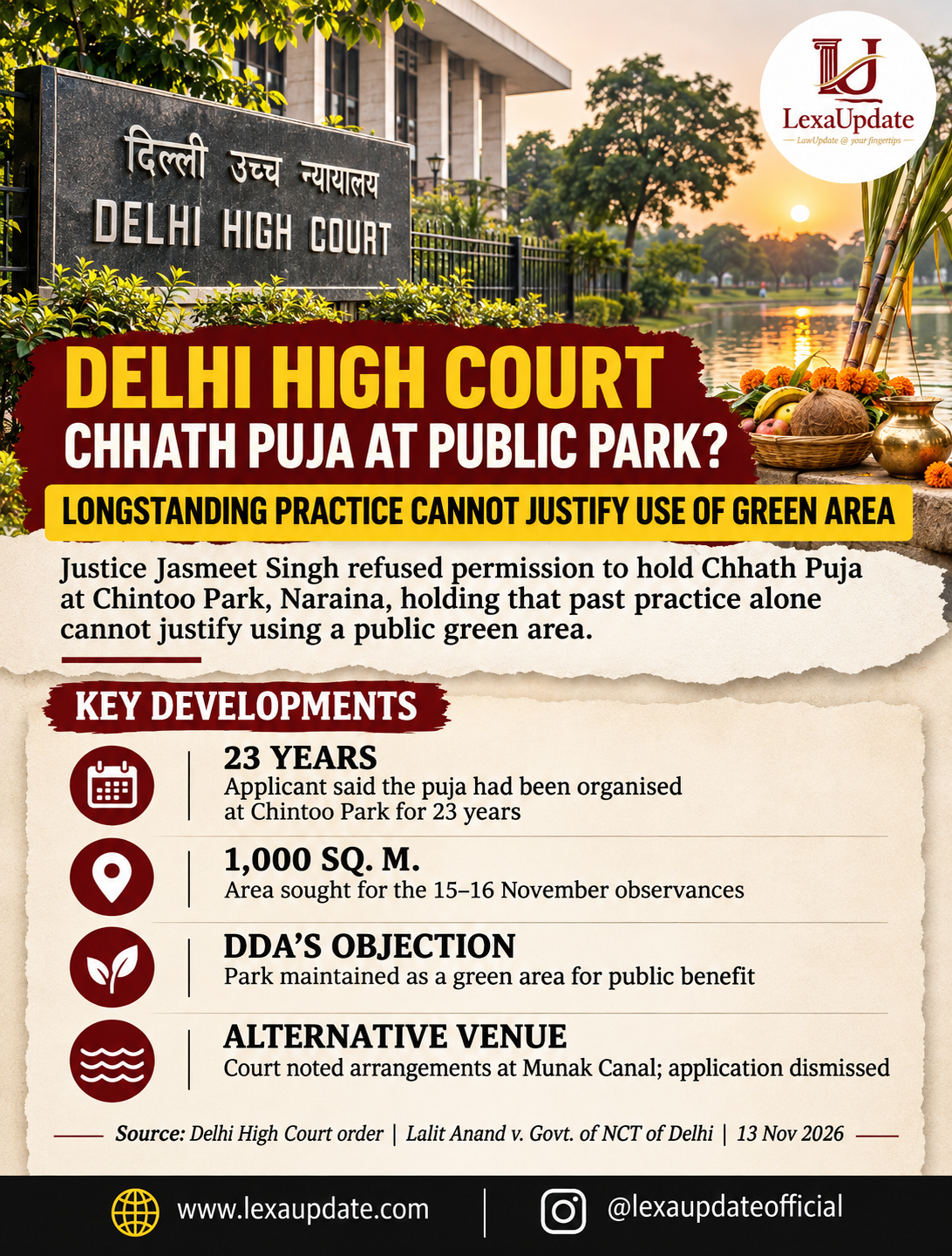
The Delhi High Court has firmly ruled that a longstanding or historical practice of organising religious observances cannot, by itself, justify the commercial or temporary use of public green spaces. Justice Jasmeet Singh dismissed a petition seeking temporary booking rights over a portion of Chintoo Park in Naraina Village for the celebration of Chhath Puja, emphasizing that urban parks must be preserved for the general public and environmental welfare.
The ruling addresses the recurrent friction between traditional community festivities and urban environmental conservation. By denying temporary commercial or organizational allotments within designated green zones maintained by the Delhi Development Authority (DDA), the High Court underscored the primacy of ecological preservation over customary public land use, particularly when comprehensive alternative arrangements have been formally established by the administration.
Background and Facts
The matter arose through an application filed under Section 151 of the Code of Civil Procedure, 1908, within the pending writ proceedings of Lalit Anand v. Govt. of NCT of Delhi & Ors. (W.P.(C) 36/2026). The applicant sought urgent vacation intervention to secure temporary booking rights over approximately 1,000 square metres of Chintoo Park in Naraina Village to conduct the Sandhya Arghya and Usha Arghya rituals on November 15 and 16, 2026. The applicant submitted that the community had been performing the festival at the specific location continuously for the past 23 years, offering undertakings to restore the park to its original condition subsequently.
Submissions and Proceedings
Appearing for the applicant, counsel argued that the longstanding nature of the religious congregation created a legitimate expectation, supported further by administrative notifications concerning single-window management for festival clearances. Conversely, the DDA vehemently opposed the plea. Counsel for the DDA contended that the land in question functions strictly as a maintained green area comprising delicate flora and landscaped trees. Permitting large-scale assemblies, temporary structures, and ritual activities would cause irreversible damage to the turf and undermine ongoing municipal maintenance efforts aimed at urban greening.
Court's Reasoning and Directions
Justice Jasmeet Singh evaluated the competing claims and noted that neither historical user rights nor the limited duration of an event can validate the encroachment or degradation of public parks. The Court observed that green spaces are maintained for the collective benefit of the entire citizenry, whose entitlement to unhindered access to clean, preserved urban ecology overrides individual or sectional convenience.
Addressing the argument concerning administrative notifications, the Court reiterated that executive circulars or single-window management guidelines cannot override or dilute binding judicial mandates. Citing established constitutional jurisprudence from the Supreme Court in S.S. Bola v. B.D. Sardana, the bench reinforced the doctrine of separation of powers and the sanctity of judicial review. Furthermore, the Court highlighted that the Government of NCT of Delhi had already designated alternative sites—such as areas near the Munak Canal—with adequate infrastructure for conducting Chhath Puja safely, rendering the conversion of neighborhood parks entirely unnecessary.
Why This Case Matters
This decision serves as a vital judicial checkpoint balancing communal rights with environmental jurisprudence in densely populated urban centers. It clarifies that municipal green lungs cannot be converted into ad-hoc event venues based purely on historical custom or executive leniency. For urban planners, civic bodies, and community organizers, the judgment establishes a clear boundary: religious and cultural traditions must be accommodated within designated civic infrastructure rather than encroaching upon protected public parks.
Key Takeaways
- No Prescriptive Rights Over Green Areas: Historical or longstanding use of a public park does not confer legal immunity or a vested right to utilize it for non-park activities.
- Environmental Priority: The ecological preservation and maintenance of urban green spaces for the general public take precedence over local community festivities.
- Primacy of Judicial Orders: Administrative circulars and single-window guidelines cannot override judicial pronouncements or statutory environmental protections.
- Availability of Alternatives: The existence of state-earmarked alternative venues (such as waterfronts or designated grounds) legally justifies the denial of park permissions.
Case Details
| Case Name | Lalit Anand v. Govt. of NCT of Delhi & Ors. |
| Court | High Court of Delhi |
| Bench | Hon'ble Mr. Justice Jasmeet Singh |
| Case Number | W.P.(C) 36/2026 & CM Appl. 78724/2026 |
| Date of Order | November 13, 2026 |
| Relevant Provisions | Section 151 of the Code of Civil Procedure, 1908; DDA Act maintenance mandates |
| Outcome | Application dismissed; permission to use green area denied |