
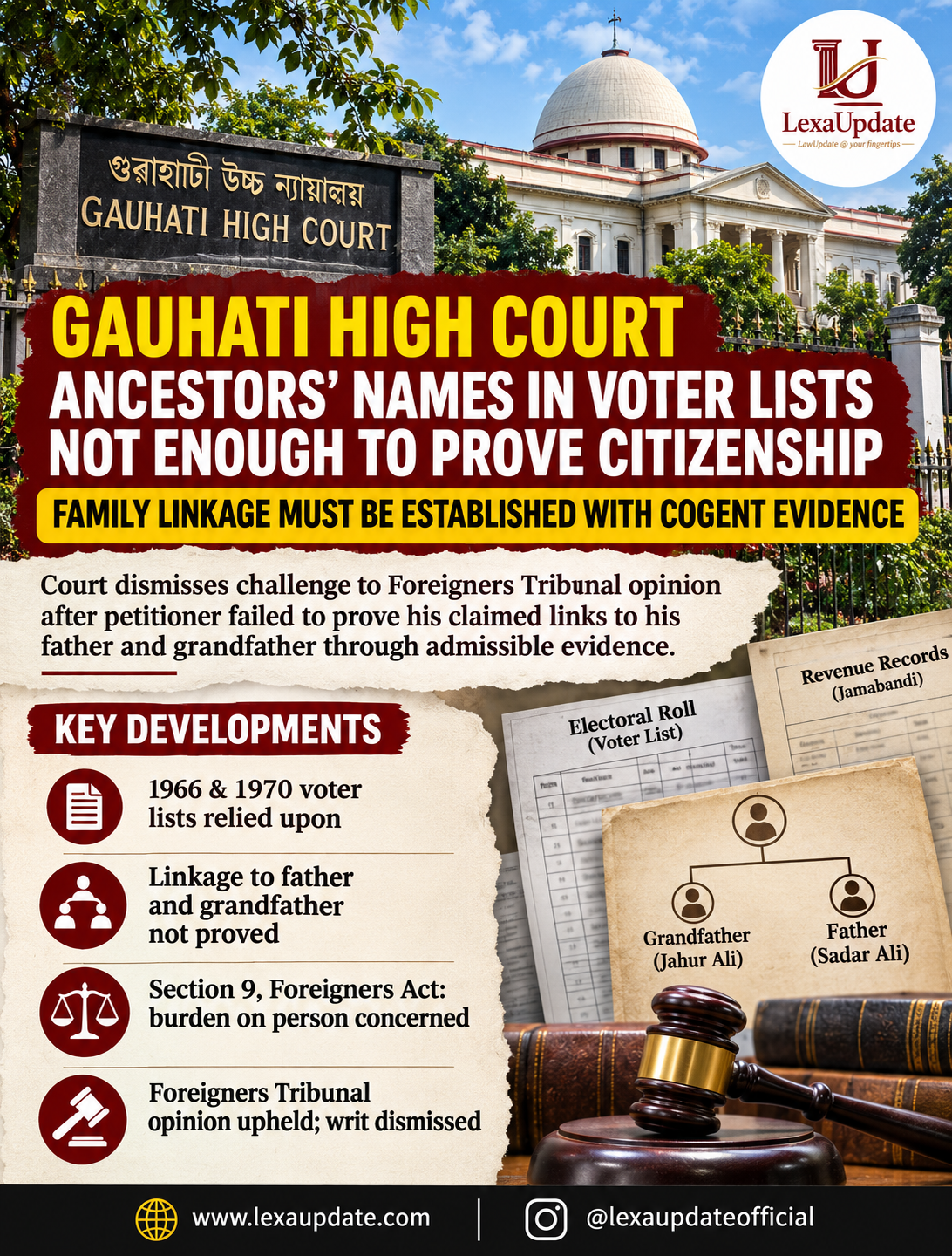
The Gauhati High Court has clarified that the mere appearance of a name – even with an ancestor’s details – on a voter list cannot, by itself, establish Indian citizenship. The court emphasised that documentary proof of a family relationship is indispensable to substantiate a citizenship claim.
The ruling emerged from a petition challenging the reliance on electoral rolls as conclusive evidence of citizenship. The bench directed the election authorities to verify lineage through appropriate documents before accepting a voter‑list entry as proof of citizenship.
Background and Facts
The dispute originated when a group of applicants sought recognition of their citizenship status based solely on entries in the electoral roll of Assam. Their names were listed alongside those of their forebears, and the applicants argued that this sufficed under the Representation of the People Act, 1951. The respondents – the State Election Commission – contended that the electoral roll is a secondary source and that primary proof of lineage is required under the Citizenship Act, 1955.
Under Indian law, citizenship can be acquired by birth, descent, registration or naturalisation. Section 2(1)(c) of the Citizenship Act, 1955 defines citizenship by descent, requiring proof of the parent’s citizenship at the time of the applicant’s birth. The Representation of the People Act, 1951, while mandating the preparation of electoral rolls, does not elevate the roll to a definitive proof of citizenship.
Submissions & Proceedings
The petitioners relied on the fact that their ancestors’ names appeared in the voter list, asserting that the list is a government‑issued document and therefore carries evidentiary weight. They submitted copies of the electoral roll extracts and argued that the statutory framework of the RPA implicitly recognises the roll as proof of eligibility to vote, which in turn presumes citizenship.
The State Election Commission, representing the respondents, argued that the electoral roll is compiled for the purpose of conducting elections and is not intended to resolve citizenship disputes. It highlighted that the Citizenship Act expressly requires documentary proof of descent – such as birth certificates, school records, or passports – and that reliance on the roll alone would contravene the constitutional guarantee of equality before law.
Court's Reasoning & Directions
The bench, after examining the relevant provisions of the Constitution (Article 5), the Citizenship Act, and the Representation of the People Act, held that the electoral roll is a secondary source and cannot supplant the primary evidentiary requirements laid down in the Citizenship Act. The court observed that while the roll reflects the names of individuals eligible to vote, it does not verify the underlying citizenship status.
Consequently, the court directed the State Election Commission to:
- Require each applicant claiming citizenship on the basis of a voter‑list entry to furnish documentary proof of family linkage, such as birth certificates, school leaving certificates, or any other government‑issued document establishing descent.
- Maintain a separate register of such documentary submissions for future reference and audit.
- Notify the petitioners that failure to produce the required documents will result in the rejection of their citizenship claim.
The judgment underscored that the principle of “proof of citizenship” cannot be diluted to a mere listing on an electoral roll, lest it erode the statutory safeguards intended to prevent fraudulent claims.
Why This Case Matters
This decision delineates the evidentiary hierarchy for citizenship claims in India. It reaffirms that the Constitution and the Citizenship Act remain the primary sources for establishing citizenship, while the electoral roll serves only a facilitative role in elections. Practitioners, NGOs, and individuals seeking citizenship will now need to ensure that documentary lineage is established before relying on voter‑list entries.
Moreover, the ruling provides guidance to election authorities across the country, compelling them to adopt a more rigorous verification process, thereby strengthening the integrity of both the electoral roll and the citizenship registration system.
Key Takeaways
- Electoral roll entries alone do not constitute proof of Indian citizenship.
- Documentary evidence of family linkage is mandatory under the Citizenship Act, 1955.
- The State Election Commission must verify lineage before accepting a voter‑list entry as proof of citizenship.
- The judgment reinforces the constitutional mandate that citizenship determination follows statutory procedures, not administrative convenience.
Case Details
| Case Name | |
| Court | Gauhati High Court |
| Bench | |
| Case Number / Citation | |
| Date of Order | |
| Relevant Provisions / Statutes | Constitution of India Art. 5; Citizenship Act 1955 Sec. 2(1)(c); Representation of the People Act 1951 Sec. 12(1) |
| Next Hearing | Not applicable / No further hearing mentioned |