
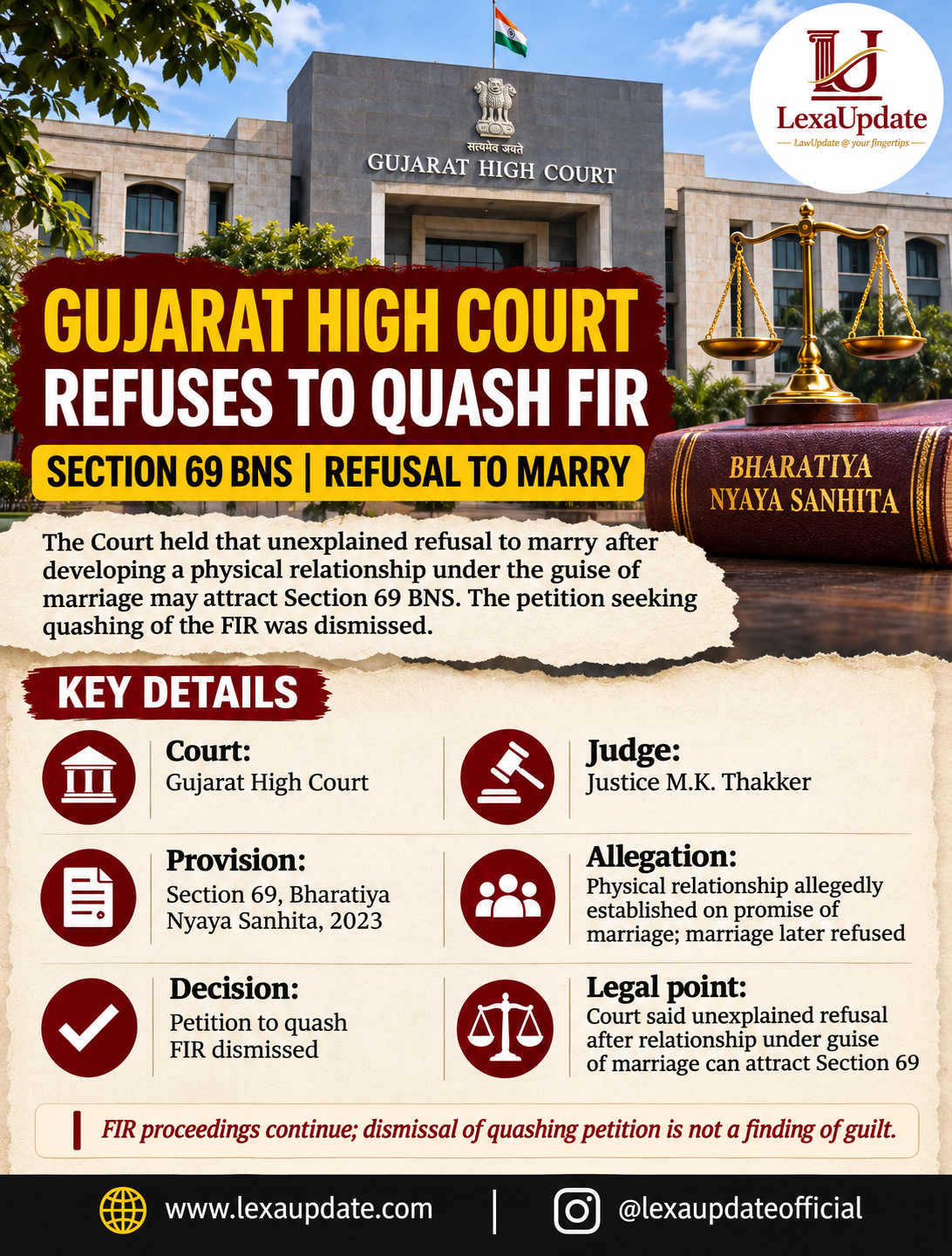
The Gujarat High Court at Ahmedabad has rejected a special criminal application seeking to quash FIR No. 11191047260009 filed under Section 69 of the Bombay Police Act (BNS). The petition, filed by Ms. Monali Bhatt, was dismissed by a bench headed by Hon'ble Mrs. Justice M. K. Thakker, leaving the criminal proceedings in force.
The court also ordered the immediate discharge of the rule and directed that the FIR and all attendant investigations continue pending final disposal. No stay was granted, signalling the court's view that the allegations merit a full trial.
Background and Facts
Ms. Monali Bhatt, a 23‑year‑old B.Com. student, alleged that the petitioner, a computer engineer, had promised marriage, engaged in consensual sexual relations, and later reneged on the promise. The parties had known each other for roughly two and a half years and their families had initially agreed to an engagement, which was postponed after a death in the petitioner’s family. In May 2026, the petitioner’s father demanded Rs 15 lakhs as a condition for proceeding with the marriage, an amount reportedly accepted by the complainant’s parents. When the marriage did not occur, the complainant registered an FIR alleging false promise of marriage under Section 69 of the BNS.
The FIR further recorded that the complainant became pregnant, terminated the pregnancy with consent, and that the physical relationship was undertaken under the pre‑text of marriage.
Submissions & Proceedings
Ms. Bhatt, represented by Mr. B. B. Thakar, argued that the alleged promise was not a false promise at the time it was made and that the mere breach of a marriage promise cannot constitute an offence under Section 69. The counsel highlighted that the relationship was consensual, that no deception was proved at the inception, and that the prosecution must establish a false promise intended to deceive.
The State, appearing through Ms. Monali Bhatt (applicant for the State), contended that the petitioner entered into a sexual relationship under the guise of marriage, without any genuine intention to marry, thereby satisfying the statutory requirement of a false promise. The State relied on the FIR, the police report, and the medical evidence of a terminated pregnancy to demonstrate the deceptive motive.
Court's Reasoning & Directions
Justice Thakker observed that Section 69 BNS is designed to protect individuals from sexual assault perpetrated through a false promise of marriage. While distinguishing rape from consensual sex, the court noted that the statutory offence hinges on the accused’s intent at the time of the promise. The judgment held that the petitioner’s refusal to marry, without any articulated reason, after sexual intimacy, indicated a pre‑existing mala‑fide motive.
The bench further referred to the Supreme Court’s decision in State of Haryana v. Bhajanlal (AIR 1992 SC 604) to underscore that the High Court’s inherent powers under Section 482 of the CrPC are not to be invoked where the criminal complaint is not an abuse of process. In the present case, the court found that the FIR was not frivolous and that the allegations warranted a full trial.
Consequently, the petition was dismissed, the rule was discharged, and the FIR along with all investigative proceedings were ordered to continue.
Why This Case Matters
The judgment clarifies the threshold for invoking Section 69 BNS, reinforcing that a false promise of marriage must be proved with a clear intention to deceive at the outset. It also signals judicial reluctance to use Section 482 to quash criminal complaints where the factual matrix suggests possible culpability. Practitioners will note the emphasis on the accused’s motive and the importance of corroborative evidence, such as medical reports and financial demands, in establishing a false‑promise offence.
Key Takeaways
- The Gujarat High Court dismissed the petition to quash FIR No. 11191047260009 under Section 69 BNS.
- The court held that the petitioner’s refusal to marry, after sexual relations, indicated a false promise.
- Section 482 CrPC cannot be used to stay proceedings where the FIR is not an abuse of process.
- The FIR and investigation remain active pending trial.
Case Details
| Case Name | Monali Bhatt v. State of Gujarat & Anr. |
| Court | Gujarat High Court, Ahmedabad |
| Bench | Hon'ble Mrs. Justice M. K. Thakker |
| Case Citation | GJHC 240625812026 (2026 Guj HC 70883) |
| Date of Order | 02 November 2026 |
| Relevant Provisions | Section 69, Bombay Police Act (BNS); Section 482, CrPC |
| Next Hearing | None scheduled; FIR remains under investigation |