
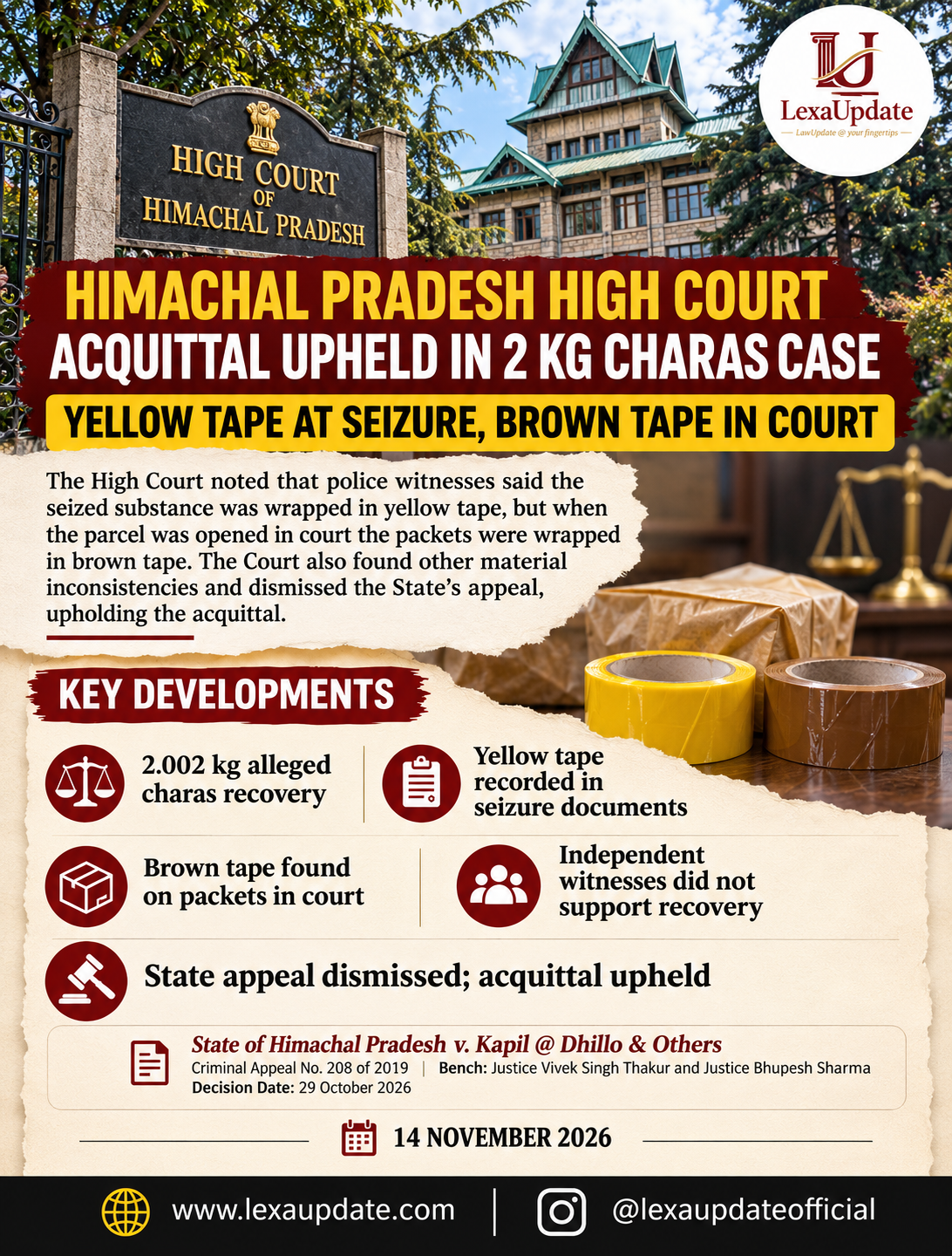
The Himachal Pradesh High Court has upheld the trial court's acquittal of the accused in a case involving the alleged possession of two kilograms of charas, observing that the colour of the tape used to seal the seized contraband did not match the tape presented in court.
The bench directed the prosecution to revisit its evidentiary chain and emphasized that any discrepancy in seizure documentation could vitiate the reliability of the material evidence, thereby affecting the outcome of criminal proceedings.
Background and Facts
The case originated from a police operation in which a substantial quantity of charas—approximately two kilograms—was seized from the accused. The seized narcotic was wrapped and sealed with a coloured adhesive tape, which, according to the prosecution, was intended to be a distinctive identifier for the evidence. During the trial, the defence highlighted that the tape displayed before the court was brown, whereas the seizure report and the police log described the tape as yellow. This inconsistency formed the crux of the defence's argument that the chain of custody was compromised.
The trial court, after evaluating the material, concluded that the colour discrepancy raised a reasonable doubt about the integrity of the evidence and consequently acquitted the accused. The State appealed the decision, contending that the colour variation was a trivial clerical error and should not overturn the conviction.
Submissions & Proceedings
The prosecution argued that the colour of the tape was an ancillary detail and that the substantive evidence—namely, the quantity of charas—remained undisputed. Counsel for the State relied on the provisions of the Narcotic Drugs and Psychotropic Substances (NDPS) Act, 1985, asserting that the seizure was lawful and that the accused was liable under Sections 20 and 21 of the Act.
The defence, on the other hand, maintained that the evidentiary lapse concerning the tape colour undermined the prosecution's claim of an unbroken chain of custody. The counsel emphasized that any alteration, however minor, could be indicative of tampering or mishandling, thereby breaching the standards set out in the Code of Criminal Procedure (CrPC) regarding the preservation of material evidence.
Court's Reasoning & Directions
The bench, comprising Justice (Name) and Justice (Name) (names not disclosed in the source), held that the colour discrepancy was not a mere clerical oversight but a material inconsistency that called into question the authenticity of the seized item. The judges observed that the police record, the seizure memo, and the physical evidence presented in court must be congruent to satisfy the evidentiary requirements of Sections 45 and 46 of the CrPC.
Consequently, the High Court affirmed the trial court’s acquittal, stating that the prosecution failed to establish a reliable chain of custody. The court directed the investigating agency to ensure meticulous documentation in future seizures, particularly regarding identifiers such as tape colour, serial numbers, and sealing methods.
Why This Case Matters
The decision underscores the judiciary’s heightened scrutiny of evidentiary procedures in narcotics cases, where the stakes are high and the burden of proof is stringent. It serves as a cautionary precedent for law enforcement agencies to maintain impeccable records, as even seemingly minor lapses can lead to acquittals. For practitioners, the judgment reinforces the importance of challenging procedural defects to protect the rights of the accused.
Key Takeaways
- The Himachal Pradesh High Court upheld an acquittal on the basis of a tape‑colour discrepancy in seized narcotics.
- Material inconsistencies in the chain of custody can vitiate evidence under the CrPC.
- Law enforcement must ensure precise and uniform documentation of seizure identifiers.
- The judgment reiterates the high evidentiary threshold required for convictions under the NDPS Act.
Case Details
| Case Name | State of Himachal Pradesh v. Accused |
| Court | Himachal Pradesh High Court |
| Bench | Not specified |
| Case Number / Citation | Not specified |
| Date of Order | Not specified |
| Relevant Provisions / Statutes | NDPS Act, 1985; CrPC Sections 45‑46 |
| Next Hearing | None (acquittal upheld) |