
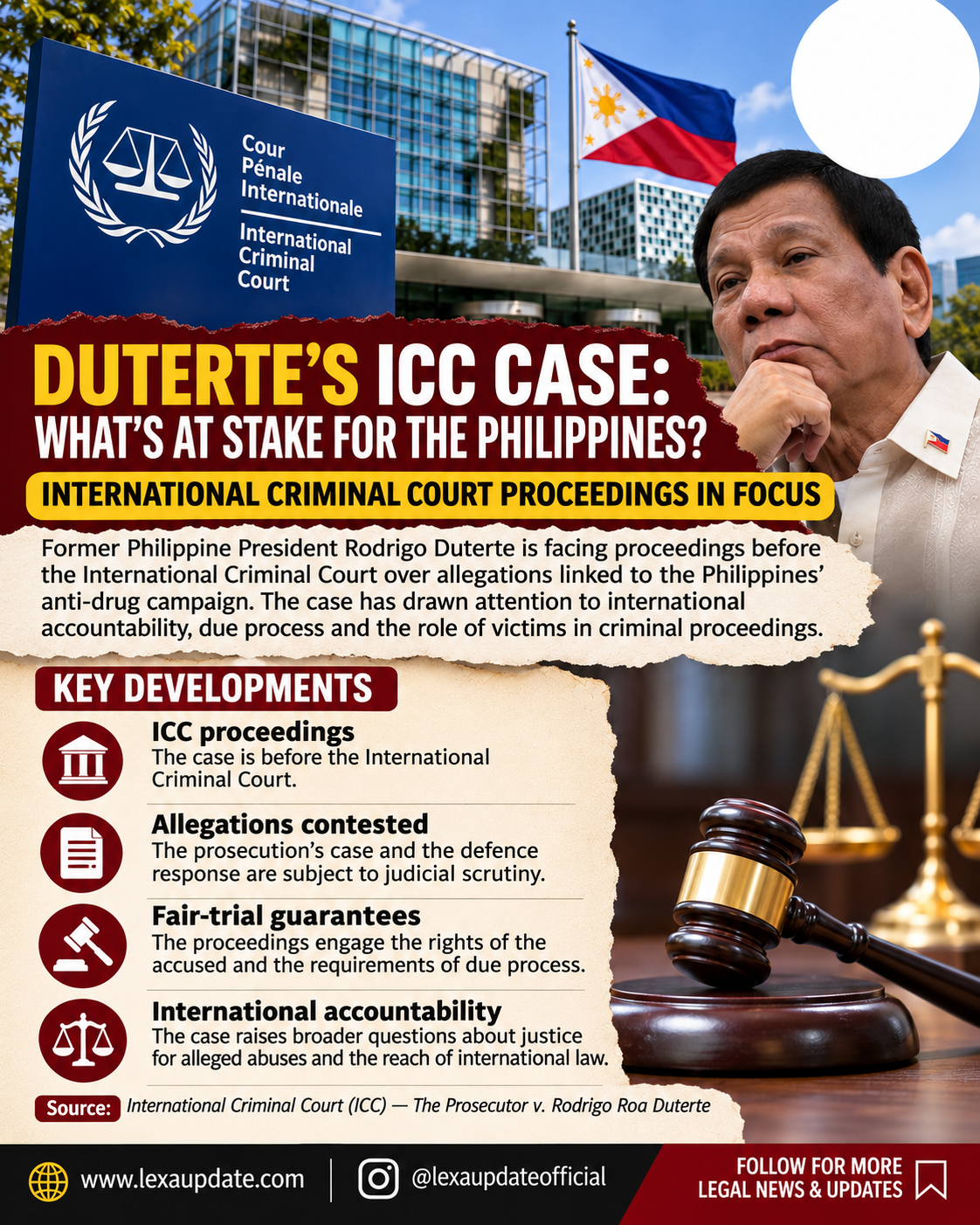
Trial Chamber III of the International Criminal Court (ICC) is preparing to oversee the historic proceedings in the case of The Prosecutor v. Rodrigo Roa Duterte. Presided over by Judge Joanna Korner, alongside Judge Keebong Paek and Judge Nicolas Guillou, the court has been navigating a complex series of pre-trial legal challenges, evidentiary disclosures, and procedural motions concerning former Philippine President Rodrigo Roa Duterte's alleged crimes against humanity during his anti-drug campaigns.
The unfolding proceedings highlight critical questions regarding international criminal procedure, prosecutorial scope, defendant fitness, and the procedural rights of participating victims. As the parties finalize their evidentiary parameters, the court continues to balance rigorous judicial oversight with the practical demands of an international atrocity trial.
Background and Facts
The case stems from widespread and systematic attacks against civilians carried out during Rodrigo Roa Duterte's tenure as mayor of Davao City and subsequently as president of the Philippines. The Office of the Prosecution (OTP) alleges that a model of neutralizing alleged drug users—initially developed in Davao—was transformed into a nationwide state policy following Duterte's inauguration in July 2016. The implementation of operational directives such as Project Double Barrel and localized clearance sweeps resulted in thousands of fatalities.
Following confirmation of charges by Pre-Trial Chamber I, the matter was transferred to Trial Chamber III. Litigation ensued regarding the final roster of charged incidents, culminating in an updated trial brief featuring 56 specific incidents categorized across three distinct temporal and geographic counts, ranging from localized execution allegations in Davao City to nationwide barangay police sweeps during Duterte's presidency.
Submissions and Proceedings
The pre-trial and status conference phases involved extensive adversarial submissions among the Prosecution, the Defense, and the Common Legal Representatives of Victims (CLRV).
The Defense, led by counsel Peter Haynes KC, raised multiple threshold objections. Notably, the Defense challenged Duterte's fitness to stand trial, pointing to alleged memory impairments and requesting a comprehensive medical re-examination. However, an independent panel of medical experts appointed by the court concluded that Duterte was fit to stand trial, prompting Trial Chamber III to reject the fitness challenge while ordering specialized courtroom accommodations.
Additionally, the Defense contested the inclusion of additional trial incidents and the vast volume of electronic evidence disclosed by the OTP, arguing that late additions and massive document drops infringed upon fair trial rights and the principle of adequate preparation time.
Court's Reasoning and Directions
Trial Chamber III addressed the contested boundaries of the prosecution's case by issuing targeted procedural rulings. On October 9, the Chamber confirmed seven additional incidents (Incidents 50 to 56) while striking out Incident 57 for exceeding the temporal boundaries established under Count 2.
To safeguard the fairness of the proceedings, the court implemented administrative and technical accommodations, including noise-canceling headphones, flexible scheduling, and continuous health monitoring by the court's medical officer. Furthermore, the Chamber addressed complexities surrounding victim participation, as the Registry and legal representatives debated whether strict temporal cutoffs would inadvertently disenfranchise indirect victims whose family members were killed outside narrow windows.
Why This Case Matters
The trial represents a watershed moment for international criminal jurisprudence, testing the efficacy of the Rome Statute in addressing large-scale state-sponsored violence originating outside active international armed conflicts. It underscores the ongoing tension between domestic state sovereignty and international accountability mechanisms, while establishing crucial precedents regarding defendant fitness, evidence disclosure limits, and the extent of victim participation rights before the ICC.
Key Takeaways
- Trial Scope Locked: Trial Chamber III finalized the prosecution's trial roster at 56 charged incidents across three primary counts.
- Fitness Determination: Independent medical evaluations confirmed the defendant's fitness to stand trial, supported by mandated courtroom accommodations.
- Evidentiary Disputes: The Defense challenged the volume of electronic disclosures and the inclusion of late-notified incidents under fair trial provisions.
- Victim Participation: Legal debates persist over whether strict temporal cutoffs will exclude recognized victim families from reparations and participation.
Case Details
| The Prosecutor v. Rodrigo Roa Duterte |
| International Criminal Court (ICC), Trial Chamber III |
| Judge Joanna Korner (Presiding), Judge Keebong Paek, Judge Nicolas Guillou |
| ICC-01/21 (Pending Trial Phase) |
| Status Conferences and Rulings spanning mid-to-late 2026 |
| Rome Statute (Articles 7, 67, and related rules of procedure) |