
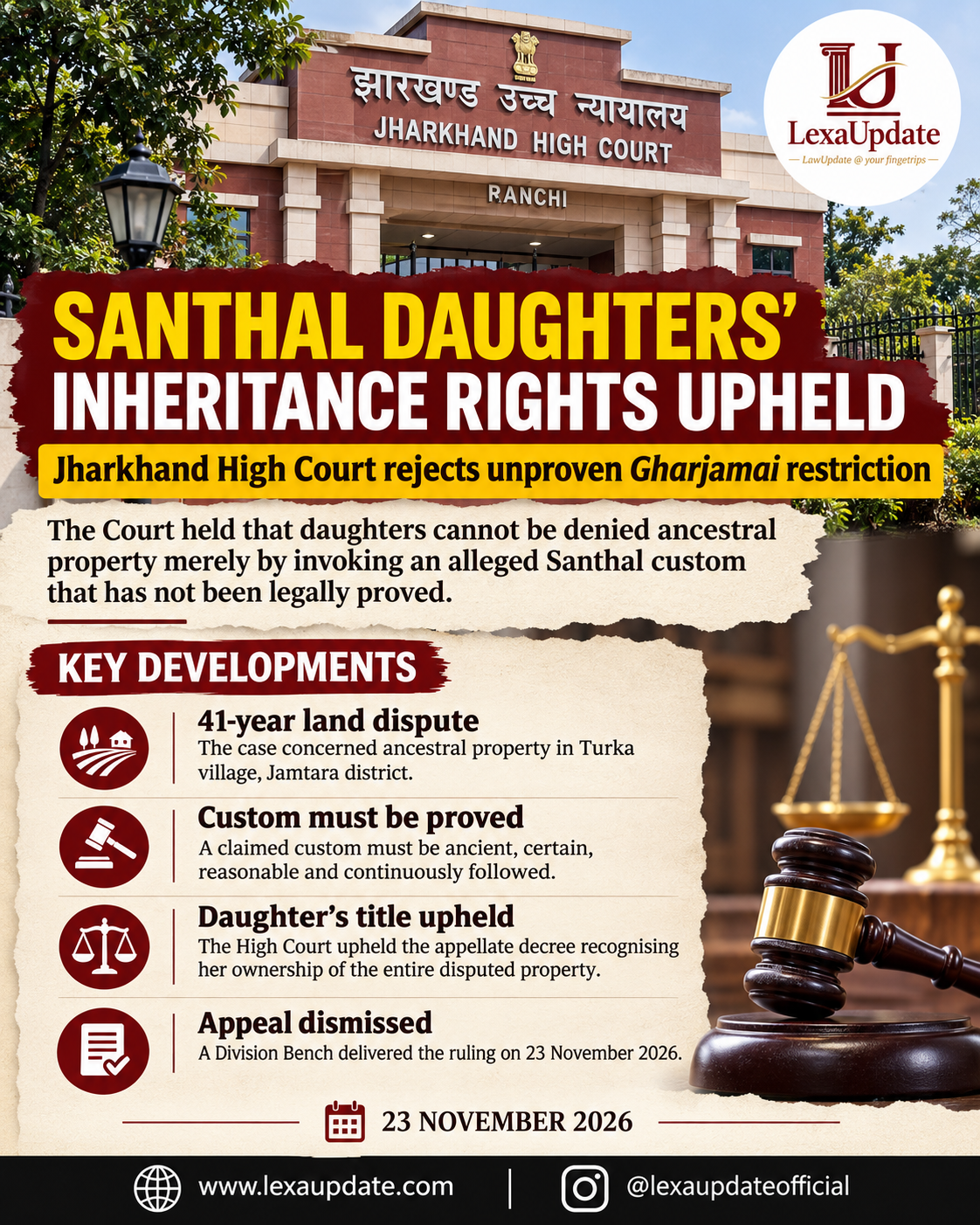
The Jharkhand High Court has dismissed the appeal of the defendants and affirmed that a Santhal daughter is entitled to inherit her father’s entire ancestral property, rejecting the so‑called ‘Gharjamai’ custom as a basis for denial.
The division bench, comprising Chief Justice M S Sonak and Justice Rajesh Shankar, upheld the decree of the first appellate court dated 4 March 2006 and clarified that any custom that contravenes constitutional equality must be proven to be ancient, certain and continuously observed – a threshold the appellants failed to meet.
Background and Facts
The dispute originated in 1985 when the plaintiff, a Santhal daughter from Turka village in Jamtara district, filed Title Suit No. 45/1985 seeking ownership and possession of her late father’s ancestral land. The trial court in 1996 granted her a one‑third share, reflecting the then‑prevalent interpretation of tribal customs. On appeal, the first appellate court modified the order on 4 March 2006, recognising her right to the whole property. The defendants challenged this judgment before the High Court, contending that under the traditional Gharjamai practice a daughter could inherit only if she married a resident son‑in‑law who would reside with the family.
Submissions & Proceedings
Senior advocate Jai Prakash Jha, appearing for the appellants, argued that the Santhal community historically denied daughters full inheritance rights unless the Gharjamai custom was satisfied. He submitted that the custom was well‑established and formed part of the community’s personal law.
The plaintiff’s counsel, assisted by amicus curiae Sumit Garodia, countered that the custom was neither ancient nor uniformly practiced, pointing to evolving social attitudes and recent jurisprudence that recognises women’s property rights. They urged the court to apply the constitutional guarantees of equality (Article 14) and non‑discrimination (Article 15) over unsubstantiated customary claims.
Court's Reasoning & Directions
The bench observed that reliance on any custom that conflicts with statutory law or constitutional morality requires proof that the custom is "ancient, certain, reasonable and continuously and necessarily followed" in the relevant community. The court found the appellants’ evidence insufficient to satisfy this test.
Referencing Supreme Court precedents, including the landmark Madhu Kishwar judgment and the earlier Narayan Soren decision, the judges held that tribal customs cannot be invoked to curtail the fundamental right to equality. The bench noted the growing awareness within the Santhal community regarding women’s status and property rights, emphasizing that public policy now favours gender‑neutral inheritance.
Consequently, the High Court dismissed Second Appeal No. 102/2006, reinstated the decree granting the daughter full ownership of the ancestral land, and directed lower courts to apply the same constitutional standards in analogous tribal inheritance matters.
Why This Case Matters
The judgment reinforces the primacy of constitutional principles over unverified customary practices, particularly in tribal contexts where gender discrimination has historically persisted. It provides a clear precedent for future disputes involving tribal inheritance, signalling to courts and litigants that claims based solely on alleged customs must meet a rigorous evidentiary threshold. The decision also aligns with broader national efforts to ensure gender‑equal property rights under the Constitution.
Key Takeaways
- Santhal daughters are entitled to inherit the entire ancestral property irrespective of marital status.
- The Gharjamai custom cannot override Articles 14 and 15 of the Constitution without solid proof of its antiquity and uniformity.
- Lower courts must scrutinise tribal customs against constitutional morality before allowing them to restrict women’s rights.
- The ruling strengthens gender‑neutral inheritance jurisprudence across India’s tribal regions.
Case Details
| Case Name | Santhal Daughter (appeal) v. Defendants |
| Court | Jharkhand High Court |
| Bench | Chief Justice M S Sonak and Justice Rajesh Shankar |
| Case Number / Citation | Second Appeal No. 102/2006 |
| Date of Order | 23 November 2026 |
| Relevant Provisions / Statutes | Constitution of India Articles 14 & 15; Tribal Land Rights under the Scheduled Tribes (Protection of Rights) Act, 1989 |
| Next Hearing | None – final judgment |