
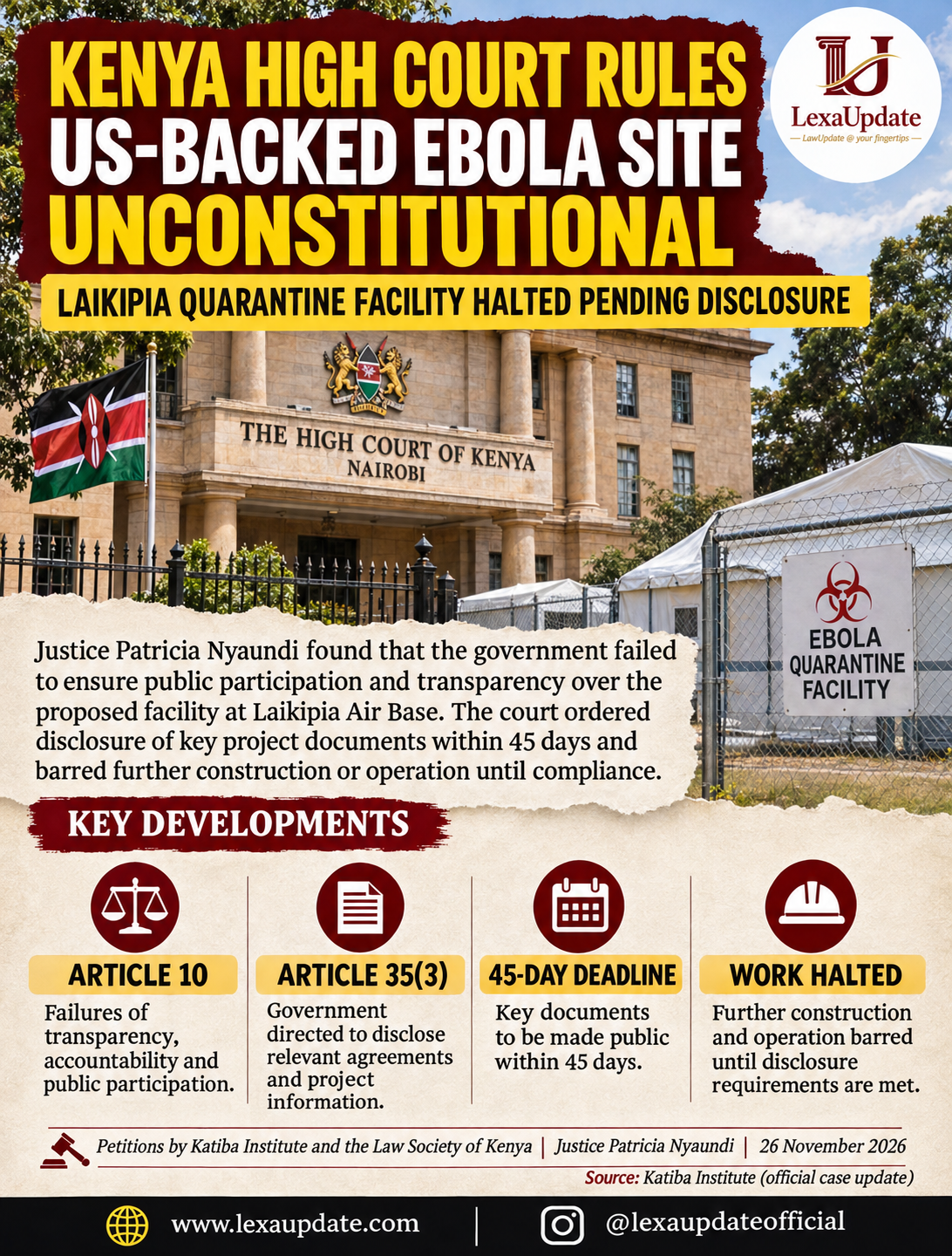
The High Court of Kenya has delivered a landmark ruling declaring that the government breached parts of the national constitution by permitting the construction of a United States-backed Ebola quarantine facility at a military air base. Presiding over the matter, High Court Judge Patricia Nyaundi ruled that executive authorities failed to fulfil constitutional obligations regarding transparency and public engagement before entering into binding international health infrastructure agreements.
Alongside the constitutional declaration, the court issued strict injunctive relief, ordering an immediate halt to all further construction and operational activities at the site. The prohibition will remain in force until the government satisfies mandatory disclosure conditions, including the publication of core terms and texts contained within the bilateral agreement executed with the United States government.
Background and Facts
The controversy stems from the establishment of a 50-bed tented quarantine facility positioned inside the Laikipia Air Base, situated near the central Kenyan town of Nanyuki. The project was conceived as a public health contingency response to isolate individuals exposed to the Ebola virus, specifically incorporating provisions to accommodate foreign nationals, including United States citizens aiding disease containment efforts.
Public anxiety intensified following the arrival of seven American aid workers who were quarantined at the facility in July after deployment to the Democratic Republic of Congo—the epicentre of a severe regional outbreak. Local communities staged widespread protests, driven by fears of contagion and deep-seated frustration regarding the lack of official communication from state authorities. The civil unrest tragically resulted in fatalities among demonstrators, turning the infrastructure project into a major flashpoint over civil liberties, executive overreach, and national sovereignty.
Submissions and Proceedings
Constitutional watchdogs, including the Katiba Institute, alongside aggrieved local residents, initiated legal proceedings challenging the legality of the project. The petitioners argued that bypassing public consultation violated core constitutional tenets governing citizen participation, access to information, and accountability in governance.
The litigation previously resulted in interim orders temporarily halting construction. Enforcement friction followed when health authorities allegedly delayed compliance, leading the court to find Health Minister Aden Duale in contempt of court before he subsequently affirmed that construction directives had been suspended. The government defended the facility as a vital contingency measure necessary for regional health security, rooted in long-standing bilateral cooperation between Nairobi and Washington.
Court's Reasoning and Directions
In her detailed judgment, Justice Patricia Nyaundi forcefully criticized the opaque manner in which the executive negotiated and implemented the project. The court underscored that neither emergency health demands nor diplomatic compacts with foreign powers can override domestic constitutional safeguards.
Using pointed judicial imagery, Justice Nyaundi observed that local residents and the wider Kenyan public were left standing outside a sealed window, forced to guess at decisions fundamentally impacting their safety and community welfare. The court ordered that all construction remain frozen until full transparency is achieved through the disclosure of the bilateral accord and the integration of meaningful public input.
Why This Case Matters
This ruling serves as a vital constitutional checkpoint establishing the limits of executive power during public health emergencies. For legal scholars and human rights advocates across international jurisdictions, the judgment reinforces the principle that transparency, public participation, and adherence to constitutional due process are non-negotiable, even when responding to transnational health crises backed by superpower allies.
Key Takeaways
Constitutional Breach: The Kenyan High Court ruled that constructing the US-backed Ebola facility without public participation violated the national constitution.
Construction Halted: All building and operational work at the Laikipia Air Base site is legally frozen pending full disclosure of the bilateral agreement.
Judicial Stand on Transparency: The court affirmed that health emergencies do not exempt the executive from transparency and democratic engagement.
Case Details
| Court | High Court of Kenya at Nairobi |
| Judge | Justice Patricia Nyaundi |
| Subject Matter | Constitutionality of US-backed Ebola quarantine facility |
| Key Respondents | Ministry of Health (Health Minister Aden Duale) |
| Petitioners | Katiba Institute and local residents of Laikipia County |
| Location | Laikipia Air Base, Nanyuki, Kenya |