
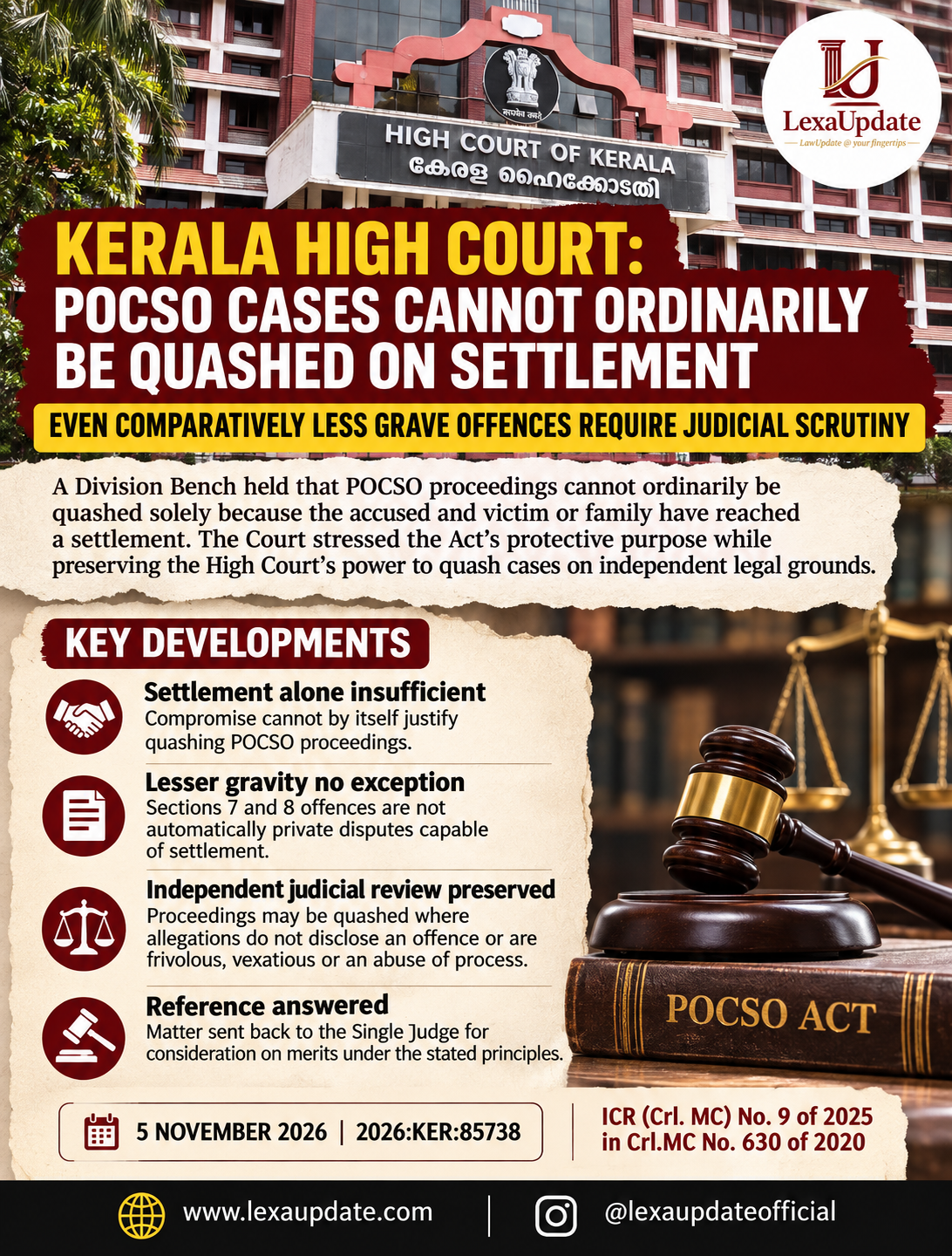
The Kerala High Court, sitting in Ernakulam, held that criminal proceedings under the Protection of Children from Sexual Offences (POCSO) Act, 2012 cannot be ordinarily quashed merely on the basis of a settlement between the accused and the victim or the victim’s family. The Division Bench, comprising Justices Raja Vijayaraghavan and K.V. Jayakumar, delivered the opinion on 5 November 2026.
The order arose from a reference made by a Single Judge seeking authoritative guidance on the scope of the Court’s inherent powers under Section 482 of the Criminal Procedure Code (CrPC) to terminate POCSO matters when the victim, having attained majority, expresses willingness to withdraw the prosecution.
Background and Facts
The petition was filed by Ummer, a 49‑year‑old teacher at Hibamul Islam Madrassa, seeking quash of criminal proceedings initiated on 24 April 2019 for alleged sexual assault of a 17‑year‑old girl on 1 July 2018. The complaint, registered as Crime No. 357 of 2019 at Panoor Police Station, invoked Section 354A(1)(i) of the Indian Penal Code and Sections 7, 8, 9(1), 9(f) and 10 of the POCSO Act. After the trial court’s continuation of the case, the victim, now an adult, submitted an affidavit stating that the complaint was filed on a mistaken impression and that she no longer wished to pursue the prosecution.
Submissions & Proceedings
Counsel for the petitioner, Smt. Swarna Thomas, relied on Supreme Court precedents such as Ayyub Malik v. State of Uttarakhand and a recent Delhi High Court decision (Harmeet Singh v. State of GNCT Delhi, 16 April 2026) where the Court quashed POCSO proceedings on settlement grounds. The argument was that, for offences of comparatively lesser gravity, a genuine and voluntary settlement should permit the Court to exercise its inherent jurisdiction to dismiss the case.
The State, represented by the Senior Public Prosecutor, contended that the special nature of the POCSO Act precludes such quashing. Citing Section 482 CrPC and Section 528 of the Bharatiya Nagarik Suraksha Sanhita, 2023, the prosecution argued that the power to interfere can be exercised only to secure the ends of justice or to prevent abuse of process, and not to undermine the legislative intent to protect children.
Court's Reasoning & Directions
The Bench noted divergent judgments of the Kerala High Court on this issue, particularly Abdul Salam v. State of Kerala versus Vishnu & Others v. State of Kerala. It held that while the inherent jurisdiction under Section 482 is wide, it must be exercised in harmony with the object of the POCSO Act – safeguarding children from sexual exploitation.
Accordingly, the Court observed that settlement cannot, as a matter of course, override the statutory mandate. Only where the offence is of a comparatively lesser gravity and the settlement is demonstrably voluntary, transparent, and in the child’s best interest, may the Court consider quashal after a careful balancing of factors. The Bench refrained from granting the petition’s relief, directing the trial court to continue proceedings and to assess the victim’s consent and the public interest before any further relief.
Why This Case Matters
The decision provides a clear benchmark for lower courts handling POCSO matters, emphasizing that the protection of children is a matter of public policy that cannot be sidelined by private settlements. It delineates the limits of the Court’s inherent powers, ensuring that the legislative purpose of the POCSO Act is not diluted. Practitioners must now scrutinise settlement offers in child sexual offence cases more rigorously, evaluating the gravity of the offence, the victim’s autonomy, and societal interests before invoking Section 482.
Key Takeaways
- POCSO proceedings cannot be automatically quashed on settlement alone.
- The Court’s inherent jurisdiction under Section 482 CrPC is subject to the protective purpose of the POCSO Act.
- Only offences of comparatively lesser gravity may be considered for quashal after a detailed assessment.
- Trial courts must examine the voluntariness of settlement and the broader public interest.
Case Details
| Case Name | Ummer v. Station House Officer, Panoor Police Station & Others |
| Court | Kerala High Court, Ernakulam |
| Bench | Justice Raja Vijayaraghavan and Justice K.V. Jayakumar |
| Case Citation | ICR (Crl. MC) No. 9 of 2025 in Crl.MC No. 630 of 2020 |
| Date of Order | 5 November 2026 |
| Relevant Provisions | POCSO Act 2012 (ss.7,8,9(1),9(f),10); IPC s.354A(1)(i); CrPC s.482; Bharatiya Nagarik Suraksha Sanhita 2023 s.528 |
| Next Hearing | Not specified |