
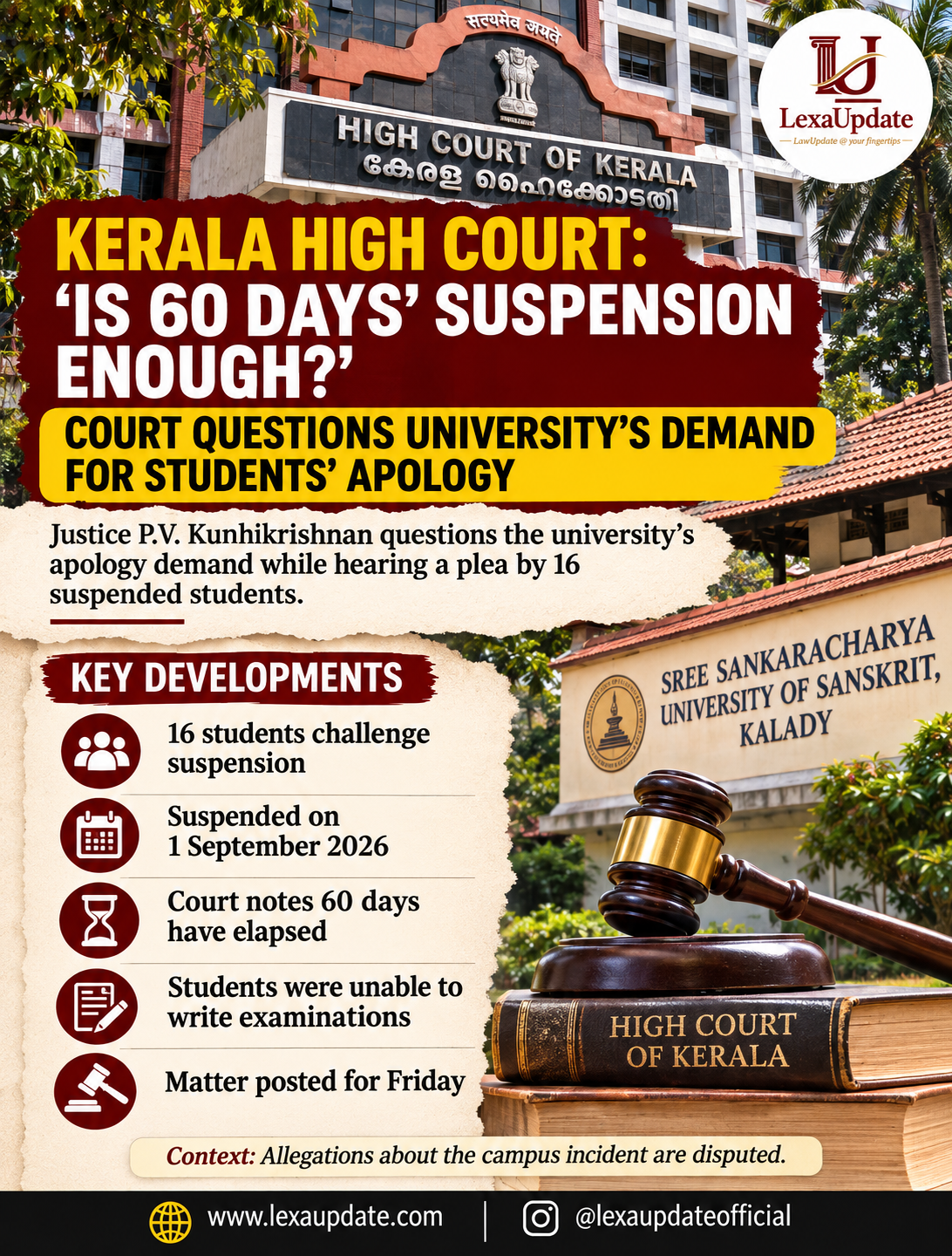
The Kerala High Court has intervened in a disciplinary dispute involving Sree Sankaracharya University of Sanskrit, asking the institution to apologise to a group of students and to reassess a 60‑day suspension imposed on them. The bench highlighted the need for proportionality and procedural fairness before imposing such a lengthy punitive measure.
The order, delivered on 11 November 2026, comes after a petition filed by the aggrieved students alleging that the suspension was excessive, violated natural justice principles and contravened statutory provisions governing university discipline.
Background and Facts
Sree Sankaracharya University of Sanskrit, a state‑run university in Kerala, suspended a cohort of undergraduate students for a period of 60 days following alleged violations of campus conduct rules. The university cited repeated disruptions to academic activities and alleged non‑compliance with the university's code of conduct. The students, represented by a senior advocate, filed a petition in the Kerala High Court asserting that the suspension was disproportionate, lacked a proper hearing, and that the university had failed to issue a formal apology for the reputational damage caused.
Under the Kerala University Act, 2010 and the University Grants Commission (UGC) Regulations on Student Discipline, universities are required to follow a prescribed procedure before imposing any disciplinary action, including giving the student an opportunity to be heard and providing a written statement of reasons.
Submissions & Proceedings
The petitioners argued that:
- The 60‑day suspension amounted to a punitive measure far exceeding the gravity of the alleged misconduct.
- The university did not afford the students a proper hearing, violating the principles of natural justice.
- The lack of an official apology compounded the injury to the students' reputation and future prospects.
The university, through its counsel, contended that the suspension was a necessary response to repeated disruptions and that the students had been given notice of the alleged violations. It further submitted that the disciplinary committee had examined the evidence and acted within its statutory powers.
Court's Reasoning & Directions
The bench, after reviewing the petition and the university's response, observed that while universities enjoy a degree of autonomy in managing internal discipline, such autonomy is not unfettered. The court stressed that any disciplinary action must be "reasonable, proportionate and in accordance with the procedure laid down by law".
Key observations included:
- The suspension period of 60 days was deemed excessive in the absence of a detailed, written justification.
- The university had not provided a formal opportunity for the students to present their defence, thereby breaching the principle of audi alteram partem (hear the other side).
- An apology was warranted to mitigate the reputational harm suffered by the students.
Accordingly, the court directed the university to:
- Issue a written apology to the affected students within ten days.
- Re‑evaluate the suspension, ensuring that any revised sanction complies with the procedural safeguards under the Kerala University Act and UGC regulations.
- Submit a compliance report to the bench by 30 November 2026.
Why This Case Matters
This judgment underscores the judiciary's role in safeguarding student rights against arbitrary administrative action. It reaffirms that university disciplinary powers are subject to constitutional guarantees of fairness and that any punitive measure must be proportionate to the alleged misconduct. The order also serves as a cautionary precedent for higher education institutions across India to meticulously follow due‑process requirements before imposing severe sanctions.
Key Takeaways
- The Kerala High Court found a 60‑day suspension to be excessive without proper procedural backing.
- Universities must provide a fair hearing and a written statement of reasons before imposing disciplinary action.
- An official apology is required when reputational damage is caused by administrative decisions.
- Compliance reports are now mandatory to ensure the university adheres to the court's directions.
Case Details
| Case Name | |
| Court | Kerala High Court |
| Bench | |
| Case Number / Citation | |
| Date of Order | 11 November 2026 |
| Relevant Provisions / Statutes | Kerala University Act, 2010; UGC Regulations on Student Discipline |
| Next Hearing | Compliance report due 30 November 2026 |