
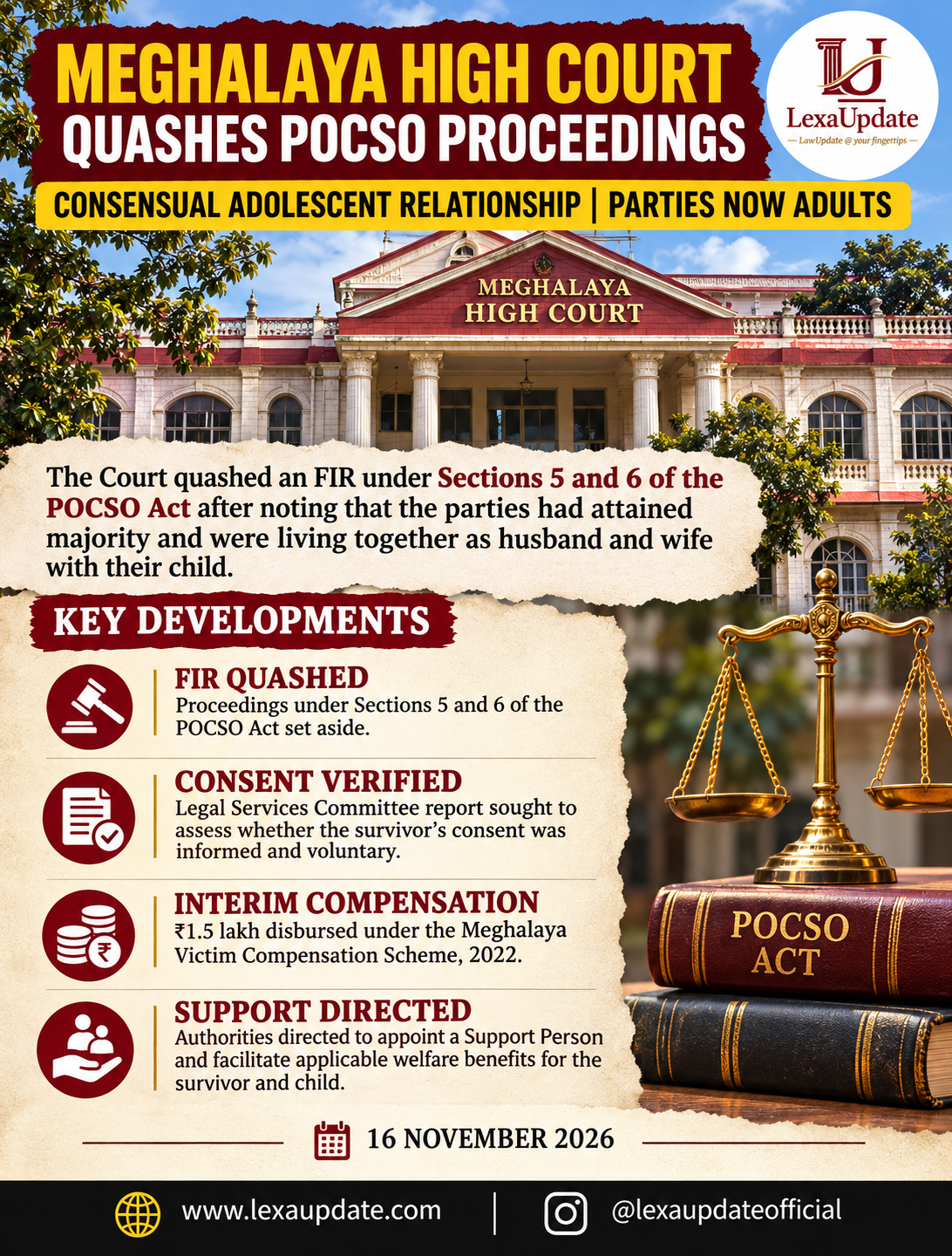
The Meghalaya High Court has set aside criminal proceedings filed under the Protection of Children from Sexual Offences (POCSO) Act against a man accused of engaging in a consensual relationship with an adolescent partner who lives with a child. The bench held that the mere fact of cohabitation does not, per se, constitute an offence under the Act.
The order, delivered in a petition seeking quashal of the case, directs the trial court to dismiss the charges and restore the status quo, while leaving open the possibility of revisiting the matter should fresh evidence of non‑consensual conduct emerge.
Background and Facts
The petition arose from a complaint lodged by the State alleging that a man, identified only as the respondent, was in a relationship with a teenage girl and that the couple were residing together with a child. The complainant invoked Sections 5, 6 and 7 of the POCSO Act, 2012, which criminalise sexual activity with a child and prescribe enhanced penalties for penetrative acts. The respondent contended that the relationship was consensual, that the girl was above the age of fourteen, and that the child in the household was not a victim of any sexual act.
During the trial, the prosecution relied on the fact of cohabitation as an indicator of a sexual relationship, while the defence argued that the POCSO Act is intended to address sexual exploitation, not consensual adolescent relationships where no sexual act is alleged.
Submissions & Proceedings
The defence counsel submitted that Sections 5 and 6 of the POCSO Act require proof of a sexual act involving a child, and that the presence of a child in the household does not satisfy this element. Counsel also highlighted the Supreme Court’s observations in Shyam v. State of Uttar Pradesh that the Act should not be employed to criminalise consensual behaviour between adolescents.
The State, on the other hand, argued that the age of the girl (below eighteen) automatically brings the relationship within the ambit of the Act, citing the protective intent of the legislation.
Court's Reasoning & Directions
The Meghalaya High Court bench examined the language of the POCSO Act and noted that its primary purpose is to safeguard children from sexual exploitation and abuse. The court observed that the statute does not expressly criminalise consensual relationships between adolescents, provided that no sexual act is proven.
In its reasoning, the bench referred to the principle of "lex specialis" – that a specific law (POCSO) must be read in light of its object and purpose. Since the petition did not allege any penetrative or non‑penetrative sexual act, the court concluded that the statutory conditions for invoking Sections 5‑7 were not satisfied.
Consequently, the bench ordered the dismissal of the criminal case, directing the lower court to close the file. The judgment also cautioned lower tribunals to assess the factual matrix carefully before invoking the POCSO provisions in cases involving consensual adolescent relationships.
Why This Case Matters
This decision clarifies the scope of the POCSO Act in the context of consensual adolescent relationships, reinforcing that the law is not a blanket tool for criminalising cohabitation. It provides guidance to prosecutors and courts across India on distinguishing between genuine sexual exploitation and consensual behaviour, thereby protecting the rights of young adults while preserving the protective mantle of the Act for actual victims.
Key Takeaways
- The Meghalaya High Court quashed POCSO proceedings where no sexual act was alleged.
- Cohabitation alone does not trigger liability under Sections 5‑7 of the POCSO Act.
- Courts must examine the protective intent of the Act before applying it to consensual adolescent relationships.
- The judgment may influence future prosecutions involving adolescents across Indian jurisdictions.
Case Details
| Case Name | State v. Unnamed (POCSO) |
| Court | Meghalaya High Court |
| Bench | Meghalaya High Court bench |
| Case Number / Citation | |
| Date of Order | |
| Relevant Provisions / Statutes | Protection of Children from Sexual Offences (POCSO) Act, 2012 – Sections 5, 6, 7 |
| Next Hearing | None (case dismissed) |