
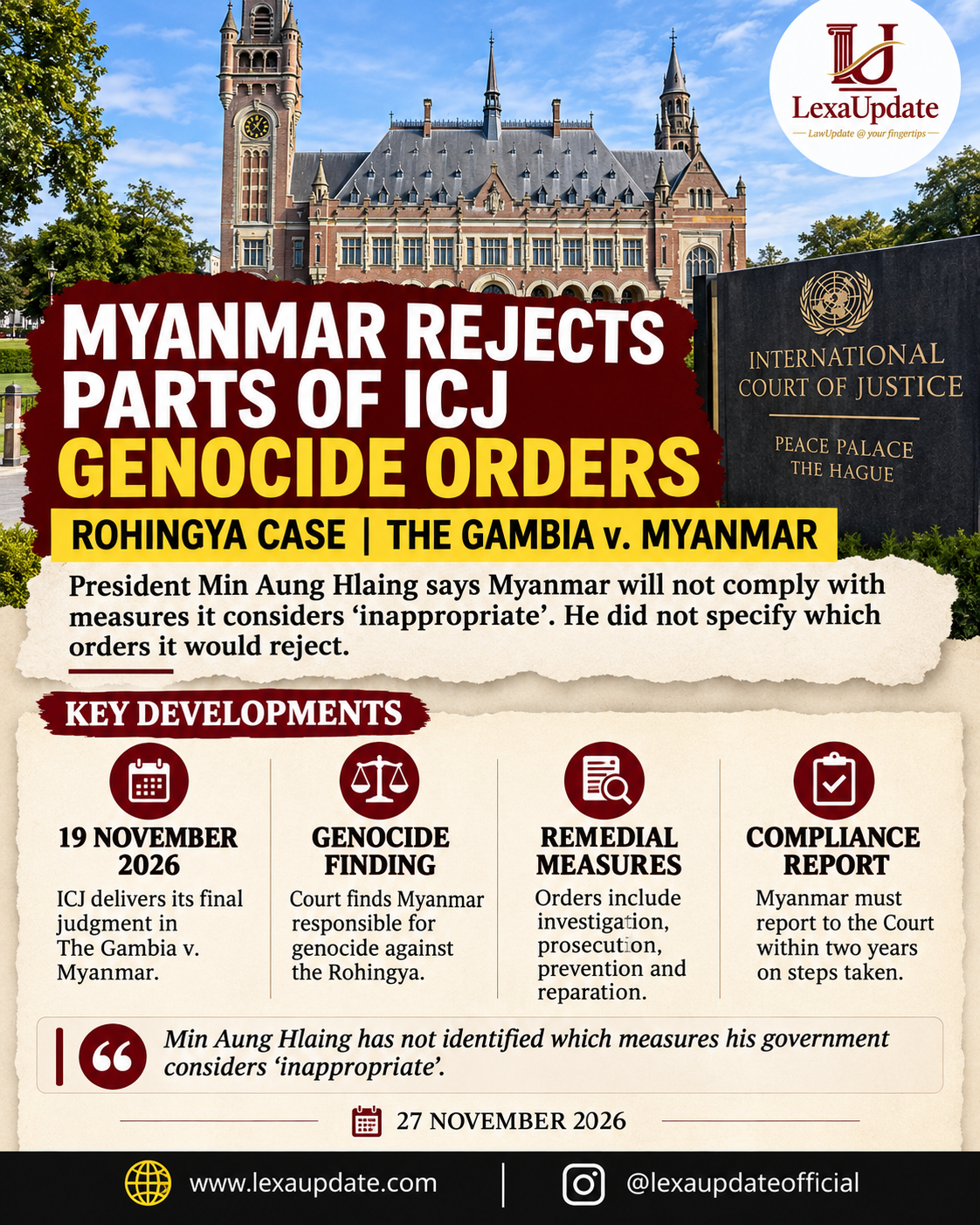
Myanmar President Min Aung Hlaing has publicly stated that his government will refuse to fully comply with what he termed 'inappropriate' aspects of a landmark International Court of Justice (ICJ) ruling. The UN's highest judicial body recently delivered an unprecedented verdict holding Myanmar directly responsible for committing genocide against its Rohingya Muslim minority during military crackdowns in Rakhine State.
Speaking in his official capacity following the delivery of the final judgment, the Myanmar leader denounced the findings as one-sided and damaging to the nation's reputation, marking the first official state pushback against binding international directives that mandate survivor compensation, investigations, and the repatriation of refugees.
Background and Facts
The legal proceedings stem from a 2019 application filed by The Gambia against Myanmar at the International Court of Justice under the 1948 Genocide Convention. The case centered on the military's aggressive 'clearance operations' executed in 2017 across northern Rakhine State. According to UN estimates and the court's subsequent findings, these operations resulted in the violent deaths of thousands of Rohingya civilians, widespread sexual violence, and the mass displacement of over 700,000 refugees who fled across the border into Bangladesh.
Myanmar has consistently maintained that its security operations were legitimate counter-insurgency responses directed at armed rebel groups rather than an ethnic population. However, in a historic 9-6 majority decision delivered in November 2026, the ICJ bench rejected these assertions, ruling that the only reasonable inference from the scale of the state-sponsored violence was a specific intent to destroy the Rohingya group in whole or in part.
Submissions and Proceedings
Throughout the protracted litigation, legal representatives for Myanmar argued that state forces acted in self-defence against militant threats and denied all allegations of genocidal intent. Conversely, The Gambia presented extensive documentary evidence, satellite imagery, and witness testimonies detailing systematic killings, destruction of civilian infrastructure, and discriminatory policies.
The 15-judge panel at The Hague was sharply divided. While the majority found clear violations of multiple provisions of the 1948 Genocide Convention, a dissenting bloc led by the court's vice-president argued that the threshold for proving specific genocidal intent—legally known as dolus specialis—had not been robustly met, warning against blurring the lines between war crimes and genocide.
Court's Reasoning and Directions
The ICJ's final and unappealable judgment established state responsibility for genocide for the first time in the institution's 80-year history. The court held that the systematic nature of the atrocities, combined with severe restrictions on community life and basic survival necessities, demonstrated a manifest intent to destroy the Rohingya population.
As part of its operative directions, the court ordered Myanmar to immediately halt any ongoing acts violating the Genocide Convention, initiate credible criminal investigations into suspects, provide proportional financial compensation to surviving victims, and facilitate the safe, unhindered return of displaced Rohingya refugees. Because the ICJ lacks independent enforcement mechanisms, its rulings rely entirely on the UN Security Council and international diplomatic pressure.
Why This Case Matters
This ruling is a watershed moment in international criminal and humanitarian jurisprudence, setting a profound precedent for how international courts evaluate state-level genocidal intent in asymmetric conflicts. For global legal scholars, human rights advocates, and states party to ongoing international disputes—such as South Africa's genocide case against Israel—the Myanmar judgment offers critical interpretive frameworks regarding circumstantial evidence, military objectives versus discriminatory intent, and state accountability.
Key Takeaways
- Landmark Verdict: The ICJ found Myanmar guilty of violating the 1948 Genocide Convention, marking the first time a sovereign state has been held directly responsible for genocide.
- State Defiance: Myanmar leadership has rejected key remedial directives, declaring certain ICJ orders 'inappropriate' and refusing full compliance.
- Specific Intent Standard: The ruling reaffirms the strict requirement of proving specific genocidal intent, though it has sparked intense debate among legal scholars regarding judicial interpretation of military conduct.
- Enforcement Limitations: Lacking an independent police force, the court's directives depend heavily on UN Security Council backing and international sanctions.