
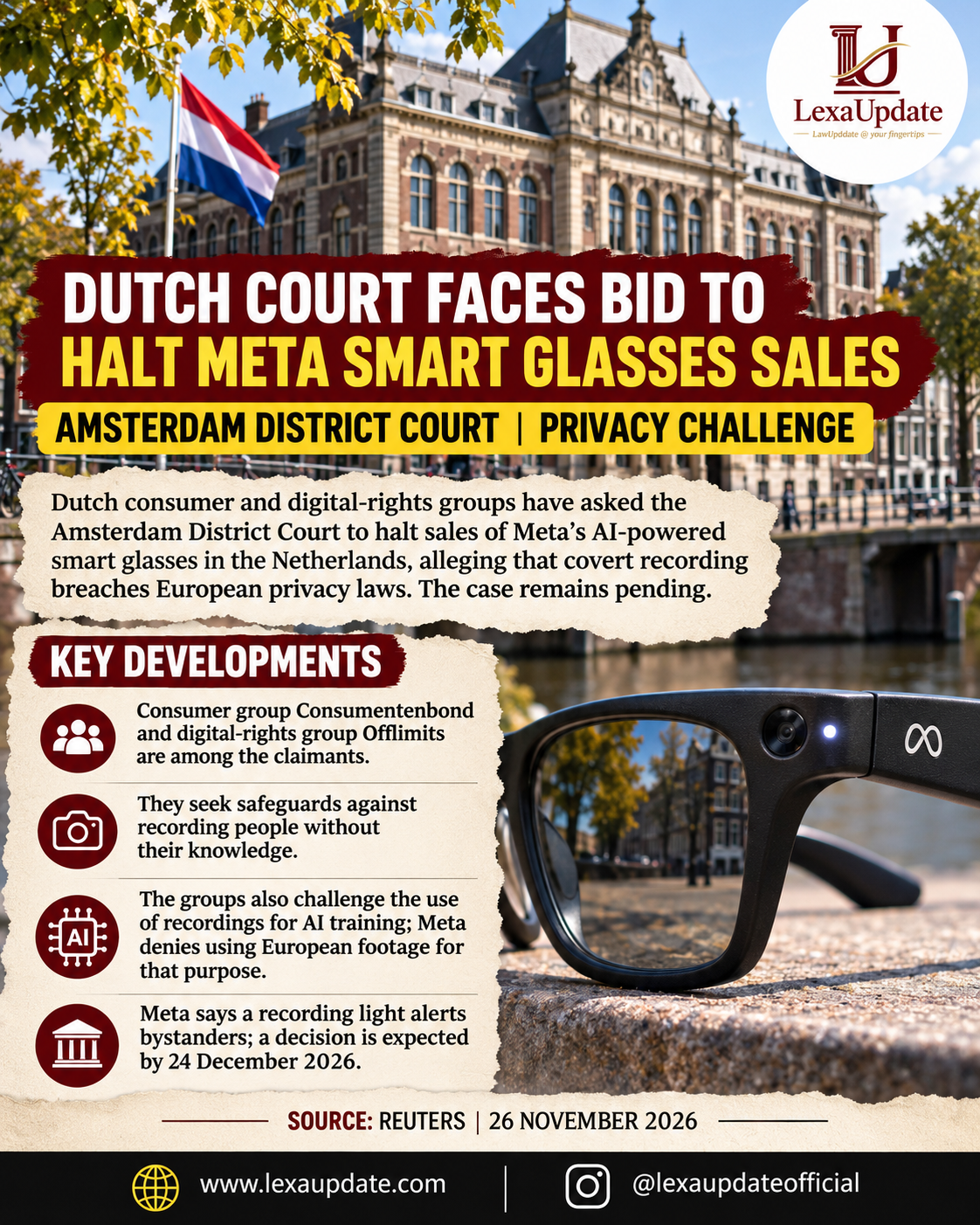
Dutch consumer and digital rights organizations have initiated legal proceedings before the Amsterdam District Court in the Netherlands, seeking to suspend the sales of Meta's AI-powered smart glasses. The plaintiffs allege that the wearable devices breach European data protection regulations by enabling users to covertly record individuals without their knowledge or informed consent.
The civil lawsuit, which specifically targets the Dutch market, tests the legal boundaries of AI wearable technology and could establish a significant precedent across the European Union. The Amsterdam District Court heard arguments from both sides, with a judicial decision anticipated before the end of December.
Background and Facts
The legal challenge is spearheaded by the Dutch Consumers' Association (Consumentenbond) alongside Offlimits, an organization combating online sexual abuse, and The Firewall. The dispute centers on Meta's popular smart glasses, developed in partnership with EssilorLuxottica under the Ray-Ban brand. Plaintiffs contend that the devices create an intrusive surveillance environment in public spaces, as wearers can capture video and audio of unsuspecting bystanders in sensitive locations such as changing rooms, hospitals, and beaches.
Prior to initiating court action, Consumentenbond issued a formal demand letter (sommatiebrief) to Meta giving the technology giant an ultimatum to alter the product. Following alleged refusal by Meta to modify the devices, the groups filed for summary proceedings (kort geding) requesting both a mandatory redesign and, as a fallback, a complete commercial sales ban in the Netherlands.
Submissions & Proceedings
During the court hearings, counsel for the consumer groups argued that the built-in recording LED indicator light is inadequate, easily overlooked, and can be physically obstructed by users. They further asserted that captured footage may be unlawfully processed and utilized to train Meta's artificial intelligence models, potentially capturing special category data under the General Data Protection Regulation (GDPR), such as biometric information or details revealing religious beliefs and political opinions.
In response, Meta and its manufacturing partner EssilorLuxottica strongly rejected the allegations. Meta's legal representatives argued that manufacturers should not bear strict liability for the deliberate misuse of products by individual consumers. The company highlighted that the glasses feature an integrated recording indicator light and emphasized that it does not process European recordings in violation of privacy rules. EssilorLuxottica maintained that a sales ban would be disproportionate and ineffective, noting that similar wearable devices are sold by competing manufacturers.
Court's Reasoning & Directions
The Amsterdam District Court has reserved its judgment following the summary hearings. Under Dutch procedural practice for summary proceedings, the court is expected to deliver its ruling within two weeks of the hearing. The judicial determination will focus primarily on whether current hardware safeguards—such as the indicator light—adequately satisfy European privacy mandates, and whether the processing mechanisms comply with EU data protection statutes.
Why This Case Matters
This litigation represents a critical intersection between rapid advancements in consumer artificial intelligence hardware and stringent European privacy frameworks. With Meta and its partners having sold millions of smart glasses globally, any adverse ruling or mandatory redesign imposed by the Amsterdam court could compel technology manufacturers to fundamentally overhaul how wearable recording devices are engineered, marketed, and regulated across international markets.
Key Takeaways
- Legal Challenge: Dutch consumer groups have asked the Amsterdam District Court to compel Meta to redesign its smart glasses or face a local sales ban.
- Core Privacy Concerns: Plaintiffs argue that covert recording capabilities and inadequate LED indicator lights violate European data protection laws.
- AI Training Allegations: Concerns were raised regarding the potential unlawful processing of captured media to train artificial intelligence models without bystander consent.
- Global Implications: The impending Dutch ruling arrives amid broader international scrutiny and regulatory warnings regarding smart wearables across Europe, the US, and Australia.
Case Details
| Case Name | Consumentenbond & Offlimits v. Meta Platforms Inc. & EssilorLuxottica |
|---|---|
| Court | Amsterdam District Court (Rechtbank Amsterdam), Netherlands |
| Bench | Presiding Judge in Summary Proceedings (Kort Geding) |
| Case Number / Citation | Summary Proceedings (Kort Geding) - Pending Citation |
| Date of Hearing | 26 November 2026 |
| Relevant Provisions / Statutes | General Data Protection Regulation (GDPR), Dutch Civil Code |
| Next Hearing | Judgment expected by late December 2026 |