
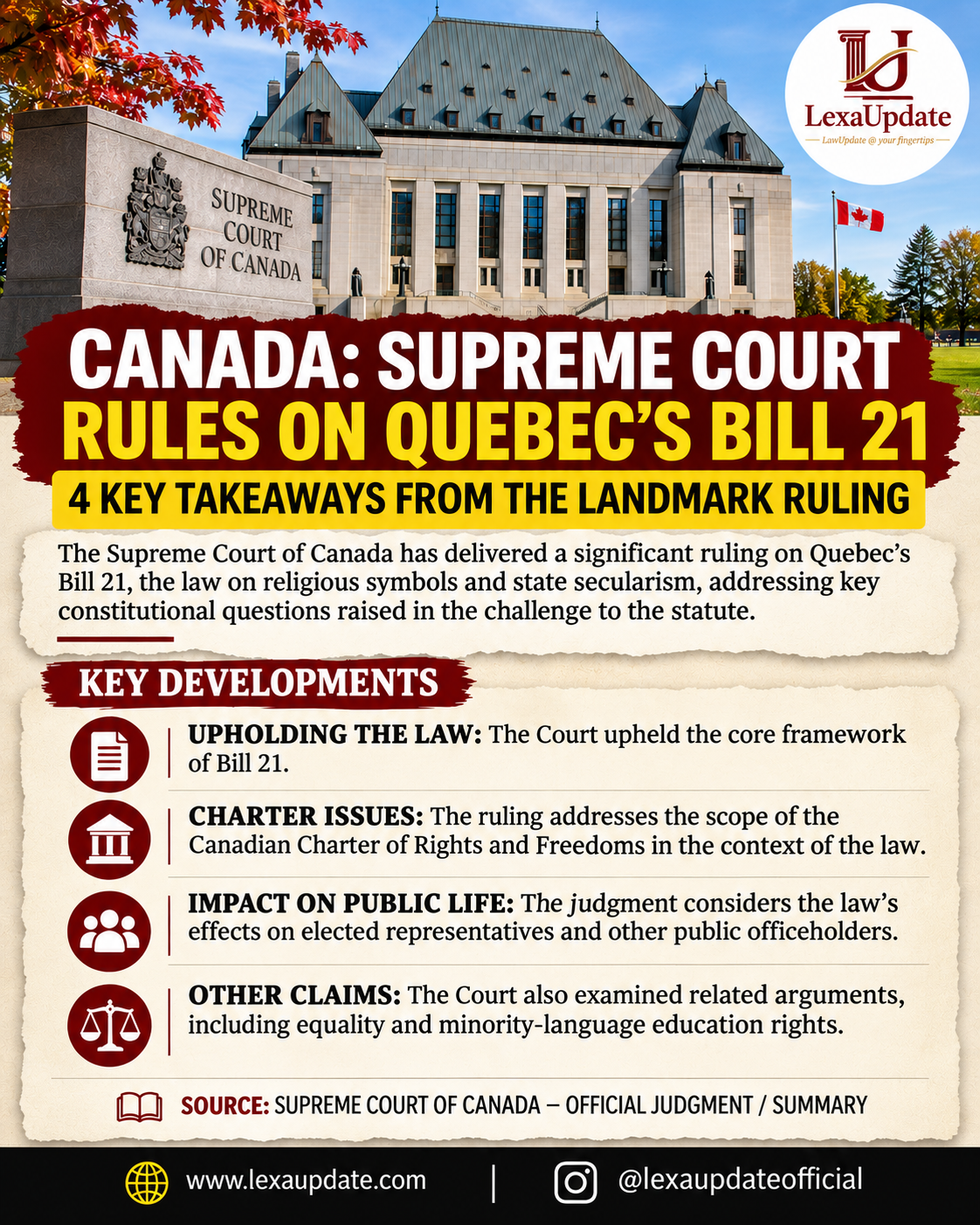
The Supreme Court of Canada has delivered a landmark judgment upholding Quebec's controversial secularism legislation, commonly known as Bill 21, while simultaneously charting a new constitutional course regarding the limits of the Canadian Charter of Rights and Freedoms. In a deeply fractured decision involving seven judges who split across multiple camps, the top court affirmed that the province had validly invoked the Charter's notwithstanding clause when passing the law in 2019, shielding it from many fundamental rights challenges.
At the same time, the apex court broke significant legal ground by ruling that Canadian courts retain the authority to issue formal declarations of inconsistency when a law protected by the notwithstanding clause infringes upon Charter rights. This nuanced ruling has triggered widespread political and legal reactions across Canada, balancing provincial legislative autonomy with judicial oversight of fundamental freedoms.
Background and Context of Bill 21
Enacted in 2019 by the Quebec legislature, Bill 21 prohibits various public sector workers in positions of authority—including teachers, police officers, and crown prosecutors—from wearing religious symbols on the job. The legislation immediately sparked a seven-year legal odyssey, drawing intense challenges from civil liberties groups, teachers' unions, and affected individuals who argued that the law violated freedom of religion and equality rights guaranteed under the Canadian Charter of Rights and Freedoms.
To protect the statute from judicial invalidation, the Quebec government preemptively invoked Section 33 of the Charter, commonly known as the notwithstanding clause. This powerful constitutional provision allows provincial legislatures or Parliament to temporarily override specific fundamental freedoms and legal rights for a renewable five-year period. The central question before the Supreme Court of Canada was not only whether Quebec could validly deploy this override mechanism, but also whether courts could scrutinize legislation protected by it.
Submissions and Judicial Division
During the proceedings, human rights organizations, civil liberties associations, and the federal government argued against the unchecked use of the notwithstanding clause, pressing the court to impose tighter restrictions on its pre-emptive deployment. Conversely, Quebec and several other provinces stoutly defended provincial autonomy and parliamentary sovereignty, emphasizing that the notwithstanding clause is an essential and legitimate pillar of the 1981 constitutional bargain.
The seven Supreme Court justices divided sharply on the core issues. By a 6-1 majority, the court ruled that Quebec had validly utilized the notwithstanding clause. Chief Justice Richard Wagner, writing for the main opinion, emphasized that "Bill 21 is rooted in Quebec’s legitimate and historical commitment to ensuring the secularism of the state in a free and democratic society." However, on the issue of judicial oversight, the bench split 4-3 to allow courts to issue declaratory judgments concerning Charter violations, even if the underlying statute cannot be struck down due to the override.
Court's Reasoning and Legal Significance
The court's decision establishes a crucial distinction between striking down legislation and issuing declaratory judgments. While the majority affirmed that the notwithstanding clause prevents courts from invalidating protected laws, four justices concluded that judges are not silenced from declaring whether a statute infringes upon protected constitutional rights. Proponents of this aspect of the ruling argued that such declarations bolster democratic accountability by ensuring that citizens know when fundamental rights are compromised. Conversely, dissenting judges and provincial leaders warned that allowing declaratory judgments introduces legal instability and encroaches upon parliamentary supremacy.
Why This Case Matters
This ruling is a watershed moment for Canadian constitutional jurisprudence. It cements the constitutional validity of the notwithstanding clause while creating a novel legal mechanism—declaratory judgments—that allows courts to formally critique laws shielded by the override. For litigants, advocates, and lawmakers, the decision alters the landscape of intergovernmental relations and shapes how provincial legislatures across Canada may utilize override powers in the future.
Key Takeaways
- Bill 21 Upheld: The Supreme Court of Canada upheld Quebec's secularism law, confirming the valid use of the notwithstanding clause.
- Judicial Declarations Permitted: By a 4-3 margin, the court ruled that judges can issue declarations of inconsistency when a law protected by the override violates Charter rights.
- Fractured Bench: The seven justices divided into multiple camps, reflecting deep divisions over the balance between fundamental rights and parliamentary sovereignty.
- Political Impact: The ruling preserves provincial autonomy while shifting the ongoing debate over rights and secularism back into the political and public arena.
Case Details
| Reference re Bill 21 (Quebec Secularism Law Challenges) |
| Supreme Court of Canada |
| Chief Justice Richard Wagner and accompanying bench of seven judges |
| November 27, 2026 |
| Canadian Charter of Rights and Freedoms (Sections 2, 15, and 33) |