
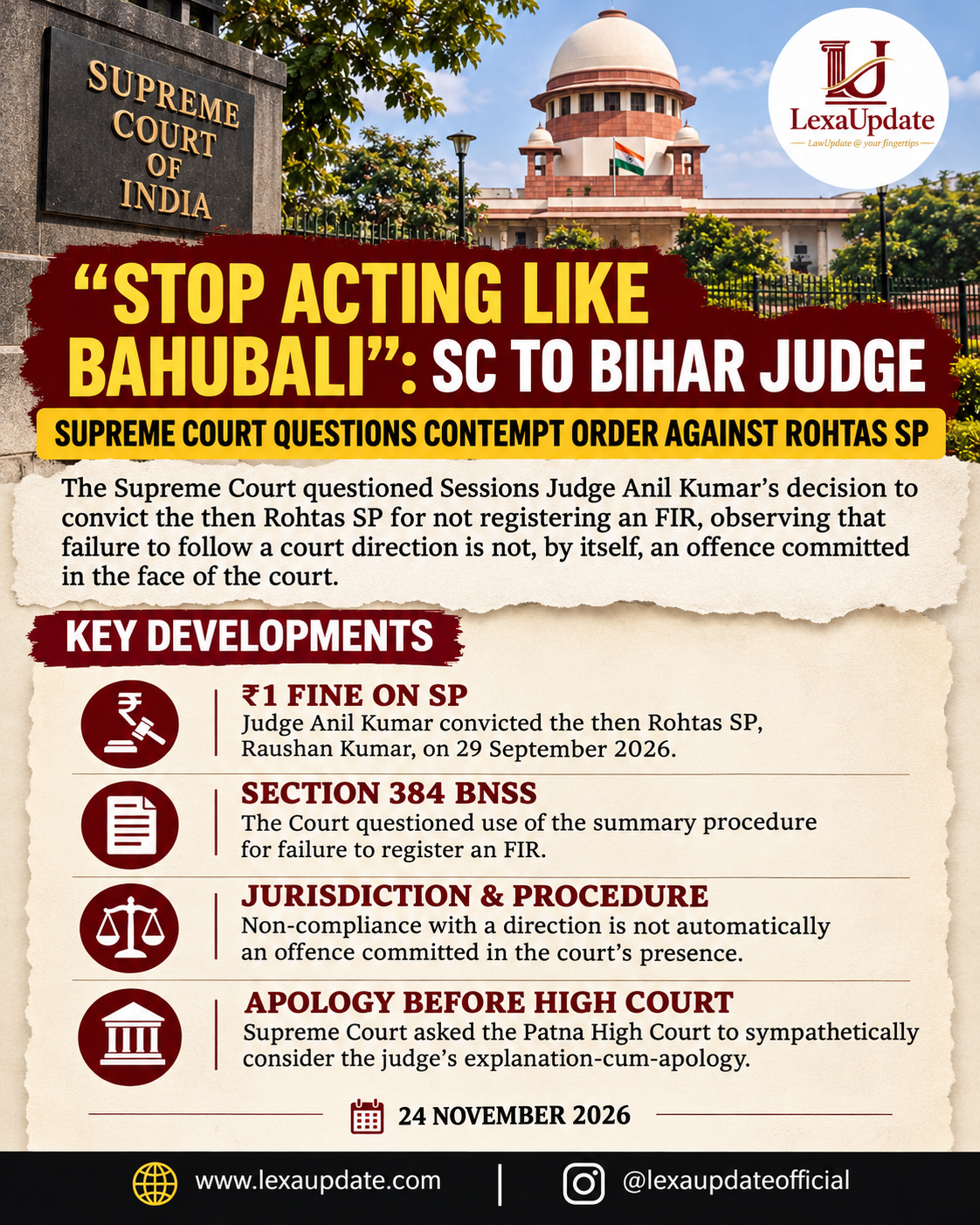
The Supreme Court of India has issued a sharp reprimand to a trial judge in Bihar, instructing him to cease acting like a local figure of arbitrary authority while exercising judicial powers. A three-judge bench comprising Chief Justice Surya Kant, Justice Joymalya Bagchi, and Justice V. Mohana expressed profound astonishment at the legal understanding displayed by the judicial officer, who had summarily convicted a senior police officer for criminal contempt.
The apex court was hearing a challenge filed by the judicial officer against an interim order passed by the Patna High Court, which had previously stayed the contentious contempt sentence and called for comprehensive case records. The Supreme Court's oral observations underscore the strict boundaries of judicial jurisdiction, emphasizing that statutory procedures cannot be bypassed to penalize executive officials for administrative non-compliance.
Background and Facts
The controversy originated in Rohtas at Sasaram, where Anil Kumar, serving as the 4th Additional Sessions Judge, initiated summary criminal contempt proceedings against Raushan Kumar, an Indian Police Service (IPS) officer who was then posted as the Superintendent of Police (SP) of Rohtas. The sequence of events unfolded after the sessions judge issued an explicit judicial direction ordering local police authorities to register a First Information Report (FIR) against individuals who allegedly provided false evidence during a criminal trial concluded in 2023.
When the police department allegedly failed to register the FIR in accordance with the timeline and terms of the judicial directive, the sessions judge took immediate cognizance. On September 29, 2026, the trial court held the Superintendent of Police guilty of criminal contempt for willful disobedience. The judge imposed a symbolic fine of one rupee, directed the Director General of Police (DGP) of Bihar to enter adverse remarks into the officer's official service records, and further requested the Union Ministry of Personnel and Training to overhaul foundational training programs for IAS and IPS officers to align them with constitutional governance.
Submissions and High Court Intervention
Aggrieved by the extraordinary nature of the order, the penalised police officer moved the Patna High Court. On October 8, 2026, a bench of the High Court stayed the sentence and castigated the proceedings as peculiar and unprecedented. The High Court underscored that trial judges must maintain judicial decorum and procedural integrity, noting particularly that an appeal regarding the underlying 2023 judgment was already sub judice before the High Court itself.
Unfazed by the High Court's intervention, the sessions judge initiated administrative and legal pushback, ultimately approaching the Supreme Court to challenge the High Court's stay and defend his actions. Counsel representing the various dimensions of the dispute pointed to the escalating institutional friction between the subordinate judiciary and executive law enforcement machinery in the state.
Court's Reasoning and Observations
During the Supreme Court hearings, the bench delivered unvarnished observations regarding the limits of judicial power. Justice Joymalya Bagchi remarked that the trial judge's comprehension of criminal procedure was deeply flawed. The bench elaborated on the precise scope of contempt provisions under Section 384 of the Bharatiya Nagarik Suraksha Sanhita (BNSS)—corresponding to Section 345 of the erstwhile Code of Criminal Procedure (CrPC).
The apex court clarified that an offence committed in the face of the court is narrowly confined to direct incidents such as physical violence, direct verbal abuse inside the courtroom, or flatly refusing to vacate the court premises when ordered to do so. The bench firmly ruled that the failure of an executive officer to register an FIR pursuant to a court direction does not constitute an offence committed in the face of the court, thereby stripping the summary conviction of any legal foundation. The court further questioned whether the judicial officer operated within his legal domain when summoning senior administrative and police officials for summary penalization, bluntly instructing that judicial authorities must exercise restraint rather than embarking on administrative adventures.
Why This Case Matters
This ruling serves as a vital constitutional check on judicial overreach within the subordinate judiciary. It reinforces the doctrine of separation of powers and highlights the procedural safeguards embedded in criminal contempt jurisprudence. By drawing a sharp distinction between genuine contempt in the face of the court and administrative delays or non-compliance by executive agencies, the Supreme Court has protected administrative officers from arbitrary penal action while reinforcing that judicial mandates must be pursued through proper appellate and statutory mechanisms rather than summary punitive measures.
Key Takeaways
- Jurisdiction Limits: Summary contempt powers for offences committed in the face of the court cannot be invoked for administrative non-compliance like failing to register an FIR.
- Statutory Interpretation: Section 384 of the BNSS and Section 345 of the CrPC require direct, in-court disruptive behavior, not executive delays.
- Judicial Restraint: Trial judges must adhere strictly to statutory constraints and procedural discipline, avoiding unilateral punitive actions against police officials.
- Appellate Protection: High Court interventions staying arbitrary contempt sentences are fully vindicated when subordinate courts overstep their legal authority.
Case Details
| Case Name | Anil Kumar v. State of Bihar & Ors. (SMC / Connected Petitions) |
| Court | Supreme Court of India |
| Bench | Chief Justice Surya Kant, Justice Joymalya Bagchi, and Justice V. Mohana |
| Case Number / Citation | Special Leave Petition arising from Patna High Court Proceedings (2026) |
| Date of Order | November 23, 2026 |
| Relevant Provisions | Section 384 of the Bharatiya Nagarik Suraksha Sanhita, 2023 (BNSS) / Section 345 CrPC |