
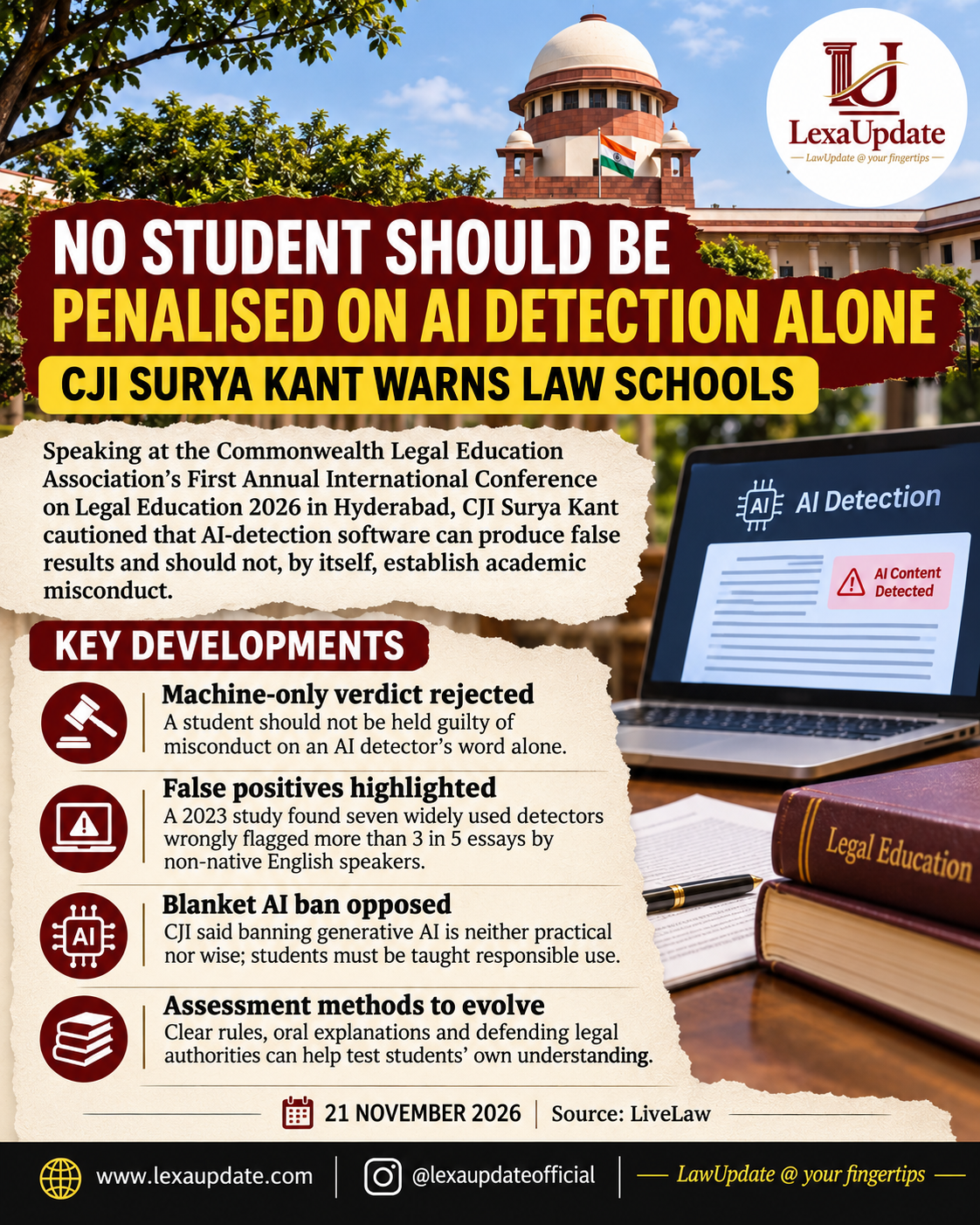
Chief Justice of India Surya Kant has publicly cautioned that no student should face punitive action solely on the basis of an artificial‑intelligence (AI) detection tool’s output. Speaking at a recent legal‑tech forum, the CJI underscored the need for a nuanced approach when AI‑driven software flags potential academic misconduct.
The remarks come amid a surge in Indian universities adopting AI‑based plagiarism and content‑authenticity solutions to curb cheating in examinations and assignments. While institutions argue that such tools enhance integrity, the CJI’s warning signals a possible call for procedural safeguards and a re‑examination of existing assessment policies.
Background and Facts
Over the past two years, a growing number of Indian higher‑education institutions have integrated AI‑powered detection platforms—such as Turnitin’s AI‑write check and home‑grown algorithms—into their examination and evaluation processes. These systems analyse text patterns, linguistic fingerprints and metadata to flag content that may have been generated by large‑language models (LLMs) like ChatGPT.
Several high‑profile cases have emerged where students received disciplinary notices after an AI tool flagged their submissions. Critics argue that the technology is still imperfect, often producing false positives, especially with technical or creative writing where phrasing may resemble AI‑generated text. In response, the University Grants Commission (UGC) has issued advisory notes, but no binding statutory framework governs the use of AI detection in academic adjudication.
Submissions & Proceedings
During the forum, representatives of student bodies, university administrators and legal scholars presented contrasting viewpoints. Student advocates highlighted instances where AI tools misidentified original work, leading to unwarranted suspensions and mental distress. They called for a “human‑in‑the‑loop” review before any sanction is imposed.
University officials, on the other hand, argued that AI detection is a necessary deterrent against the rapid diffusion of generative AI among students. They cited internal policy manuals that stipulate immediate provisional action upon a positive AI flag, pending a faculty review.
Legal experts warned that reliance on algorithmic outputs without statutory backing could violate principles of natural justice, particularly the right to a fair hearing under Article 21 of the Indian Constitution.
Court's Reasoning & Directions
Although the Chief Justice’s comments do not constitute a formal judgment, they reflect the Supreme Court’s broader jurisprudence on procedural fairness and the admissibility of scientific evidence. The CJI emphasized three core principles:
- Reliability: Any technological tool used in adjudicative contexts must be demonstrably reliable and validated.
- Transparency: Institutions should disclose the methodology, thresholds and error margins of AI detectors to the affected student.
- Human Oversight: Final disciplinary decisions must involve a qualified academic or legal authority who can contextualise the AI output.
The CJI urged the Ministry of Education and the UGC to consider drafting comprehensive guidelines that balance technological innovation with due‑process safeguards.
Why This Case Matters
The statement is significant for several reasons. First, it signals judicial awareness of emerging AI technologies and their impact on education law. Second, it may prompt legislative or regulatory action to codify standards for AI‑assisted assessment, thereby reducing arbitrary or disproportionate penalties. Third, the guidance could influence university policy‑making, encouraging a shift from punitive to remedial approaches when AI flags are raised.
Key Takeaways
- Chief Justice Surya Kant advises against using AI detection tools as the sole basis for student penalties.
- Reliability, transparency and human oversight are essential for any AI‑driven assessment mechanism.
- Potential regulatory guidelines from the Ministry of Education and UGC are anticipated.
- Students and institutions should prepare for a more balanced, evidence‑based adjudication framework.
Case Details
| Case Name | Statement by Chief Justice of India |
| Court | Supreme Court of India |
| Bench | Chief Justice Surya Kant |
| Case Number / Citation | Not applicable |
| Date of Order | 2026-11-21 |
| Relevant Provisions / Statutes | None cited; reference to Article 21 (right to life & liberty) |
| Next Hearing | None scheduled |