
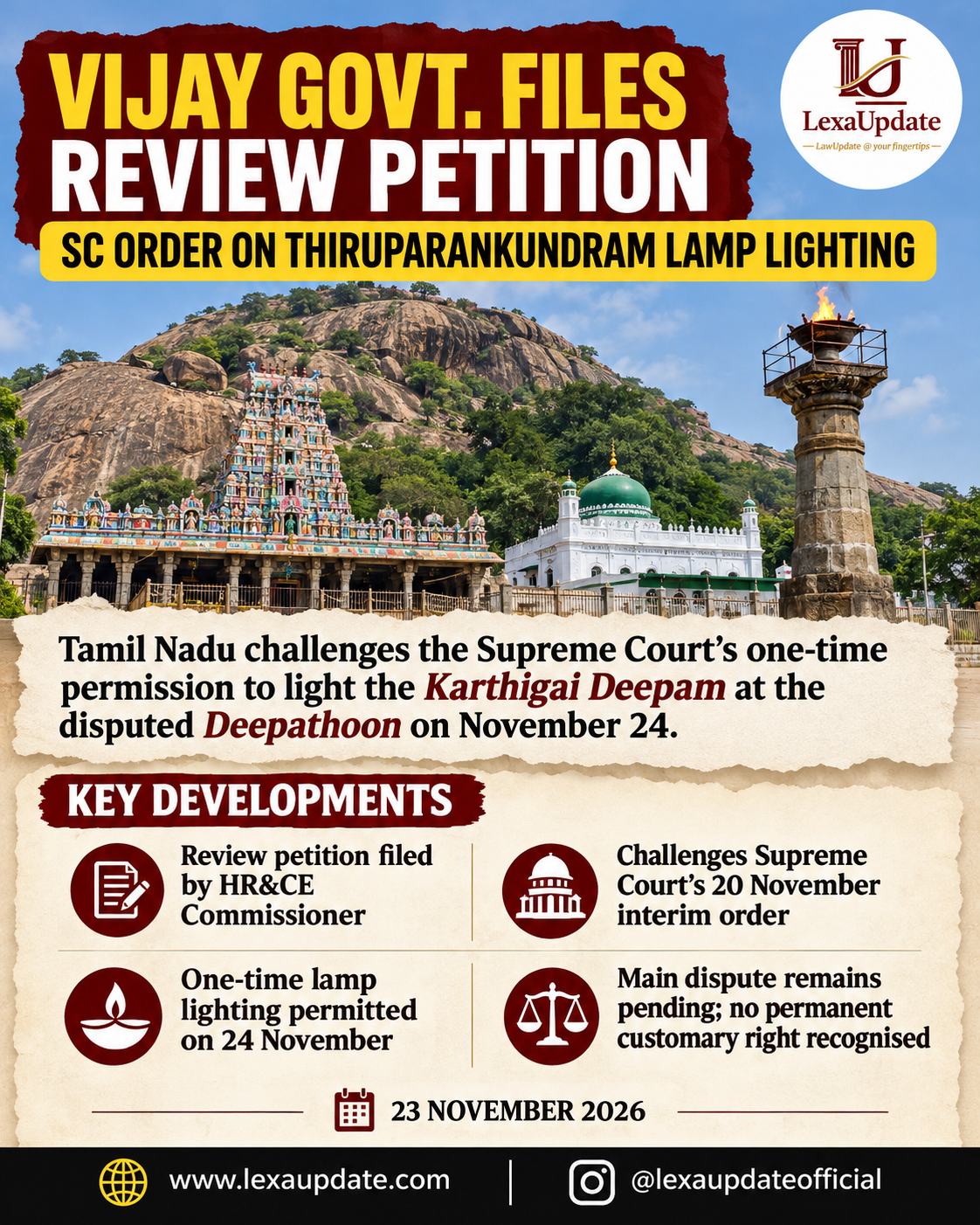
The Tamil Nadu government, through its Hindu Religious and Charitable Endowments (HR&CE) Department, has filed a review petition in the Supreme Court of India challenging the apex court's November 20 order that permitted a one‑time lighting of the Karthigai Deepam lamp on the disputed stone pillar (Deepathoon) at Thiruparankundram hill in Madurai.
The petition, lodged on November 22, 2026, seeks to set aside the interim permission and urges the Court to reconsider the decision in light of alleged threats to public order, communal harmony and the absence of any historical precedent for lighting the lamp at that specific site.
Background and Facts
Karthigai Deepam is a traditional Tamil Hindu festival celebrated by lighting a large oil lamp. Historically, the lamp is ignited at the Deepa Mandapam near the Uchippillaiyar Temple in Thiruparankundram. The Supreme Court, in a bench comprising Justices Aravind Kumar and Vipul M Pancholi, allowed a one‑time exception for the lamp to be lit on the Deepathoon – a stone pillar situated roughly 50 metres from the Hazrat Sultan Sikandar Badhusha Auliya Dargah – on November 24, 2026.
The Court’s order was conditioned: only authorised representatives of the temple administration and designated government officials could access the site; the general public, processions and demonstrations were expressly prohibited; the Madurai District Collector was appointed as the nodal officer; and the Central Industrial Security Force (CISF) could be deployed if required. The Court also clarified that the permission did not create a permanent right or precedent for future celebrations, and that a detailed hearing on the broader religious‑rights issues would be scheduled for January 2027.
Submissions & Proceedings
The HR&CE Department, representing the Tamil Nadu government, argues that the Deepathoon lacks any established ritual significance for Karthigai Deepam. It contends that the traditional venue is the Deepa Mandapam and that relocating the ceremony could inflame communal sensitivities, given the proximity of the Dargah. The petition stresses potential law‑and‑order disruptions, citing intelligence inputs that predict heightened tensions if the lamp is lit at the contested location.
The State also points to the Supreme Court’s own observations in the earlier Madras High Court judgment, which had highlighted the delicate communal balance in the area. While the petition does not dispute the Court’s authority, it requests a re‑examination of the factual matrix and urges the apex court to stay the November 24 arrangement.
Representatives of the BJP in Tamil Nadu have publicly condemned the state’s move, labeling it “anti‑Hindu” and accusing the government of vote‑bank politics. However, these political comments were not part of the formal petition.
Court's Reasoning & Directions
The Supreme Court’s original order, issued on November 20, was premised on the principle of minimal interference with religious practice while safeguarding public order. By limiting the ceremony to authorised officials and deploying security forces, the bench sought a calibrated approach that respected religious sentiment without opening the venue to mass gatherings.
In its order, the Court emphasized that the permission was “special, one‑time and interim”, expressly stating that it should not be interpreted as a permanent entitlement. The appointment of the Madurai District Collector as the nodal officer was intended to ensure real‑time monitoring and rapid response to any disturbance.
The review petition asks the Court to revisit these observations, arguing that the factual premise – namely, the absence of a historic tradition at the Deepathoon – was not adequately considered. The petition also seeks clarification on whether the security arrangements are sufficient given the alleged intelligence reports.
Why This Case Matters
The dispute sits at the intersection of religious freedom, communal harmony and state‑regulated public order – core themes in Indian constitutional jurisprudence. A definitive ruling could clarify the extent to which the judiciary can intervene in intra‑religious practices that have potential communal repercussions. Moreover, the case may set a benchmark for how temporary religious permissions are balanced against security considerations, especially in sensitive multi‑religious locales.
For advocates, the matter underscores the importance of presenting robust factual records when seeking judicial accommodation for religious events. For policymakers, it highlights the need for clear guidelines on the use of heritage sites for public religious ceremonies.
Key Takeaways
- The Tamil Nadu HR&CE Department has filed a review petition challenging the Supreme Court’s one‑time permission for a Karthigai Deepam lamp lighting at Thiruparankundram hill.
- The original order, dated 20 Nov 2026, allowed the ceremony only for authorised officials, barred public processions, and appointed the Madurai District Collector as nodal officer.
- The petition argues lack of historic precedent and potential law‑and‑order risks, seeking a stay of the November 24 arrangement.
- The Supreme Court’s interim permission was expressly non‑precedential and a detailed hearing is slated for January 2027.
- The case could shape future judicial approaches to religious events in communal‑sensitive zones.
Case Details
| Case Name | Tamil Nadu Government (HR&CE) v. Union of India |
| Court | Supreme Court of India |
| Bench | Justice Aravind Kumar and Justice Vipul M Pancholi |
| Case Citation | |
| Date of Order | 22 November 2026 |
| Relevant Provisions | Constitution of India, Article 25 (freedom of religion); Public Order considerations under Article 21 |
| Next Hearing | January 2027 (full hearing on religious‑rights issues) |