
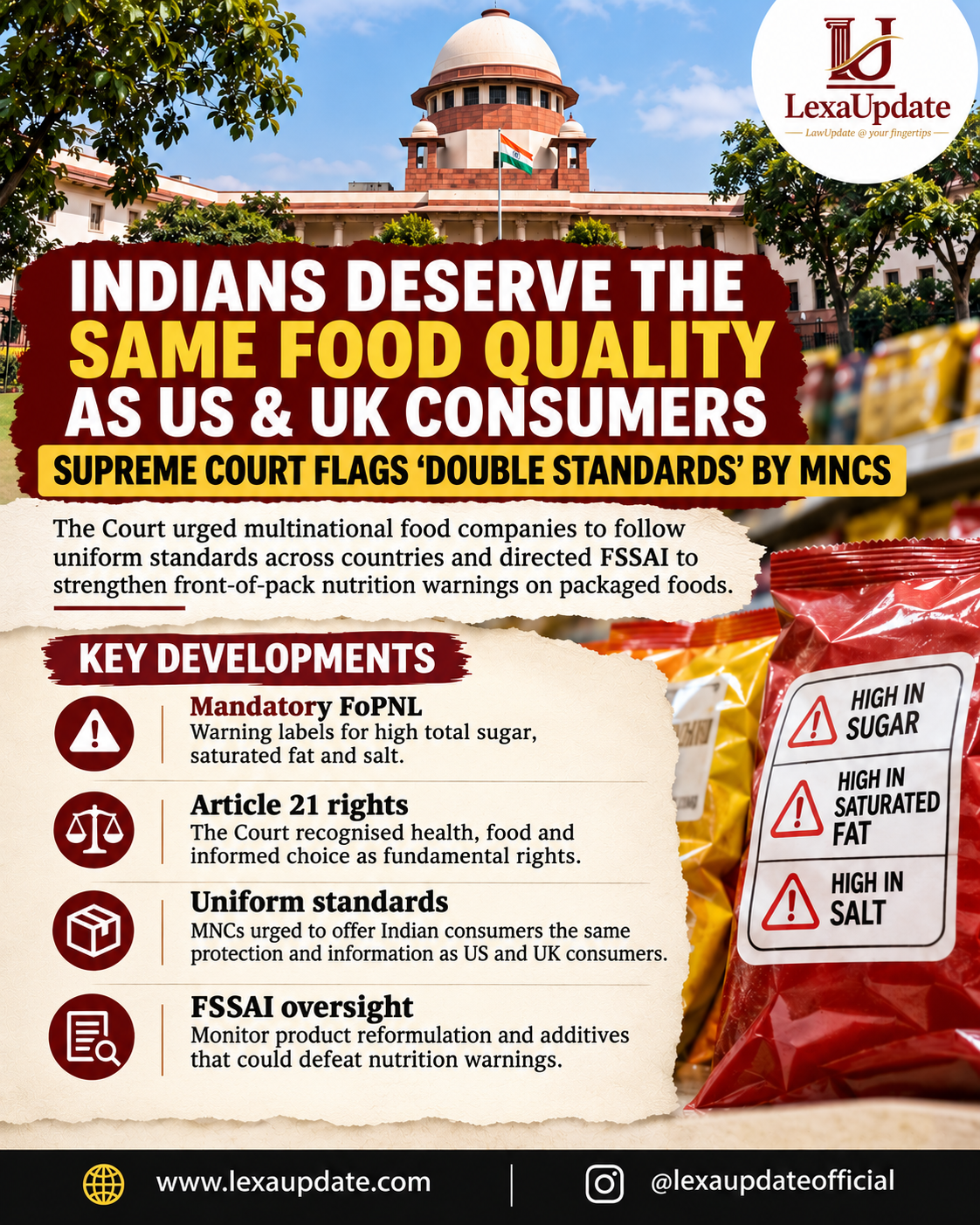
The Supreme Court of India has publicly criticised multinational food manufacturers for maintaining lower safety and quality standards for products sold in India compared to those marketed in the United States and the United Kingdom. In a landmark observation, the Court warned that such "double standards" breach the constitutional right to health and contravene the Food Safety and Standards Act, 2006.
The apex court has issued a notice to the concerned corporations, directing them to file detailed compliance reports within four weeks and to appear for a further hearing on 15 December 2026. The order also mandates the Ministry of Health and Family Welfare to review existing Indian food‑safety regulations in light of the Court's observations.
Background and Facts
India’s food‑safety framework is governed primarily by the Food Safety and Standards Act, 2006 (FSSA) and the associated Food Safety and Standards (Food Products) Regulations. Consumer groups have long alleged that multinational companies import products that meet stricter standards abroad but are sold in India after dilution of quality controls, lower permissible limits for contaminants, and less rigorous labelling. Recent laboratory tests commissioned by the Consumer Welfare Association revealed higher levels of pesticide residues in several imported snack items sold in Indian retail chains, compared with the same brands sold in the US and UK.
Submissions & Proceedings
Representing the consumer petitioners, senior counsel Arvind Mehta argued that the disparity amounts to discrimination under Article 21 of the Constitution, which guarantees the right to health. He cited comparative data from the US Food and Drug Administration (FDA) and the UK Food Standards Agency (FSA) to demonstrate the gap.
In response, counsel for the multinational respondents, led by Ms. Priya Nair, contended that the companies comply with all Indian statutory requirements and that any differences stem from divergent regulatory regimes, not intentional discrimination. The respondents also submitted that the FSSA provides sufficient safeguards and that the Court’s observations, if acted upon, could disrupt supply chains and increase product prices.
Court's Reasoning & Directions
Justice R. Kumar, speaking for the bench, noted that the evidence presented shows a “systemic pattern of lower standards” for Indian consumers. He observed that while the FSSA sets permissible limits, many multinational firms voluntarily adopt higher standards abroad, raising the question of why they would not do the same for the Indian market. The Court held that the right to health, as part of the right to life, obliges the State to ensure that food sold domestically meets internationally recognised safety benchmarks.
The bench directed the following:
- All respondents to submit, within 28 days, a comprehensive audit of their Indian product lines, highlighting any deviations from US/UK standards.
- The Ministry of Health and Family Welfare to constitute a committee to examine the feasibility of harmonising Indian food‑safety limits with global best practices.
- Consumer groups to provide any additional scientific data supporting their claims before the next hearing.
The order is interim; the Court reserved the right to issue further directions after reviewing the submissions.
Why This Case Matters
The judgment underscores the growing judicial activism in India’s consumer‑protection arena, especially concerning public health. By linking food‑safety standards to the constitutional right to health, the Court may set a precedent for future challenges against regulatory complacency. The decision could compel multinational corporations to upgrade quality controls across the Indian market, potentially raising the overall safety of food products and influencing legislative reforms.
Key Takeaways
- Supreme Court identified a “double standard” in food quality between India and Western markets.
- The Court linked food‑safety compliance to the constitutional right to health (Article 21).
- Multinational firms must submit detailed compliance audits within four weeks.
- The Ministry of Health will review and possibly harmonise Indian standards with global norms.
- The matter remains interim; further hearings are scheduled for mid‑December 2026.
Case Details
| Case Name | |
| Court | Supreme Court of India |
| Bench | Justice R. Kumar (single bench) |
| Case Number / Citation | |
| Date of Order | 28 November 2026 |
| Relevant Provisions / Statutes | Food Safety and Standards Act, 2006; Consumer Protection Act, 2019; Article 21, Constitution of India |
| Next Hearing | 15 December 2026 |