
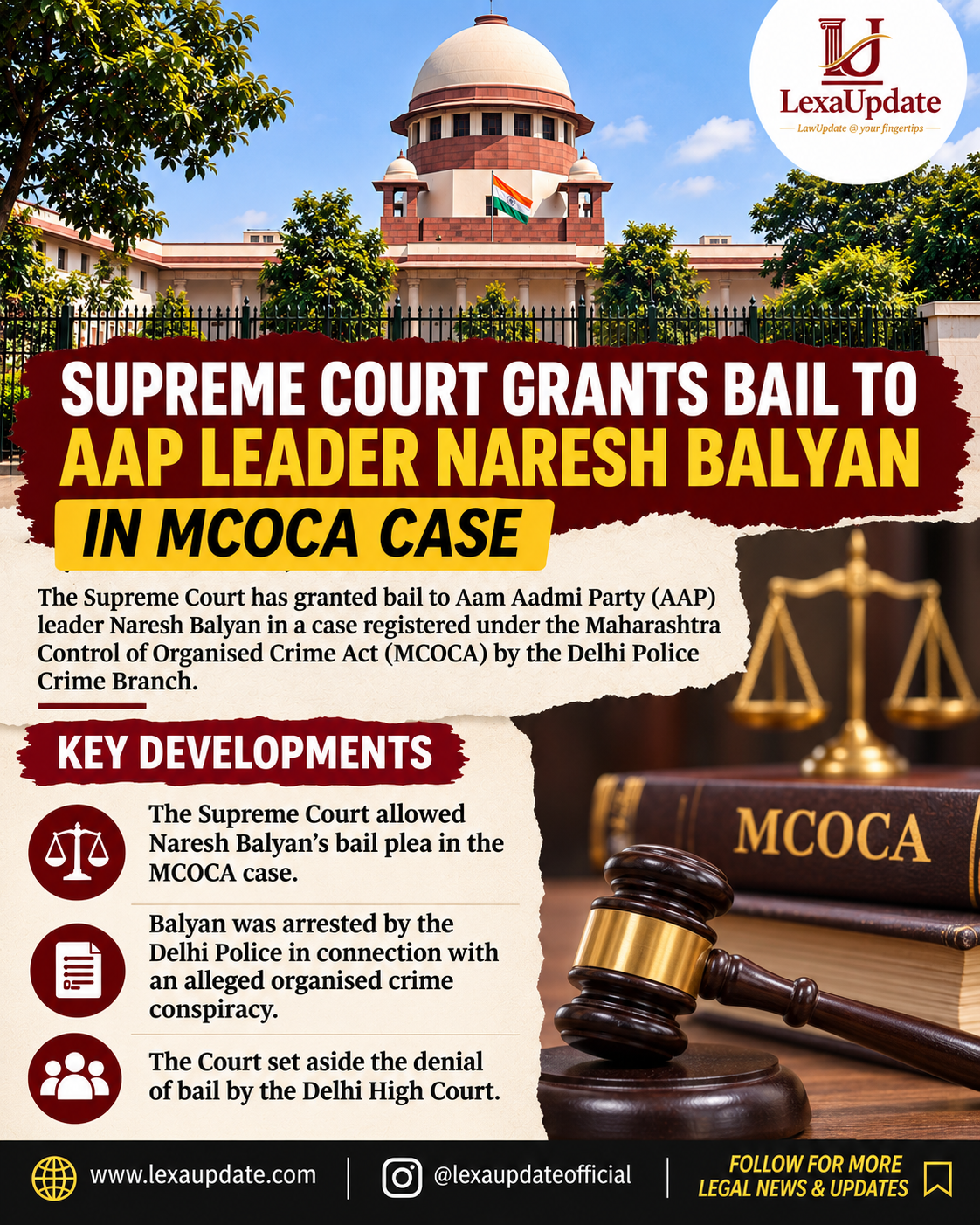
The Supreme Court of India has granted bail to former Aam Aadmi Party (AAP) MLA Naresh Balyan in a high-profile case registered under the Maharashtra Control of Organised Crime Act (MCOCA). A bench comprising Justice Vikram Nath and Justice Aparesh Kumar Singh allowed Balyan's special leave petition, setting aside the Delhi High Court's August 2026 judgment which had earlier denied him relief.
The apex court's order comes with a strict stipulation that the former legislator must fully cooperate with the ongoing trial, warning that any failure to do so could result in the revocation of his bail. Balyan had spent nearly two years behind bars following his arrest in late 2024.
Background and Facts
The criminal proceedings stem from a case registered by the Delhi Police Crime Branch on August 28, 2024, invoking stringent provisions of MCOCA. The prosecution alleged that Naresh Balyan acted as a facilitator and active associate in an organized crime syndicate allegedly operated by absconding gangster Kapil Sangwan. According to investigative agencies, the syndicate was involved in widespread extortion, property grabbing, and coercing owners into selling plots at distressed prices. Balyan was arrested on December 4, 2024, after trial courts repeatedly denied his bail pleas.
Before approaching the apex court, Balyan challenged the Delhi High Court's August 3, 2026 order, which had concluded that intercepted conversations demonstrated a prima facie active criminal nexus between him and the syndicate. The High Court had rejected his arguments regarding political vendetta and held that prolonged custody alone did not override the stringent statutory thresholds for bail under MCOCA.
Submissions & Proceedings
During the Supreme Court hearings, Senior Advocate Vikas Singh, appearing for Balyan, contended that his client was the victim of political targeting and had himself previously lodged formal police complaints against gangster Kapil Sangwan, even securing police protection. Singh pointed out that two key witnesses slated to testify against the former MLA had subsequently rescinded their statements, and emphasized that Balyan was not originally named as a principal offender.
In response, Additional Solicitor General Raja Thakare, representing the State, strongly opposed the grant of bail. The prosecution maintained that MCOCA focuses on the syndicate as an entity—against which numerous First Information Reports (FIRs) had been filed—rather than requiring multiple individual cases against every single accused person. The State argued that substantial material collected during the investigation established Balyan's active role as a facilitator for the syndicate's illicit activities.
Court's Reasoning & Directions
While evaluating the rival submissions, the bench expressed critical reservations regarding the prolonged incarceration of an elected representative under the circumstances presented. Weighing the totality of the record, the length of pre-trial detention already undergone, and the shifting stances of key evidentiary sources, the Supreme Court determined that continued detention was unwarranted at this stage.
The Court formally set aside the Delhi High Court's judgment denying bail and directed that Naresh Balyan be released. The relief was expressly made conditional upon his absolute cooperation with the trial court proceedings to ensure unhindered judicial progress.
Why This Case Matters
This ruling serves as an important judicial touchstone regarding the application of stringent special legislation like MCOCA against public figures and elected representatives. It highlights the fine balance constitutional courts must strike between societal interest in combating organized crime syndicates and protecting individual liberty against prolonged pre-trial detention, particularly when core factual foundations and witness statements are contested.
Key Takeaways
- Relief Granted: The Supreme Court granted bail to former AAP MLA Naresh Balyan, reversing the Delhi High Court's denial.
- Stringent Conditions: Release is strictly contingent upon Balyan's continuous cooperation with the trial proceedings.
- Duration of Custody: Balyan spent approximately two years in judicial custody following his December 2024 arrest.
- Syndicate Allegations: The prosecution's case centers around alleged facilitation of the Kapil Sangwan organized crime syndicate under MCOCA.