
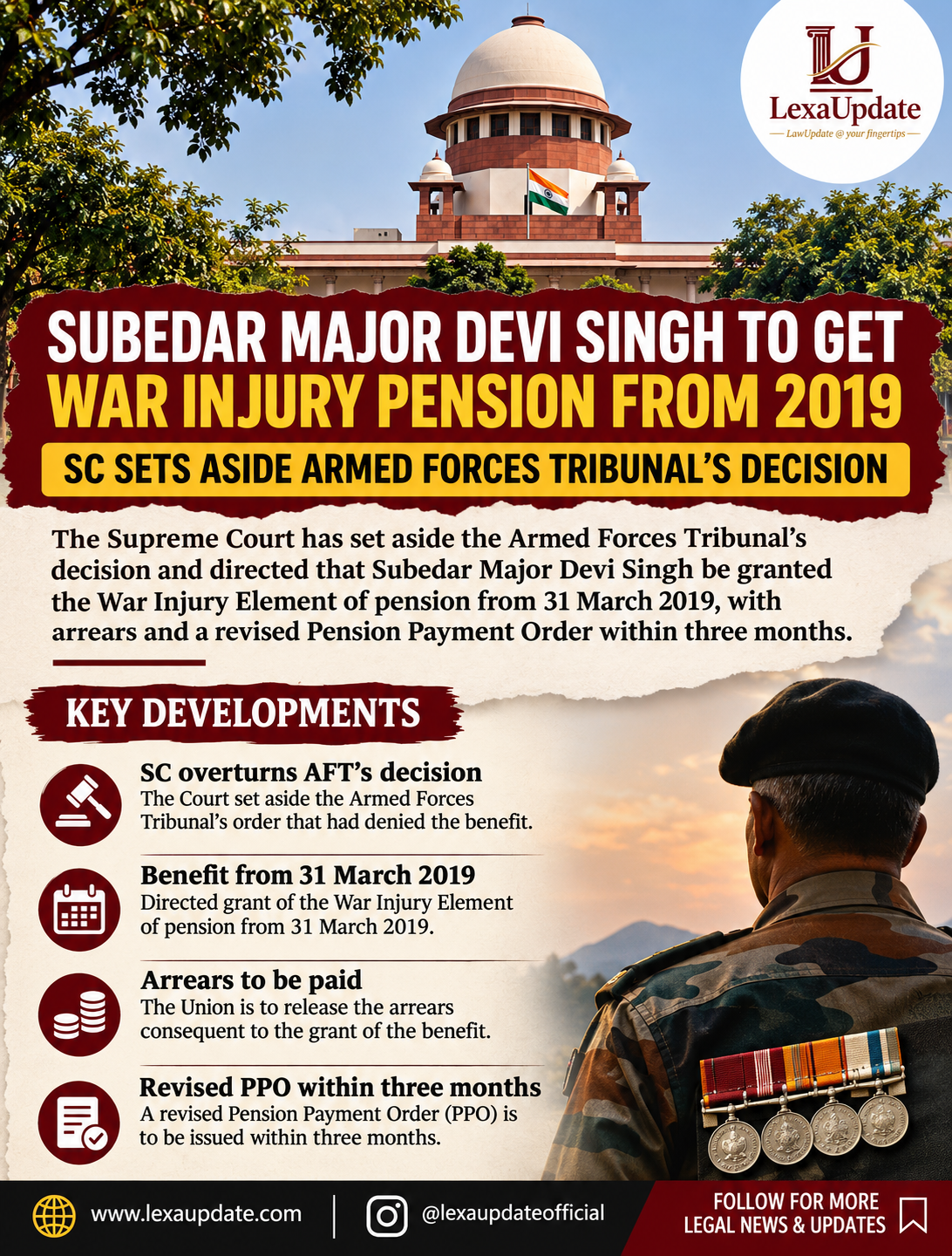
The Supreme Court of India on 20 November 2026 set aside the Armed Forces Tribunal’s refusal to recognise former Subedar Major and Honorary Lieutenant Devi Singh’s injury as a war‑related casualty, directing the Union to grant him a war‑injury pension retroactive to his retirement in 2019.
The two‑judge bench ordered the Ministry of Defence to issue a revised pension order with arrears within three months, clarifying the legal distinction between self‑inflicted wounds and accidental discharges of a serviceman’s own weapon.
Background and Facts
Devi Singh enlisted in the Indian Army on 24 June 1985 and served for 33 years, retiring on 31 March 2019. On 7 August 2002, while on operational duty in Jammu and Kashmir during Operation Rakshak, his service rifle accidentally discharged, striking his left thigh and damaging the femoral vein. The injury rendered him partially disabled. Singh subsequently applied for the “war‑injury element” of his pension, a benefit accorded to personnel wounded in battle‑related operations.
The Armed Forces Tribunal (AFT) rejected his claim, interpreting the injury as “self‑inflicted” because the bullet originated from his own weapon. Singh appealed the decision before the Supreme Court, contending that the injury was accidental and therefore fell within the definition of a battle casualty under the Army’s pension regulations.
Submissions & Proceedings
For the appellant, counsel argued that the statutory exclusion in the pension rules targets deliberate, intentional self‑harm intended to evade duty, not accidental discharges. The petition highlighted the December 2002 “Battle Casualty Wound” order, which listed Singh’s injury as a recognised battle casualty and issued an entitlement card and certificate.
The Union of India, represented by the Ministry of Defence, maintained that the AFT’s interpretation was consistent with the language of Regulation 82, which excludes injuries caused by a serviceman’s own weapon unless intent to self‑injure is proven.
Court's Reasoning & Directions
Justice Satish Chandra Sharma and Justice N. Kotiswar Singh held that the term “self‑inflicted” in the pension regulations carries a deliberate‑intent connotation. They explained that ownership of the weapon and the intention to cause injury are distinct factual inquiries; the former alone cannot establish the latter.
The Court observed that accidental discharges may arise from impact, a fall, snagging of the trigger, inadvertent pressure, or mechanical defect. Such scenarios lack the requisite knowledge and purpose that define self‑infliction under the law.
Relying on the 16 December 2002 battle‑casualty order, the bench concluded that Singh’s injury satisfied clause (h) of Category ‘E’ of Regulation 82, which covers actions against extremists or anti‑social elements. The Court further noted that the absence of Singh’s details from a later digital database could not defeat contemporaneous official records, especially where records were lost in floods.
Accordingly, the Supreme Court set aside the AFT’s decision, directed the Union to recognise the war‑injury element from the date of Singh’s retirement, adjust the disability component already paid, and issue a revised pension order with arrears within three months.
Why This Case Matters
The judgment clarifies the legal interpretation of “self‑inflicted” injuries in military pension law, establishing that accidental discharges do not fall within the exclusion. It reinforces the principle that statutory exclusions must be read in light of intent, not merely the source of injury. The decision also underscores the binding effect of contemporaneous official records over later digital entries, offering guidance for future pension disputes involving record‑keeping lapses.
Key Takeaways
- Accidental discharge of a serviceman’s own weapon is not “self‑inflicted” for pension purposes.
- Intentionality, not weapon ownership, determines exclusion under Regulation 82.
- The Union must grant war‑injury pension retroactive to retirement and pay arrears.
- Official contemporaneous records outweigh later digital database omissions.
Case Details
| Case Name | Devi Singh v. Union of India |
| Court | Supreme Court of India |
| Bench | Justice Satish Chandra Sharma and Justice N. Kotiswar Singh |
| Case Citation | N/A |
| Date of Order | 20 November 2026 |
| Relevant Provisions | Regulation 82, Clause (h) Category ‘E’ (Army Rules); Armed Forces (Pension) Act |
| Next Hearing | None – order is final |