
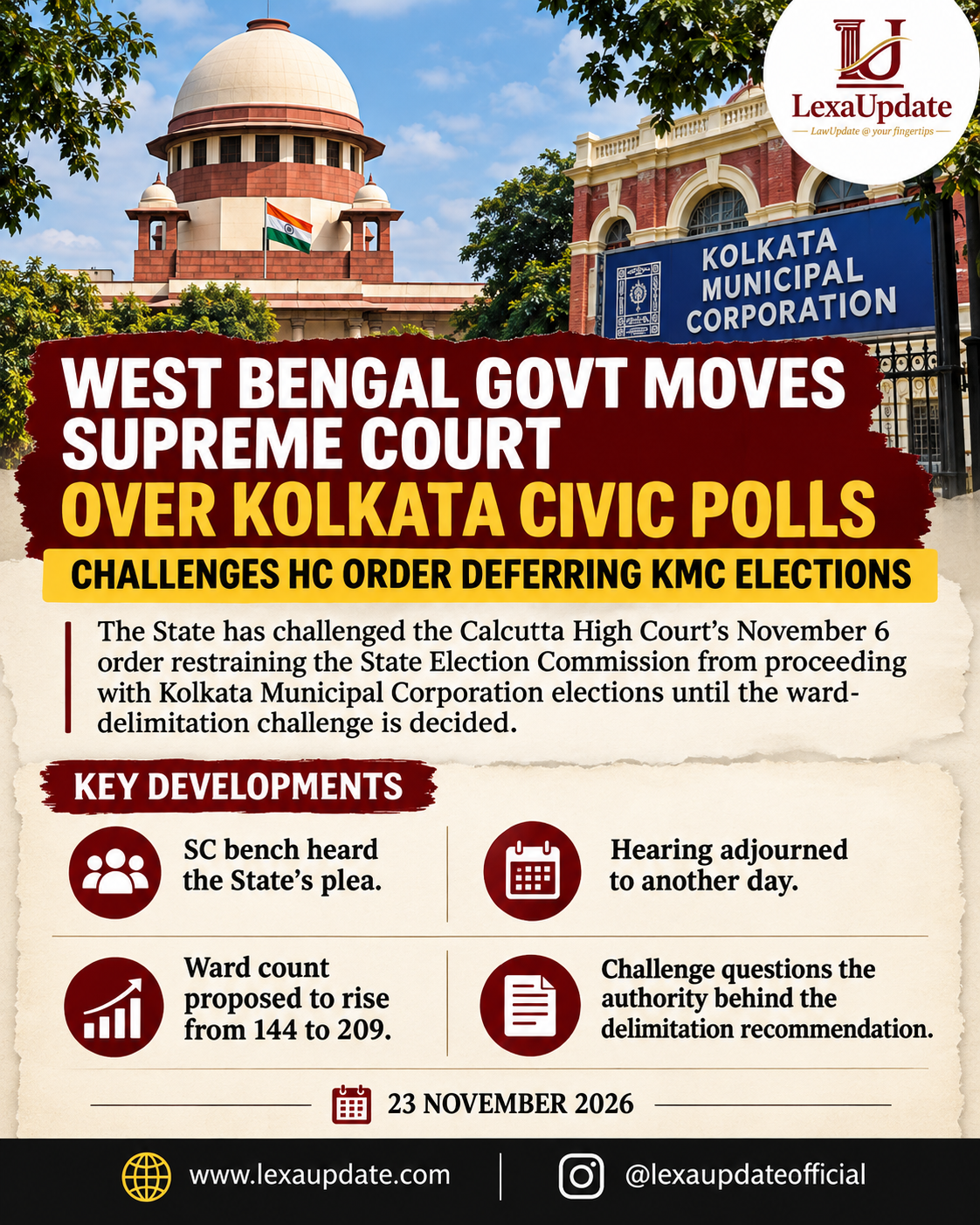
The Supreme Court of India has been approached by the West Bengal government seeking relief from a Calcutta High Court order that deferred the upcoming Kolkata municipal elections. The petition, filed on 23 November 2026, contends that the lower court’s intervention disrupts the constitutional mandate to conduct regular local elections and raises procedural concerns.
The state government argues that the High Court’s deferment lacks a solid evidentiary basis and requests the apex court to set aside the order, restore the original election timetable, and direct the State Election Commission to proceed with polls as scheduled.
Background and Facts
Kolkata, the capital of West Bengal, is due to hold its municipal corporation elections in early 2027. The elections are pivotal for local governance, influencing urban development, public services, and political representation. On 15 November 2026, a bench of the Calcutta High Court issued an interim order postponing the elections, citing alleged irregularities in the voter list and concerns over law‑and‑order conditions.
The High Court’s order was based on a petition filed by a coalition of civil society groups and a few opposition parties, who claimed that the State Election Commission had not adequately addressed discrepancies in the electoral roll. The order deferred the elections by an indeterminate period, pending a detailed examination of the alleged flaws.
Submissions & Proceedings
In its petition before the Supreme Court, the West Bengal government, represented by Advocate Sanjay Mukherjee, argued that the High Court’s deferment contravenes Article 324 of the Constitution, which vests the superintendence of elections in the Election Commission of India and, by delegation, the State Election Commission for local bodies. The government asserted that the alleged irregularities could be remedied through a targeted correction process without halting the entire electoral exercise.
The petitioners also highlighted the Representation of the People Act, 1951, which mandates that municipal elections be conducted within a stipulated timeframe to avoid a governance vacuum. They urged the Supreme Court to direct the State Election Commission to proceed with the elections while the voter‑list issues are rectified.
Opposition parties, whose intervenor status was recognised by the High Court, maintain that the electoral roll contains substantive errors that could disenfranchise thousands of voters. Their counsel, Advocate Ritika Sengupta, submitted that a thorough audit is indispensable to preserve the integrity of the electoral process.
Court's Reasoning & Directions
As of the filing date, the Supreme Court has not delivered a substantive judgment. The Court has, however, listed the matter for urgent hearing and issued a provisional direction that the State Election Commission continue with preparatory activities, such as candidate nominations and logistical arrangements, but refrain from finalising the poll date until the Court’s final order.
The apex court’s order also calls for both parties to submit detailed affidavits on the specific nature of the alleged irregularities within ten days, enabling the Court to assess whether the High Court’s deferment was proportionate.
Why This Case Matters
The dispute sits at the intersection of constitutional law, electoral administration, and federal‑state relations. A decision favouring the state could reaffirm the principle that election deferments must be narrowly tailored and justified by compelling evidence. Conversely, a ruling upholding the High Court’s order may set a precedent for broader judicial oversight of local electoral rolls, potentially influencing future municipal elections across India.
For legal practitioners, the case underscores the importance of timely compliance with the Representation of the People Act and the procedural safeguards required when challenging election‑related orders.
Key Takeaways
- The West Bengal government has petitioned the Supreme Court to overturn a Calcutta High Court order postponing Kolkata municipal elections.
- The High Court’s deferment was based on alleged voter‑list irregularities raised by civil‑society groups and opposition parties.
- The Supreme Court has scheduled an urgent hearing and directed interim compliance with preparatory election steps.
- The outcome will clarify the limits of judicial intervention in local electoral matters under Article 324 and the Representation of the People Act.
Case Details
| Case Name | West Bengal Government v. Calcutta High Court (SC Petition) |
| Court | Supreme Court of India |
| Bench | Not disclosed |
| Case Citation | Not available |
| Date of Order | 23 November 2026 |
| Relevant Provisions | Article 324 Constitution of India; Representation of the People Act, 1951 (Sections 16, 18) |
| Next Hearing | Urgent hearing scheduled (date to be notified) |