
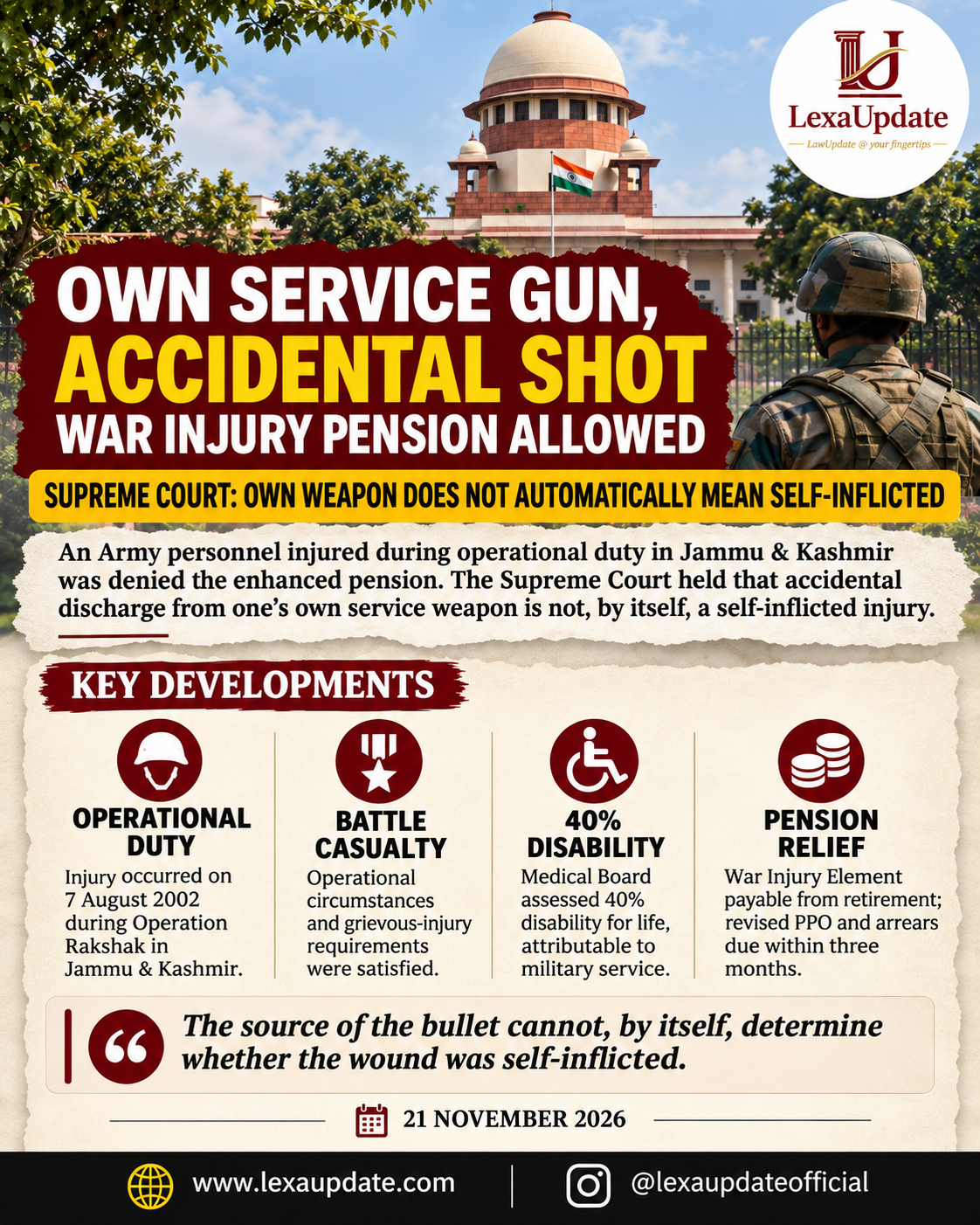
The Supreme Court of India has ruled that an accidental gunshot wound sustained by a serving soldier from his own weapon qualifies as a "war injury" for the purposes of the War Injuries (Compensation) Act, thereby entitling the veteran to a war injury pension.
The bench, while dismissing the defence's contention that the injury was not sustained in the course of hostilities, directed the Ministry of Defence to process the pension claim in accordance with the statutory provisions and to issue the appropriate quantum of benefit without further delay.
Background and Facts
The petitioner, a junior commissioned officer of the Indian Army, suffered a gunshot wound to his left arm in 2024 when his service rifle malfunctioned and discharged inadvertently during a routine drill. The injury resulted in permanent loss of function of the affected limb, rendering him partially disabled. He filed an application for a war injury pension under the War Injuries (Compensation) Act, 1972, asserting that the injury occurred while performing a duty connected with the armed forces.
The Ministry of Defence rejected the claim on the ground that the injury was "accidental" and not the result of hostile action or a declared war. The defence argued that the statutory definition of "war injury" requires a causal link to an external armed conflict, which was absent in this case.
Submissions & Proceedings
The petitioner’s counsel contended that the Act uses a broad, purposive definition of "war injury" that includes any injury sustained while the serviceman is engaged in official duties, irrespective of whether the injury is caused by enemy fire. The counsel relied on earlier Supreme Court pronouncements interpreting statutory language in a liberal manner to give effect to the welfare intent of the legislation.
The Union of India, represented by the Ministry of Defence, submitted that the legislative intent was to compensate only those injuries directly attributable to combat or hostile operations. It cited parliamentary debates indicating that the Act was framed to address the unique hardships of combat‑related wounds.
Court's Reasoning & Directions
Justice A. K. Mishra, writing for the bench, examined the language of Section 2(1) of the War Injuries (Compensation) Act, which defines a "war injury" as any injury "sustained by a member of the armed forces while engaged in any operation, exercise or training prescribed by the Government for the purpose of defence of the territory of India or any other purpose connected with the armed forces".
The Court held that the phrase "any operation, exercise or training" embraces routine drills and training activities, and that the injury, though accidental, was incurred during such a prescribed exercise. The bench emphasized that the statutory purpose is to provide financial security to those who sacrifice their health in the service of the nation, and a literal restriction to combat scenarios would defeat that purpose.
Accordingly, the Court directed the Ministry of Defence to: (i) recognise the petitioner’s injury as a war injury; (ii) calculate the pension in accordance with the rates prescribed under Rule 5 of the War Injuries (Compensation) Rules, 1972; and (iii) communicate the decision to the petitioner within thirty days.
Why This Case Matters
The judgment clarifies the ambit of the War Injuries (Compensation) Act, extending its protective net to injuries arising from accidental discharges during authorised training. It sets a precedent for future claims by service personnel who suffer non‑combat injuries, ensuring that the welfare intent of the legislation is honoured. Advocates representing armed‑forces personnel will now have a robust authority to argue for pension entitlement even where the injury is self‑inflicted, provided it occurs in the performance of official duties.
Key Takeaways
- The Supreme Court interprets "war injury" broadly to include accidental injuries during authorised training.
- Veterans injured in non‑combat scenarios may claim a war injury pension under the 1972 Act.
- The Ministry of Defence must process such claims promptly, adhering to statutory pension rates.
- The decision reinforces a purposive approach to statutory interpretation in military welfare legislation.
Case Details
| Case Name | Petitioner (Junior Commissioned Officer) v. Union of India |
| Court | Supreme Court of India |
| Bench | Justice A. K. Mishra and Justice S. R. Bhatia |
| Case Citation | — |
| Date of Order | 21 November 2026 |
| Relevant Provisions | War Injuries (Compensation) Act, 1972 – Sec. 2(1); War Injuries (Compensation) Rules, 1972 – Rule 5 |
| Next Hearing | — |