
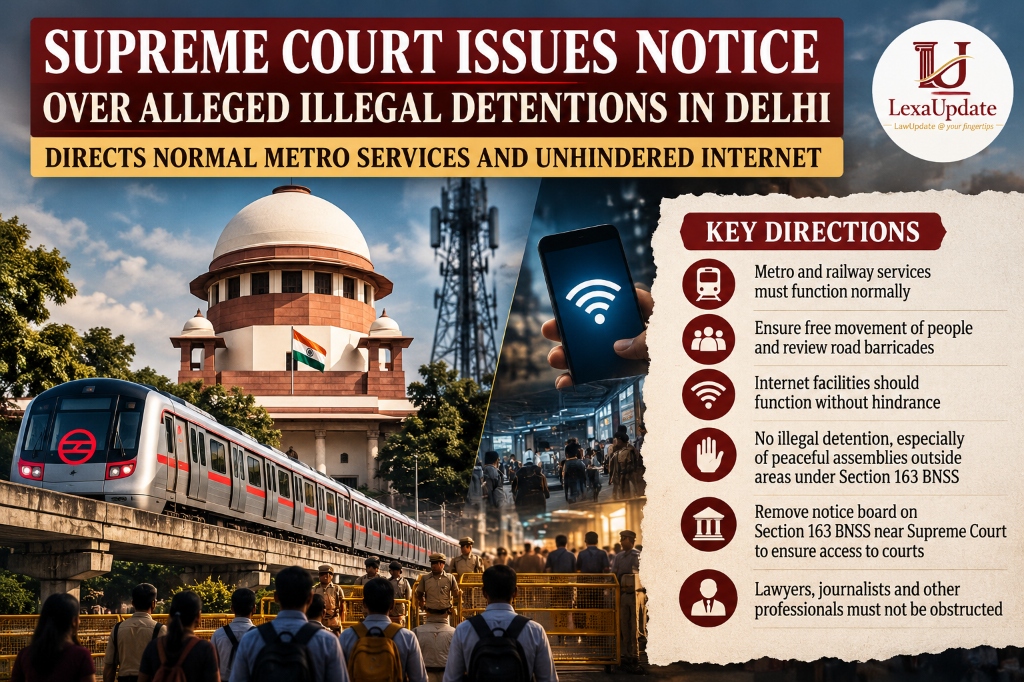
Supreme Court Issues Notice Over Alleged Illegal Detentions in Delhi, Directs Normal Metro Services and Unhindered Internet
The Supreme Court of India has issued notice in contempt proceedings alleging violations of its earlier directions concerning restrictions on public transport in Delhi and the alleged illegal detention of a large number of people. On October 11, 2026, a Bench of Justice Joymalya Bagchi and Justice V. Mohana directed that metro and railway services function normally, internet facilities remain unhindered, and the free movement of people be ensured subject to lawful restrictions.
The Court also directed the authorities to review road barricades, prevent illegal detentions outside areas where prohibitory orders under Section 163 of the Bharatiya Nagarik Suraksha Sanhita, 2023 (BNSS) were in operation, and ensure that lawyers, journalists and other professionals could discharge their duties without obstruction. The alleged contemnors have been directed to file counter-affidavits and a compliance report by October 13, 2026.
Supreme Court Takes Up Urgent Contempt Petition
The matters came before the Supreme Court following urgent applications alleging violations of its order dated October 9, 2026, concerning restrictions on metro services and other public facilities in Delhi.
The proceedings included Contempt Petition (Civil) Diary No. 63801/2026, filed by Shailendra Mani Tripathi against Govind Mohan, and a connected writ petition seeking habeas corpus relief.
The petitioners alleged that the earlier directions had not been complied with and that large numbers of people had faced harassment and illegal detention in Delhi on October 10, 2026.
During the hearing, counsel appearing for the petitioners submitted that metro stations had been closed, railway stations had remained inaccessible, traffic advisories had not been issued and internet services had been suspended. They argued that these restrictions had significantly affected the movement of people and goods across the city.
The submissions also alleged that the restrictions had created a curfew-like situation and that individuals had been detained beyond the areas covered by the prohibitory orders.
Petitioners Allege Widespread Illegal Detention
Senior Advocate Dr. Menaka Guruswamy, appearing in support of the listed matters, referred to the pleadings concerning the closure of several metro stations, including GTB Nagar and Vishwavidyalaya Metro Stations.
The petitioners alleged that the authorities had deliberately and wilfully violated the Supreme Court's earlier directions.
In the connected habeas corpus petition, the petitioners argued that the alleged illegal detention was not confined to the individuals specifically mentioned in the pleadings. They claimed that approximately 7,000 people had been detained in Delhi.
These allegations were disputed by the Union government during the hearing.
The Solicitor General of India, Tushar Mehta, and Additional Solicitor General S. V. Raju submitted that certain petitions mentioned during the hearing had not been served on the Union government, limiting its ability to assist the Court on the issues raised in them.
Union Government Denies Violation of Court's Directions
Responding to the allegations concerning the metro services, Solicitor General Tushar Mehta disputed the claim that the Supreme Court's October 9 order had been violated.
He submitted that the Delhi Metro had been functioning normally, although 45 out of 303 stations had been closed to maintain law and order.
The Solicitor General also denied that anyone had been illegally detained. Regarding the individuals referred to in the habeas corpus petition, he submitted that they had since been released and argued that the petition had consequently become infructuous.
Mehta further informed the Court that all metro stations had reopened from 10 pm on October 10, 2026, train services were functioning normally and internet connectivity had been restored.
The Court also recorded his assurance that lawyers, journalists and other professionals would not be prevented from discharging their professional duties.
Supreme Court Reiterates Distinction Between Regulation and Prohibition
The proceedings arose from the Supreme Court's earlier order dated October 9, 2026, which addressed restrictions affecting public transportation and movement in Delhi.
In that order, the Court had observed that the notifications appeared to impose an excessive restriction by completely prohibiting essential public transportation.
The Court had emphasised the distinction between the total prohibition of metro and railway services and their regulation where necessary to maintain law and order.
It had directed the authorities to reconsider the restrictions and permit metro trains and other railway services to operate in a regulated manner, ensuring that residents and members of the public did not face unnecessary inconvenience.
The earlier order also required the authorities to publicise their decisions widely and issue traffic advisories through newspapers and online platforms.
The Court had further asked the Delhi Metro Rail Corporation, the relevant railway authorities and Delhi Police (Traffic) to submit a compliance report within four days.
In the October 11 proceedings, the Court revisited these directions while considering the allegations of non-compliance.
Supreme Court Issues Notice in Contempt Proceedings
After hearing the submissions and examining the contempt petition, the Bench concluded that the petitioners had made out a prima facie case.
The Court accordingly issued notice to the alleged contemnors and directed them to file counter-affidavits, including a compliance report concerning the earlier order, by October 13, 2026.
The Court also issued notice in the connected habeas corpus petition.
The personal appearance of the alleged contemnors was dispensed with in the meantime.
The Court further directed that other connected petitions be served on the Solicitor General's office and tagged with the pending proceedings. Applications seeking intervention or impleadment were also directed to be tagged with the matters.
The issuance of notice reflects the Court's decision to examine the allegations; it does not, by itself, constitute a final finding that contempt has been committed.
Supreme Court Directs Normal Metro and Railway Operations
While considering the requests for interim relief, the Court issued specific directions concerning public transport and movement within Delhi.
It directed that metro trains and railway facilities must function normally unless regulation becomes necessary in view of reasonable restrictions envisaged under Article 19(2) of the Constitution.
The Court also directed the authorities to ensure the free movement of people throughout the city, subject to law-and-order requirements and applicable traffic regulations.
Road barricades were ordered to be reviewed forthwith to ensure that they did not unnecessarily obstruct movement, while allowing for legitimate security and traffic requirements.
The directions seek to prevent restrictions on essential public services from imposing disproportionate hardship on residents and other people travelling through Delhi.
Internet Services Must Function Without Hindrance
The Supreme Court separately directed that internet facilities should function unhindered.
During the hearing, the Solicitor General had informed the Court that internet connectivity had been restored.
The direction forms part of the Court's broader response to allegations that restrictions on public services had disrupted ordinary life in the capital.
The Court also addressed concerns regarding the invocation of Section 163 BNSS in and around the Supreme Court premises.
It directed the authorities to take down, if they had not already done so, a notice board stating that Section 163 had been invoked in the area. The purpose was to remove apprehensions regarding access to the Supreme Court and other courts of law.
Court Prohibits Illegal Detention Outside Restricted Areas
One of the significant directions in the October 11 order concerns the detention of people participating in peaceful assemblies.
The Court directed that there should be no illegal detention, particularly in cases involving peaceful, unarmed gatherings outside the area where Section 163 BNSS was in operation.
Section 163 BNSS empowers the competent authorities to issue orders in urgent cases of nuisance or apprehended danger. Such orders may impose restrictions where the statutory requirements are satisfied.
The Supreme Court's direction underscores that the existence of a prohibitory order in a particular area does not authorise unlawful detention beyond its applicable territorial scope.
The direction must be understood in the context of the specific proceedings and the Court's concern about alleged detentions beyond the area covered by the restrictions.
Lawyers, Journalists and Other Professionals Must Not Be Obstructed
The Court also addressed the impact of the restrictions on the ability of professionals to carry out their work.
It directed that lawyers, journalists and other professionals must not be hindered in discharging their professional duties in any manner.
The direction is particularly relevant where restrictions on transport, movement or access to court premises could prevent lawyers from appearing in proceedings, journalists from carrying out reporting duties, or other professionals from fulfilling their responsibilities.
The Court's order seeks to ensure that necessary law-and-order measures do not become an unnecessary barrier to professional activities or access to courts.
Supreme Court Calls for Compliance Report by October 13
The Supreme Court has listed the contempt and habeas corpus matters for further consideration on October 13, 2026.
The alleged contemnors must file their counter-affidavits and a compliance report by that date, addressing the Court's earlier directions.
The compliance report is expected to address the implementation of the directions concerning metro and railway services, public movement and traffic arrangements.
The connected petitions and intervention applications will also be considered alongside the listed matters.
The next hearing will provide the Court an opportunity to examine the responses of the authorities and assess compliance with its directions.
Why This Case Matters
The proceedings raise important questions concerning the limits of administrative restrictions imposed in the name of maintaining law and order.
Public authorities may take measures to address security concerns, but restrictions affecting transport, internet access and freedom of movement must operate within the framework of the law and applicable constitutional protections.
The Supreme Court's distinction between regulation and complete prohibition is particularly significant. It indicates that authorities should consider whether less restrictive measures can address security concerns without unnecessarily disrupting essential public services.
The directions concerning illegal detention also highlight the importance of ensuring that prohibitory orders are applied within their lawful scope.
The case will now proceed to the next stage, where the authorities will be required to respond to the allegations and demonstrate compliance with the Court's earlier directions.
Key Takeaways
The Supreme Court heard urgent contempt and habeas corpus proceedings on October 11, 2026.
The petitioners alleged violations of the Court's October 9 order and claimed that approximately 7,000 people had been detained in Delhi.
The Union government disputed the allegations, stating that metro services had been functioning subject to certain station closures and that the individuals referred to in the habeas corpus petition had been released.
The Court found that the petitioners had made out a prima facie case and issued notice in the contempt proceedings.
Metro and railway services must function normally unless lawful regulation becomes necessary.
Internet facilities should function unhindered, and the free movement of people must be ensured subject to applicable restrictions.
The Court directed that there should be no illegal detention, particularly of peaceful, unarmed gatherings outside areas where Section 163 BNSS is in operation.
Lawyers, journalists and other professionals must not be obstructed in discharging their duties.
The alleged contemnors must file counter-affidavits and a compliance report by October 13, 2026.
Case Name: Shailendra Mani Tripathi v. Govind Mohan
Court: Supreme Court of India
Bench: Justice Joymalya Bagchi and Justice V. Mohana
Proceedings: Contempt Petition (Civil), Diary No. 63801/2026; connected Writ Petition (Criminal), Diary No. 63858/2026
Date of Order: October 11, 2026
Relevant Legislation: Section 163, Bharatiya Nagarik Suraksha Sanhita, 2023
Constitutional Provision Referenced: Article 19(2) of the Constitution of India
Next Hearing: October 13, 2026