
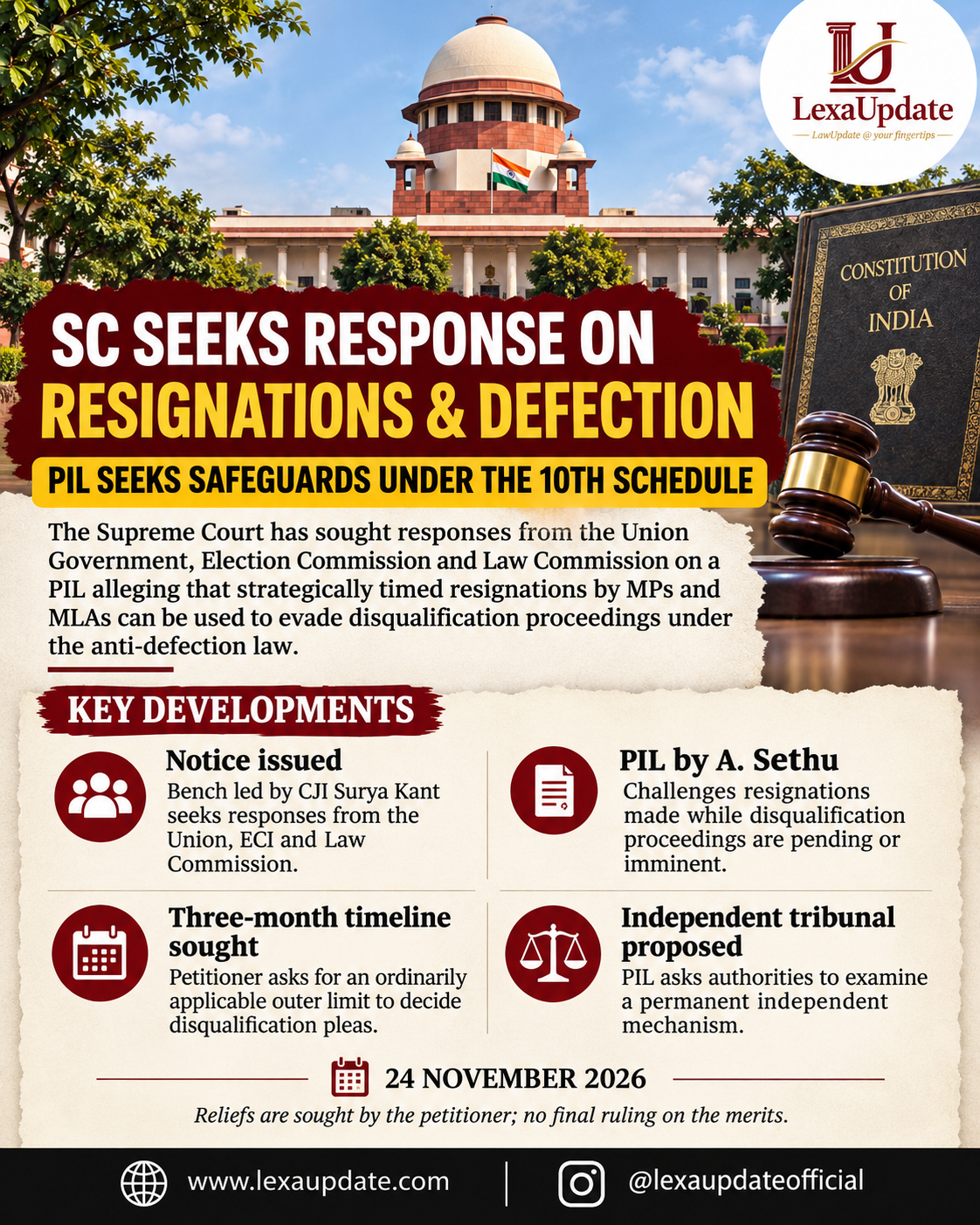
The Supreme Court of India has issued a formal notice in response to a public interest litigation (PIL) that seeks to curb the practice of Members of Parliament (MPs) and Members of Legislative Assemblies (MLAs) resigning solely to evade disqualification under the anti‑defection provisions of the Tenth Schedule of the Constitution.
The Court has directed the petitioner and the Union of India to file their written submissions, after which a hearing will be scheduled to consider whether the existing statutory framework requires amendment or a fresh judicial interpretation to plug this perceived loophole.
Background and Facts
The anti‑defection law, incorporated through the Tenth Schedule in 1985, aims to preserve the stability of elected governments by disqualifying legislators who voluntarily give up the membership of their party or defy party directives on a vote. In recent years, a pattern has emerged where legislators tender their resignations before a disqualification proceeding is initiated, thereby sidestepping the punitive provisions. The petitioner, identified as A. Setu, contends that such resignations amount to a calculated abuse of the constitutional scheme and undermine the spirit of the anti‑defection law.
The PIL alleges that the resignation route enables elected representatives to escape the consequences of floor‑crossing, while still influencing political outcomes through re‑election or by triggering by‑elections that may be strategically advantageous to their original parties.
Submissions & Proceedings
The petitioner argues that the legislature should be empowered to treat a resignation submitted with the intent to avoid disqualification as a nullity, thereby preserving the deterrent effect of the anti‑defection provisions. Counsel for the Union of India, on the other hand, maintains that the Constitution does not expressly prohibit a legislator from resigning and that any amendment to the law should be pursued through the parliamentary process rather than judicial intervention.
Amicus curiae briefs, if any, were not mentioned in the available material. The Court, in its notice, has invited both parties to elaborate on the constitutional, statutory, and policy dimensions of the issue.
Court's Reasoning & Directions
While the full judgment is pending, the Court’s notice underscores two principal considerations. First, it recognises the potential for a loophole that could erode the efficacy of the anti‑defection regime. Second, it signals a willingness to examine whether the existing provisions—primarily the Tenth Schedule and the related provisions of the Representation of the People Act, 1951—sufficiently address the scenario of pre‑emptive resignation.
The Court has ordered that the petitioner and the Union of India file their detailed written arguments within the time frame to be fixed by the registry. Subsequent oral arguments will be scheduled, after which the Court will determine whether legislative amendment or a judicially crafted remedy is appropriate.
Why This Case Matters
The outcome could reshape the legal landscape governing party discipline and legislative stability in India. A ruling that curtails resignation‑driven evasion would reinforce the deterrent purpose of the anti‑defection law, potentially prompting Parliament to amend the Tenth Schedule or to introduce procedural safeguards. Conversely, a decision that upholds the status‑quo would reaffirm the principle that resignation remains a constitutionally protected act, leaving the onus on legislators and parties to navigate the political ramifications.
For advocates, the case highlights the importance of strategic litigation in influencing statutory reforms. For scholars and students, it offers a live illustration of the interplay between constitutional provisions, statutory law, and parliamentary practice.
Key Takeaways
- The Supreme Court has taken up a PIL challenging the use of resignation to dodge anti‑defection disqualification.
- The petition seeks a judicial or legislative remedy to prevent such circumvention.
- The Union of India argues that any change should be effected through Parliament, not the courts.
- The Court has asked both sides to submit written arguments before a hearing date is fixed.
- The decision will have significant implications for party discipline, legislative stability, and future anti‑defection reforms.
Case Details
| Case Name | A. Setu v. Union of India |
| Court | Supreme Court of India |
| Bench | Not disclosed |
| Case Number / Citation | N/A |
| Date of Order | 24 November 2026 |
| Relevant Provisions / Statutes | Tenth Schedule of the Constitution (Anti‑Defection Law); Section 8, Representation of the People Act, 1951 |
| Next Hearing | To be scheduled after written submissions |