
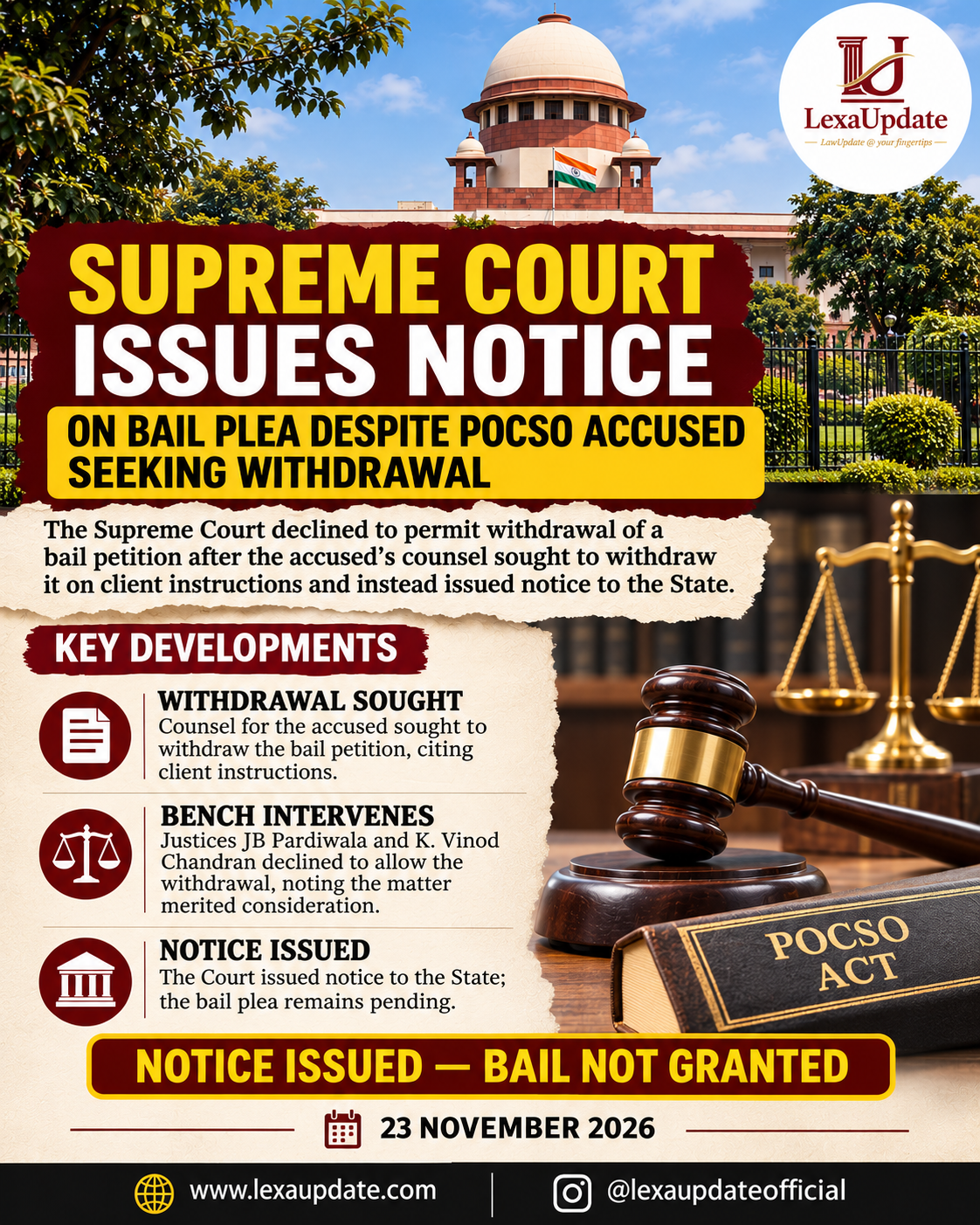
The Supreme Court of India on 23 November 2026 refused to accept the withdrawal of a bail petition filed on behalf of an accused under the Protection of Children from Sexual Offences (POCSO) Act, and instead issued a notice to the State for a response.
The bench, comprising Justices J.B. Pardiwala and Vinod K. Chandran, observed that the factual matrix suggested a consensual relationship between the accused and the alleged victim and therefore directed the State to appear and address the matter.
Background and Facts
The petition arose from a criminal case registered under the POCSO Act, 2012, wherein the accused was alleged to have engaged in sexual activity with a minor. The petitioner, a junior counsel, filed a bail application on behalf of the accused, seeking release pending trial. During the hearing, the counsel informed the bench that the client had instructed her to withdraw the petition and approach the trial court directly for bail.
POCSO cases are ordinarily non‑bailable unless the court is satisfied that the alleged act was consensual and that the accused does not pose a risk of re‑offending. Section 21 of the Act provides the statutory framework for bail applications.
Submissions & Proceedings
The State, represented by the Public Prosecutor, opposed bail on the ground that the offence involved a minor and that the statutory presumption under POCSO favours protection of the child. The defence counsel argued that the alleged relationship was consensual, that the accused had no prior criminal record, and that continued detention would be disproportionate.
When the counsel sought to withdraw the petition, Justice Pardiwala queried the motive, asking, “Why are you withdrawing?” Justice Chandran added, “Will you object if we issue notice? You have a good case.” The counsel reiterated that the instruction came directly from the client.
Court's Reasoning & Directions
The Court noted that a withdrawal of a bail petition does not automatically preclude judicial scrutiny, especially where the allegations involve a protected class of victims. The bench emphasised that the primary concern under POCSO is the welfare of the child, but also recognised that the factual matrix, as presented, hinted at possible consent.
Consequently, the judges ordered that a notice be issued to the State, directing it to file its response on the merits of the alleged consensual relationship. The order expressly stated that the bail petition was not dismissed and that the matter would proceed to a substantive hearing.
Why This Case Matters
This development underscores the Supreme Court's willingness to intervene in procedural tactics that could undermine the substantive examination of bail eligibility in sensitive POCSO matters. It clarifies that counsel‑driven withdrawal does not automatically halt judicial oversight when the court perceives a prima facie case for further inquiry. The decision also signals that allegations of consent, even in POCSO cases, will be rigorously examined before any denial of protection for the child.
Key Takeaways
- The Supreme Court can issue notice despite a petitioner's request to withdraw a bail application.
- Consent allegations in POCSO cases will be scrutinised on their merits.
- The State must respond to the Court’s notice, keeping the bail petition alive.
- Judicial discretion under Section 21 of the POCSO Act remains pivotal in bail determinations.
Case Details
| Case Name | State v. Accused (POCSO) |
| Court | Supreme Court of India |
| Bench | Justice J.B. Pardiwala and Justice Vinod K. Chandran |
| Case Number / Citation | N/A |
| Date of Order | 23 Nov 2026 |
| Relevant Provisions / Statutes | Protection of Children from Sexual Offences Act, 2012 – Section 21 (bail) |
| Next Hearing | To be fixed after State’s response |