
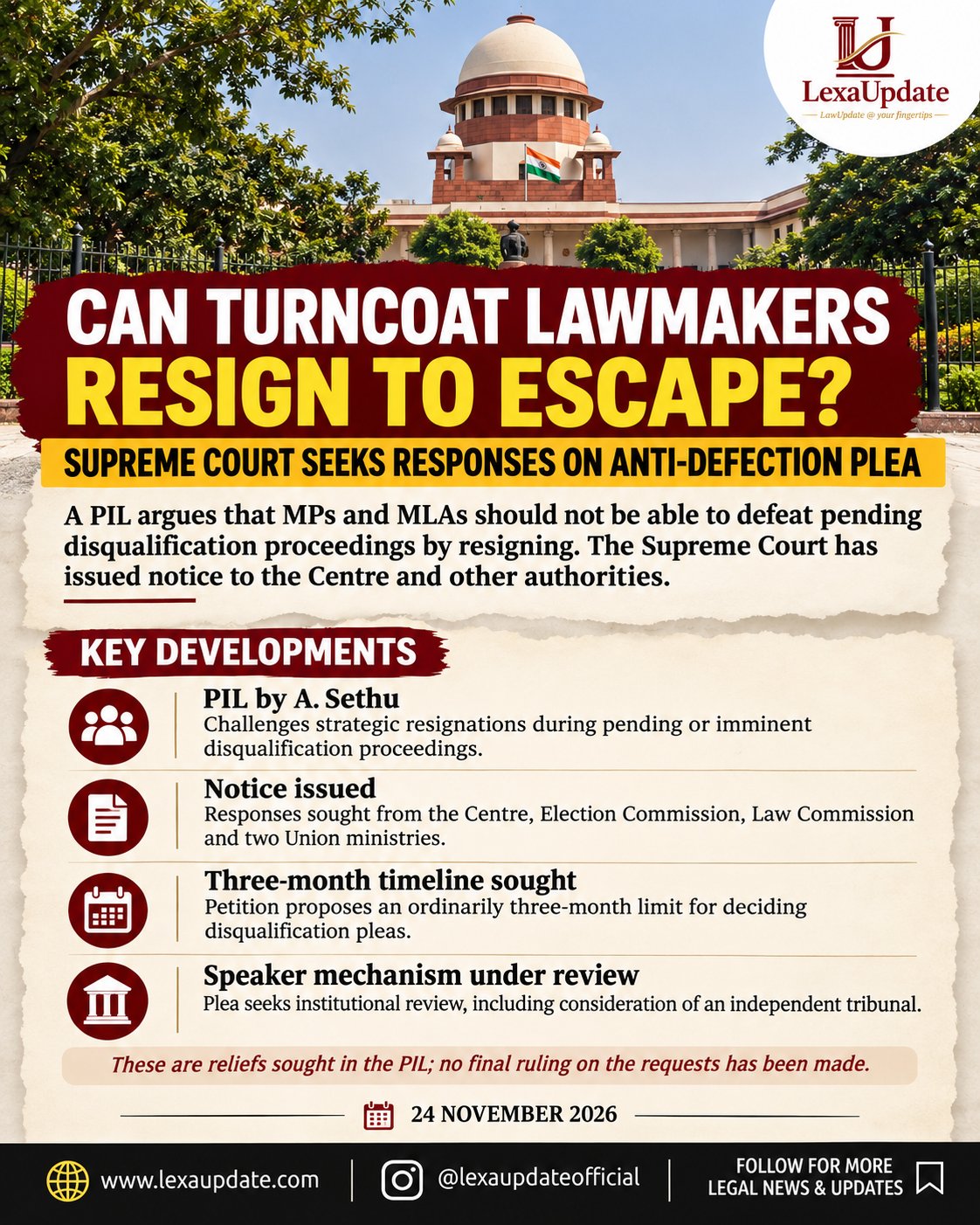
The Supreme Court of India on 23 November 2026 issued notice to the Union government and the Election Commission of India in response to a public‑interest litigation that seeks to prevent Members of Parliament (MPs) and Members of Legislative Assemblies (MLAs) from resigning strategically to escape disqualification under the anti‑defection law.
The notice marks the first judicial intervention aimed at curbing a growing practice where elected representatives time their resignations to thwart pending disqualification petitions, thereby undermining the electoral mandate and the spirit of the Tenth Schedule of the Constitution.
Background and Facts
The petition, titled A Sethu v. Union of India & Ors., was filed by a citizen‑activist alleging that several legislators have been resigning shortly before the Speaker or the Chairman of a legislative house pronounces a disqualification order under the anti‑defection provisions. By vacating their seats, the legislators claim to reset the disqualification process, forcing a fresh election and sidestepping the intended deterrent effect of the law.
Historically, the anti‑defection law—enacted through the Tenth Schedule of the Constitution by the 52nd Amendment—empowers presiding officers of legislatures to disqualify members who voluntarily give up party membership or act against the party’s directives. The petition argues that the current procedural framework allows a loophole: a resignation filed before the disqualification order can nullify the pending petition, leaving the electorate without recourse.
Submissions & Proceedings
The petitioner contended that the practice erodes the democratic principle of party stability and defeats the purpose of the anti‑defection law. He urged the Court to direct the Election Commission to frame guidelines that would either (i) treat a resignation as a tacit acknowledgment of disqualification, or (ii) prohibit resignations once a disqualification petition is pending.
The Union of India, through the Ministry of Law and Justice, argued that the Constitution already empowers the Speaker/Chairman to decide on disqualification irrespective of a resignation, and that any additional restriction could impinge on a legislator’s constitutional right to resign. The Election Commission, as a statutory body overseeing elections, maintained that it lacks jurisdiction to intervene in intra‑legislative matters unless a specific legislative amendment is made.
Court's Reasoning & Directions
While the Court has not yet delivered a substantive judgment, the notice seeks detailed responses from the Union government and the Election Commission within a stipulated time‑frame. The bench, whose composition was not disclosed in the order, emphasized the need to examine whether the existing procedural safeguards under the Tenth Schedule are sufficient to prevent abuse of resignation as a tactical device.
The Court indicated that any direction it may issue should balance two constitutional imperatives: the sanctity of the electoral mandate and the freedom of a legislator to resign, a right recognised under Article 191 of the Constitution. The notice also asked the parties to submit any comparative jurisprudence from other Commonwealth jurisdictions that have grappled with similar defections.
Why This Case Matters
The outcome could reshape the enforcement of the anti‑defection law, which has been a cornerstone of Indian parliamentary stability since 1985. A judicial directive compelling the Election Commission to issue guidelines would effectively close a loophole that political parties and opposition groups have increasingly exploited. Moreover, the case may prompt legislative reform, potentially leading to an amendment of the Tenth Schedule to expressly address resignations during pending disqualification proceedings.
For practising lawyers, political parties, and scholars, the case offers a live laboratory on the interaction between constitutional rights, statutory mechanisms, and democratic accountability. It also underscores the Supreme Court’s willingness to intervene in procedural gaps that threaten the integrity of representative democracy.
Key Takeaways
- The Supreme Court has issued notice on a PIL seeking to stop legislators from resigning to avoid anti‑defection disqualification.
- The petition argues that resignations can nullify pending disqualification petitions, undermining the Tenth Schedule.
- The Union government and Election Commission must respond with detailed submissions.
- A future judgment could lead to Election Commission guidelines or legislative amendment.
- The case highlights the tension between a legislator’s right to resign and the need to preserve electoral mandates.
Case Details
| Case Name | A Sethu v. Union of India & Ors. |
| Court | Supreme Court of India |
| Bench | Bench not disclosed |
| Case Citation | N/A |
| Date of Order | 23 November 2026 |
| Relevant Provisions | Tenth Schedule (Anti‑Defection Law), Article 191 of the Constitution |
| Next Hearing | To be fixed after parties’ responses |