
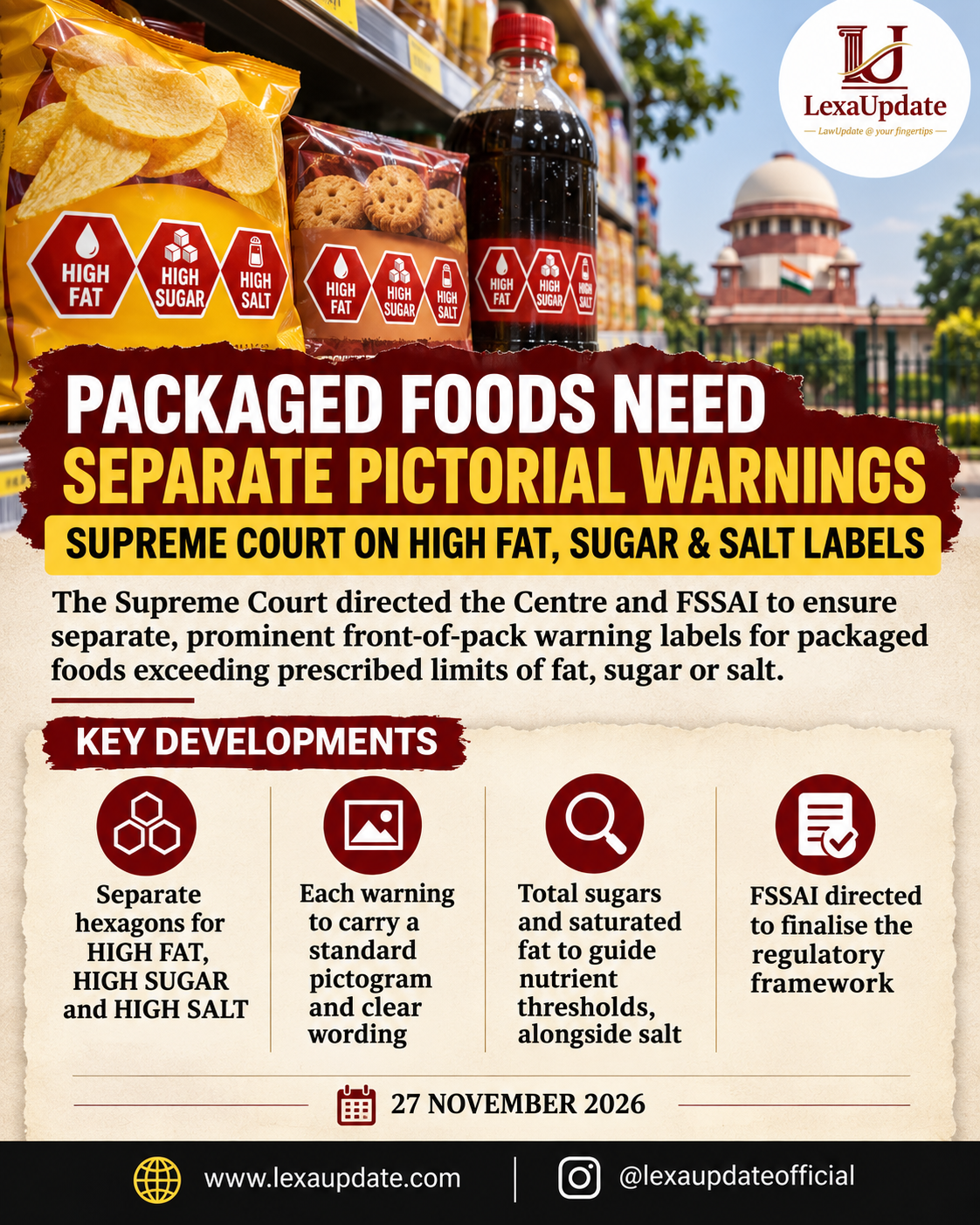
The Supreme Court of India has issued a landmark order directing the Food Safety and Standards Authority of India (FSSAI) to introduce separate, prominent red hexagonal warnings for packaged foods that exceed prescribed limits of sugar, salt or saturated fat. The directions, issued on 26 November 2026, mandate that each nutrient exceeding its threshold must carry its own warning, accompanied by a pictorial symbol and occupying at least 4‑5% of the principal display panel.
FSSAI has been given a four‑month window to finalise the draft regulations, after which food businesses will receive a 365‑day transition period to comply. The court also instructed the regulator to monitor reformulation, prevent deceptive labeling and prepare a list of exempted products, while urging the Union Government to enforce the 2020 Safe Food and Balanced Diets for Children in School Regulations and promote practical nutritional education.
Background and Facts
Front‑of‑pack nutrition labeling (FoPNL) has been a contentious issue in India for years. Earlier proposals by FSSAI included colour‑coded labels and a star‑rating system, but disagreements over scientific thresholds and design delayed implementation. In 2026, a public interest litigation (PIL) filed by the Kerala‑based non‑profit 3S and Our Health Society brought the matter before the Supreme Court, seeking stronger warnings for foods high in sugar, salt and saturated fat.
The court had previously questioned FSSAI’s phased approach, which would have covered products high in two or more nutrients first, potentially leaving single‑nutrient products unlabelled. It also challenged the use of added sugar and added fat as the basis for thresholds, arguing that total sugars and saturated fat should be considered to capture naturally occurring sugars.
Submissions & Proceedings
Industry stakeholders expressed concerns that the new thresholds could be too low, leading to “label fatigue”, or too high, allowing unhealthy products to escape warnings. They also highlighted the practical challenges of redesigning packaging, reformulating products and managing inventory during the transition period.
Advocates for public health, represented by 3S and Our Health Society, argued that separate warnings would provide clearer, more actionable information to consumers, especially those who do not routinely read nutrition tables. They stressed that pictorial symbols would enhance accessibility for all literacy levels.
Court's Reasoning & Directions
The bench, comprising Justices J.B. Pardiwala and K. Vinod Chandran, held that:
- Each nutrient exceeding its limit must have a distinct red hexagonal warning with a standard pictogram.
- Warnings must occupy at least 4‑5% of the principal display panel, unless a justified reason for deviation is provided.
- Thresholds should be based on total sugars and saturated fat, not merely added sugar and added fat.
- FSSAI must monitor product reformulation and prevent the substitution of sugar, salt or fat with other additives that conceal nutritional risks.
- Manufacturers must not use the transition period to accumulate excessive stocks of products or packaging without the new warnings.
- A clear list of exempted solid and liquid food products must be prepared, with reasons for each exemption.
- The Union Government must enforce the Food Safety and Standards (Safe Food and Balanced Diets for Children in School) Regulations, 2020, and promote practical nutritional education in schools.
- FSSAI must file an affidavit detailing progress on the draft regulations; the matter will be listed again after 10 weeks.
Why This Case Matters
This order sets a precedent for consumer protection in the FMCG sector, compelling brands to rethink product formulation, packaging design and marketing strategies. The clear, pictorial warnings will likely influence purchasing behaviour, encouraging healthier choices and potentially driving industry-wide reformulation. For regulators, the directions underscore the need for evidence‑based thresholds and robust monitoring mechanisms, reinforcing the role of the judiciary in shaping public health policy.
Key Takeaways
- Separate red hexagonal warnings for high sugar, salt and saturated fat are mandatory.
- Warnings must occupy 4‑5% of the principal display panel and include pictograms.
- Thresholds based on total sugars and saturated fat, not added sugar/fat.
- FSSAI has 4 months to finalize regulations; 365‑day transition for businesses.
- Monitoring of reformulation and prevention of deceptive labeling are required.
- Exemption list and enforcement of 2020 school‑food regulations are mandated.
- Affidavit on progress and no excessive stock accumulation allowed.
Case Details
| Case Name | 3S and Our Health Society v. Union of India |
| Court | Supreme Court of India |
| Bench | Justices J.B. Pardiwala & K. Vinod Chandran |
| Case Citation | Not available |
| Date of Order | 26 November 2026 |
| Relevant Provisions | Food Safety and Standards Act, 2006; Proposed FoPNL framework; 2020 Safe Food and Balanced Diets for Children in School Regulations |
| Next Hearing | After 10 weeks (date pending) |