
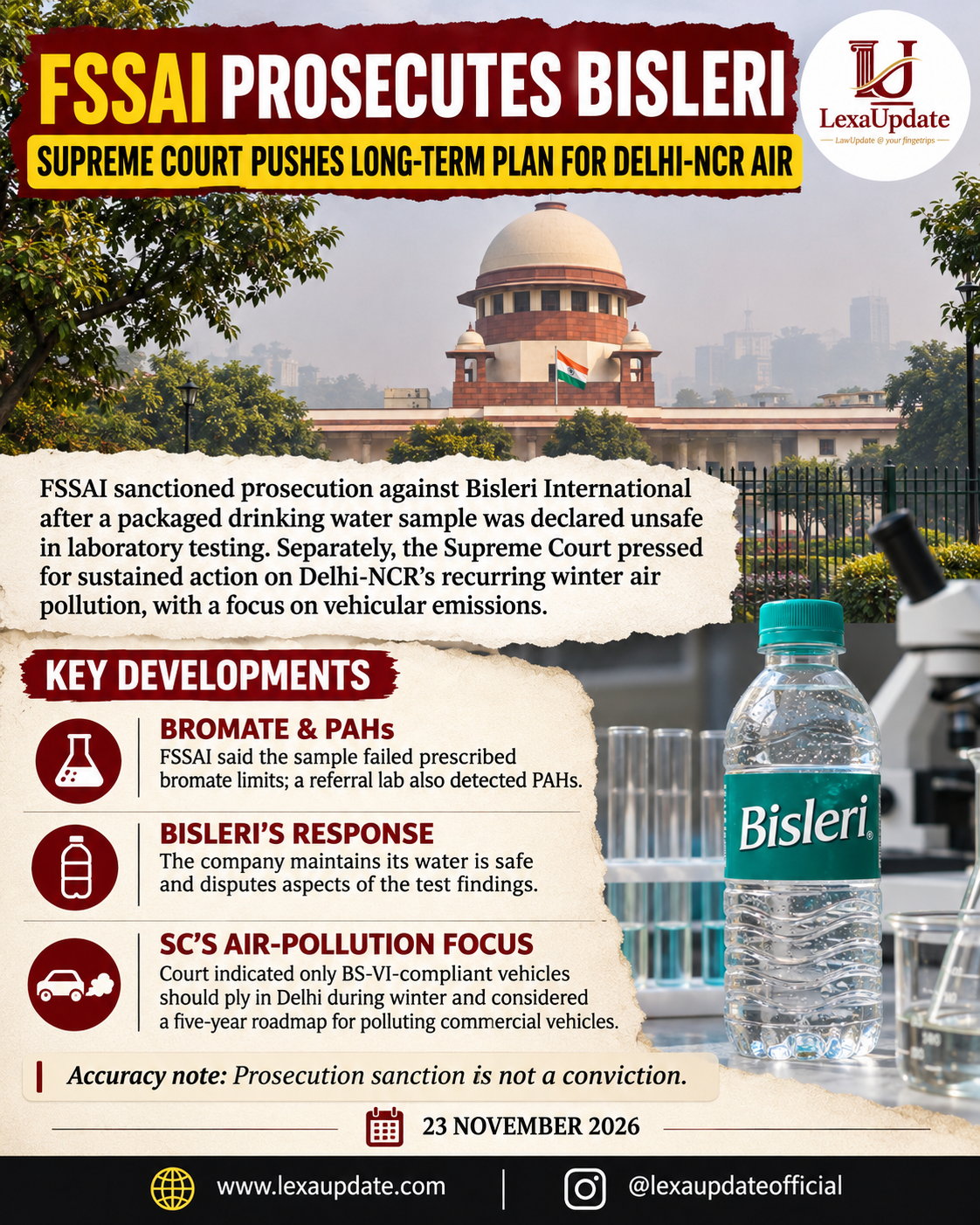
The Supreme Court of India has issued a directive requiring the governments of Delhi and the National Capital Region (NCR) to formulate and submit comprehensive long‑term plans aimed at curbing winter air‑pollution levels. The order comes amid recurring smog episodes that have repeatedly breached the National Ambient Air Quality Standards (NAAQS) during the colder months.
In a separate development, the Food Safety and Standards Authority of India (FSSI) has initiated prosecution proceedings against Bisleri International after a laboratory test on a bottled water sample from Goa revealed the presence of bromate and polycyclic aromatic hydrocarbons, substances prohibited under the Food Safety and Standards (Packaging and Labelling) Regulations, 2023.
Background and Facts
Delhi’s winter air quality has deteriorated sharply every year since 2015, with particulate matter (PM2.5) concentrations often exceeding 300 µg/m³—well above the 60 µg/m³ limit set by the NAAQS. The primary contributors are vehicular emissions, diesel‑powered commercial vehicles, construction dust, and the burning of crop residue in neighbouring states. The Supreme Court has previously intervened in 2019 and 2022, ordering temporary measures such as the odd‑even vehicle scheme and the ban on diesel generators.
Concurrently, the FSSI, the enforcement wing of the Food Safety and Standards Authority of India (FSSAI), conducted a random safety test on a Bisleri bottled water sample sourced from a retail outlet in Goa. The analysis detected bromate—a known carcinogen—and trace amounts of polycyclic aromatic hydrocarbons (PAHs), both of which are expressly prohibited under the Food Safety and Standards (Contaminants, Toxins and Residues) Regulations, 2020. Bisleri has denied receiving any formal notice and maintains that its product complies with all statutory safety standards.
Submissions & Proceedings
During the hearing, the FSSI counsel submitted the laboratory report, emphasizing that bromate levels exceeded the permissible limit of 0.1 mg/L and that PAHs were present in concentrations that could pose health risks, especially to vulnerable groups such as children and pregnant women. Bisleri’s legal team argued that the sample might have been contaminated post‑bottling and requested a re‑test, asserting that the company has a robust internal quality‑control system and that no prior consumer complaints have been recorded.
Regarding the air‑pollution directive, the Union Ministry of Environment, Forest and Climate Change (MoEFCC) highlighted the challenges of coordinating actions across multiple state jurisdictions. The Delhi government, represented by the Chief Secretary, indicated that it had already begun drafting a “Winter Air‑Quality Action Plan” but sought clarification on the scope of the Court’s expectations. The National Green Tribunal (NGT) intervenor, the Centre for Science and Environment (CSE), urged the Court to mandate enforceable emission standards for heavy‑duty vehicles.
Court's Reasoning & Directions
The Supreme Court, sitting in a bench whose members were not disclosed in the public order, observed that the recurring smog episodes constitute a violation of the constitutional right to life under Article 21, as interpreted in the landmark case of Subhash Kumar v. State of Bihar. The Court reiterated that the Environment (Protection) Act, 1986, and the Air (Prevention and Control of Pollution) Act, 1981, impose a statutory duty on the Union and State governments to prevent environmental degradation.
Accordingly, the Court directed:
- All State Governments within the Delhi‑NCR to submit a detailed, multi‑year air‑quality management plan within 60 days, outlining specific measures for vehicular emission control, promotion of public transport, and enforcement of construction‑site dust mitigation.
- The MoEFCC to monitor compliance and publish quarterly progress reports on its website.
- The FSSI to proceed with prosecution against Bisleri, ensuring that the company is served with a show‑cause notice within 15 days, and to conduct an independent re‑testing of the water sample.
The Court also warned that failure to comply could attract contempt proceedings, underscoring the urgency of protecting public health.
Why This Case Matters
The Supreme Court’s order marks a pivotal moment in India’s environmental jurisprudence, signalling a shift from ad‑hoc, short‑term measures to a structured, statutory framework for air‑quality management. For litigants and policymakers, the directive establishes a clear benchmark for inter‑state coordination and reinforces the enforceability of constitutional environmental rights. The FSSI’s prosecution of Bisleri underscores the growing regulatory scrutiny of food‑and‑beverage safety, reminding manufacturers that compliance is subject to rigorous scientific testing and swift legal action.
Key Takeaways
- Supreme Court mandates comprehensive winter air‑quality action plans from Delhi‑NCR states within 60 days.
- Non‑compliance may lead to contempt of court proceedings.
- FSSI initiates prosecution against Bisleri for bromate and PAH contamination; company must respond to show‑cause notice.
- Both orders reinforce statutory duties under the Environment (Protection) Act, 1986 and Food Safety regulations.
- Future monitoring will be overseen by the MoEFCC with public quarterly reports.
Case Details
| Case Name | Supreme Court of India – Direction on Delhi Winter Air Pollution (and FSSI v. Bisleri) |
| Court | Supreme Court of India |
| Bench | Bench (judges not disclosed) |
| Case Citation | Order dated 23‑Nov‑2026 (no formal citation) |
| Date of Order | 23 November 2026 |
| Relevant Provisions | Article 21 Constitution of India; Environment (Protection) Act, 1986; Air (Prevention and Control of Pollution) Act, 1981; Food Safety and Standards (Contaminants, Toxins and Residues) Regulations, 2020 |
| Next Hearing | State governments to file plans within 60 days; further compliance review scheduled for 30 January 2027. |