
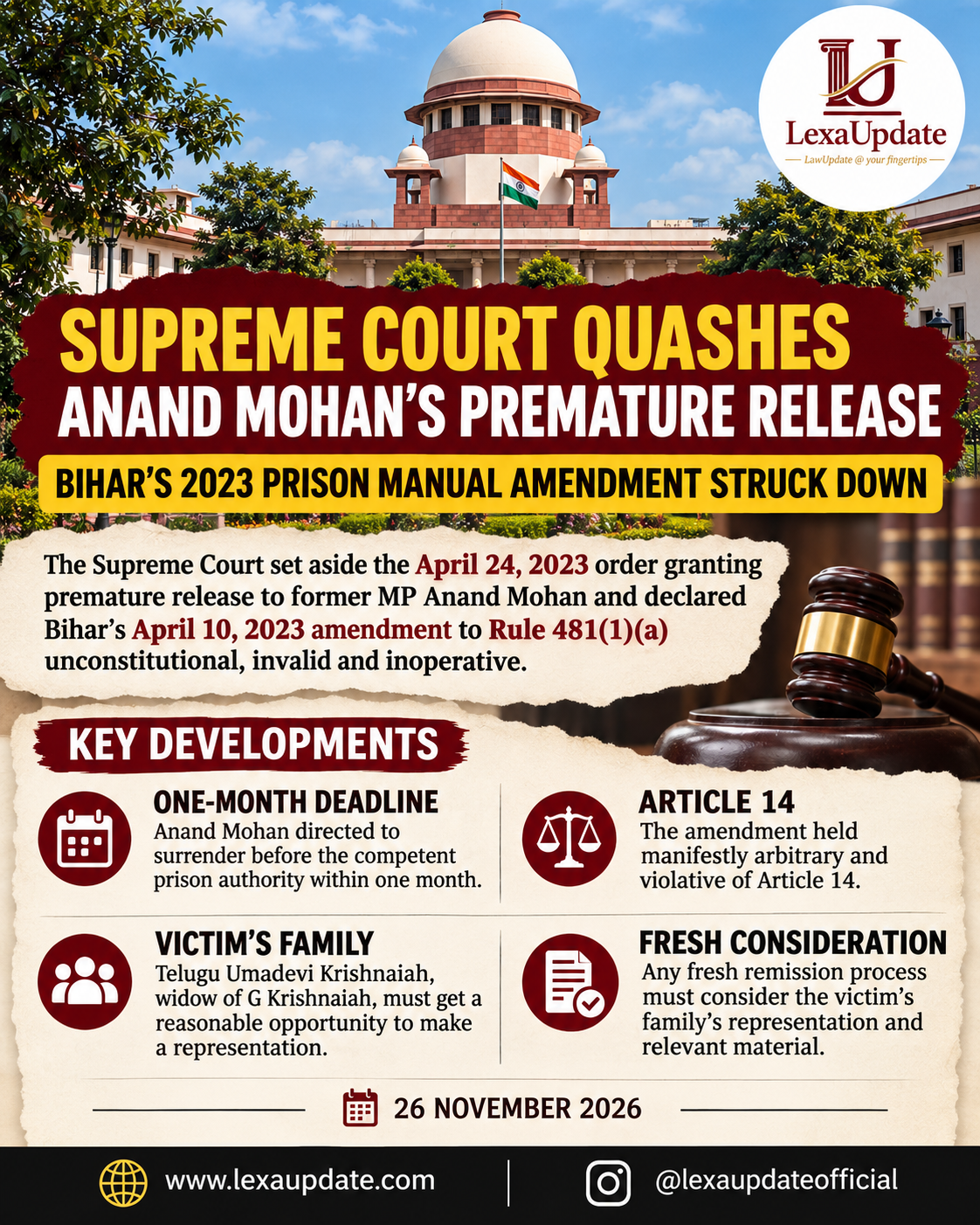
The Supreme Court of India has quashed the premature release of former Member of Parliament and political strongman Anand Mohan, who was serving a life sentence for his role in the 1994 mob killing of Gopalganj District Magistrate G. Krishnaiah. A Bench comprising Justice Dipankar Datta and Justice Sheel Nagu declared unconstitutional the Bihar government's April 2023 notification, which had amended the state prison manual to facilitate Mohan's release by removing the disqualification for those convicted of murdering public servants on duty.
Pronouncing the judgment, the Apex Court directed Anand Mohan to surrender before the competent prison authorities within one month, failing which steps must be taken to take him into custody. The Bench ruled that any fresh consideration of remission or future amendments to the relevant prison rules cannot be initiated until Mohan has formally surrendered or been returned to custody.
Background and Facts
The case stems from the tragic assassination of G. Krishnaiah, an Indian Administrative Service (IAS) officer and District Magistrate of Gopalganj, who was lynched by a mob in 1994. Anand Mohan was convicted for his involvement in the murder and sentenced to life imprisonment. After serving over a decade in prison, his path to freedom was paved when the State of Bihar amended Rule 481(1)(a) of the Bihar Prison Manual, 2012, on April 10, 2023. The amendment deleted the provision barring convicts who murder public servants from availing of premature release or remission. Consequently, an order dated April 24, 2023, granted Mohan premature freedom, triggering widespread legal challenges.
The validity of the release was challenged under Article 32 of the Constitution through a writ petition filed by Uma Krishnaiah, the widow of the slain IAS officer, who argued that the executive action was arbitrary, mala fide, and designed solely to benefit a politically connected individual.
Submissions and Proceedings
Counsel for the petitioner argued that the executive cannot arbitrarily alter foundational criminal jurisprudence and prison rules to favor specific convicts, asserting that the amendment undermined the rule of law and violated constitutional equality. It was contended that public servants discharging official duties deserve special protection under the penal framework, and removing such safeguards weakens deterrence.
Conversely, the State of Bihar defended the amendment, maintaining that the executive possesses legitimate discretion to frame and modify prison policies, remission guidelines, and rehabilitation frameworks for long-term inmates.
Court's Reasoning and Directions
In a strongly worded judgment authored by Justice Dipankar Datta, the Supreme Court held that the 2023 amendment was a sudden, unprincipled departure from established norms, devoid of any discernible public purpose or bona fide rationale. The Bench emphasized that the executive's power of remission is not absolute and must be exercised in conformity with constitutional principles, notably Articles 14 (Right to Equality) and 21 (Right to Life and Personal Liberty).
Crucially, the Court observed that Article 21 cannot be interpreted as a one-sided guarantee exclusively safeguarding the rights of convicts. Instead, the constitutional right to life equally encompasses the rights and interests of victims, their grieving families, and society at large.
The Apex Court issued the following operative directions:
- The notification dated April 10, 2023, amending the Bihar Prison Manual, is declared unconstitutional, invalid, and inoperative.
- The release order dated April 24, 2023, granting premature release to Anand Mohan, is quashed.
- Anand Mohan must surrender to prison authorities within one month.
- Any future process by the state to revise or amend Rule 481 or consider remission must not be initiated prior to his surrender or custody.
Why This Case Matters
This landmark judgment reinforces crucial boundaries on executive clemency and prison remission powers in India. By firmly establishing that executive rule-changes cannot be tailored arbitrarily to benefit politically influential convicts, the Supreme Court has safeguarded the integrity of criminal justice delivery. Furthermore, the ruling elevates the constitutional standing of crime victims, affirming that the justice system must balance the reformative rights of prisoners with the societal imperative of accountability and the protection of public servants.
Key Takeaways
Supreme Court Intervention: The Apex Court struck down Bihar's April 2023 prison manual amendment as arbitrary and unconstitutional.
Surrender Mandate: Former MP Anand Mohan has been ordered to surrender within one month.
Victims' Rights: The Court underscored that Article 21 protects society and victims alongside convicts.
Remission Limits: Future remission reviews are barred until the convict returns to custody.
Case Details
| Case Name | Telugu Umadevi Krishnaiah v. State of Bihar & Ors. |
| Court | Supreme Court of India |
| Bench | Justice Dipankar Datta and Justice Sheel Nagu |
| Case Number | Writ Petition under Article 32 |
| Date of Order | November 26, 2026 |
| Relevant Provisions | Articles 14 and 21 of the Constitution of India; Bihar Prison Manual, 2012 (Rule 481) |
| Next Hearing | Not Applicable (Disposed of with directions) |