
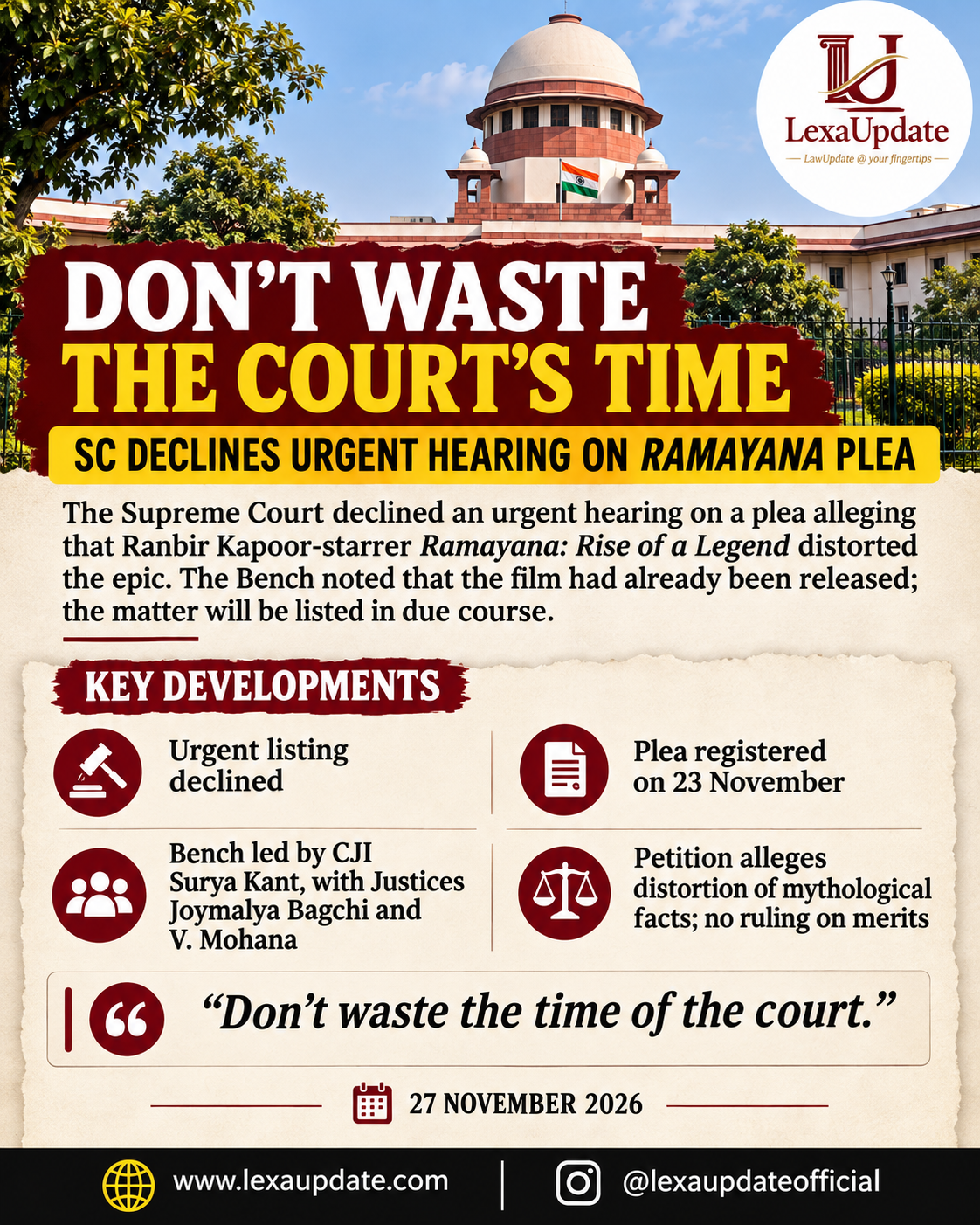
The Supreme Court of India has firmly declined an urgent listing for a petition challenging the theatrical screening and creative portrayal of the epic in the film Ramayana: Rise of a Legend (also referred to as Ramayana: Part 1). Emphasizing that judicial intervention was unwarranted given the commercial release and widespread public screening of the film, the bench noted that those aggrieved by its narrative interpretation are legally and creatively free to produce their own cinematic adaptations.
During the mentioning proceedings, a three-judge bench comprising Chief Justice of India Surya Kant, Justice Joymalya Bagchi, and Justice V Mohana addressed the petitioner's urgent plea, which had been registered on November 23. While the petitioner's counsel pressed for an expedited trial and urgent judicial scrutiny over alleged factual and mythological distortions, the apex court rejected the urgency, stating that the petition would be listed in due course according to standard judicial timelines.
Background and Facts
Directed by Nitesh Tiwari and produced by Namit Malhotra alongside Yash, Ramayana: Part 1 is a high-profile mythological cinematic adaptation arriving in theatres on November 5, 2026. The film features a prominent star cast, including Ranbir Kapoor as Lord Rama, Sai Pallavi as Goddess Sita, and Yash as Ravana. Following its commercial release, the film garnered immense box-office success, approaching the Rs 1,000-crore milestone domestically and globally. Amid its theatrical run, a petitioner approached the Supreme Court seeking urgent legal redress, alleging that the cinematic depiction contained factual distortions capable of influencing younger audiences.
Submissions and Proceedings
Advancing the petitioner's case, counsel argued that the movie presented a skewed and inaccurate version of the revered Hindu epic, urging the bench to accord priority and list the matter urgently. The lawyer maintained that judicial oversight was necessary to address potential cultural or factual misrepresentations before younger viewers. However, the bench remained unconvinced by the necessity for expedited intervention, pointing directly to the accomplished public release of the film.
Court's Reasoning and Observations
Chief Justice Surya Kant observed that because the film had already hit cinema halls and been widely viewed by the public, the element of urgency required for an out-of-turn hearing no longer existed. Expanding on the freedom of artistic expression and interpretation, Justice Joymalya Bagchi remarked that creative practitioners possess the liberty to interpret ancient epics through their own understanding. Delivering a sharp oral observation, Justice Bagchi stated, "They made a movie as they understand, you make a movie as you understand. Don't waste the time of the court. If you have a counter view about the epic, make a movie based on that." The bench underscored that alternative viewpoints regarding cultural epics are best expressed through creative and artistic mediums rather than through expedited litigation.
Why This Case Matters
This oral observation by the Supreme Court reinforces the robust legal boundaries surrounding creative freedom and artistic interpretation in India. By refusing to fast-track petitions seeking judicial censorship or alterations of released artistic works, the apex court discourages using public interest or civil litigation as a mechanism for appellate review of creative content. The ruling signals that courts will prioritize established procedural timelines and protect artistic autonomy, leaving debates over mythological interpretations to public discourse and counter-creative expression.
Key Takeaways
- Urgent Listing Denied: The Supreme Court refused to expedite the petition challenging the film, noting that the movie was already widely released and viewed.
- Freedom of Artistic Interpretation: The bench affirmed that filmmakers hold the right to interpret epics and mythological texts according to their own perspective.
- Judicial Economy: The court cautioned litigants against filing unurgent petitions over creative works, famously advising critics to express differing views through their own artistic projects.
- Standard Listing: The petition was not dismissed outright on merits but was relegated to be listed in due course under ordinary judicial management.
Case Details
| Plea challenging the screening and portrayal in Ramayana: Part 1 |
| Supreme Court of India |
| Chief Justice Surya Kant, Justice Joymalya Bagchi, and Justice V Mohana |
| November 27, 2026 |
| Constitutional principles of Artistic Freedom and Free Speech under Article 19(1)(a) |
| To be listed in due course |