
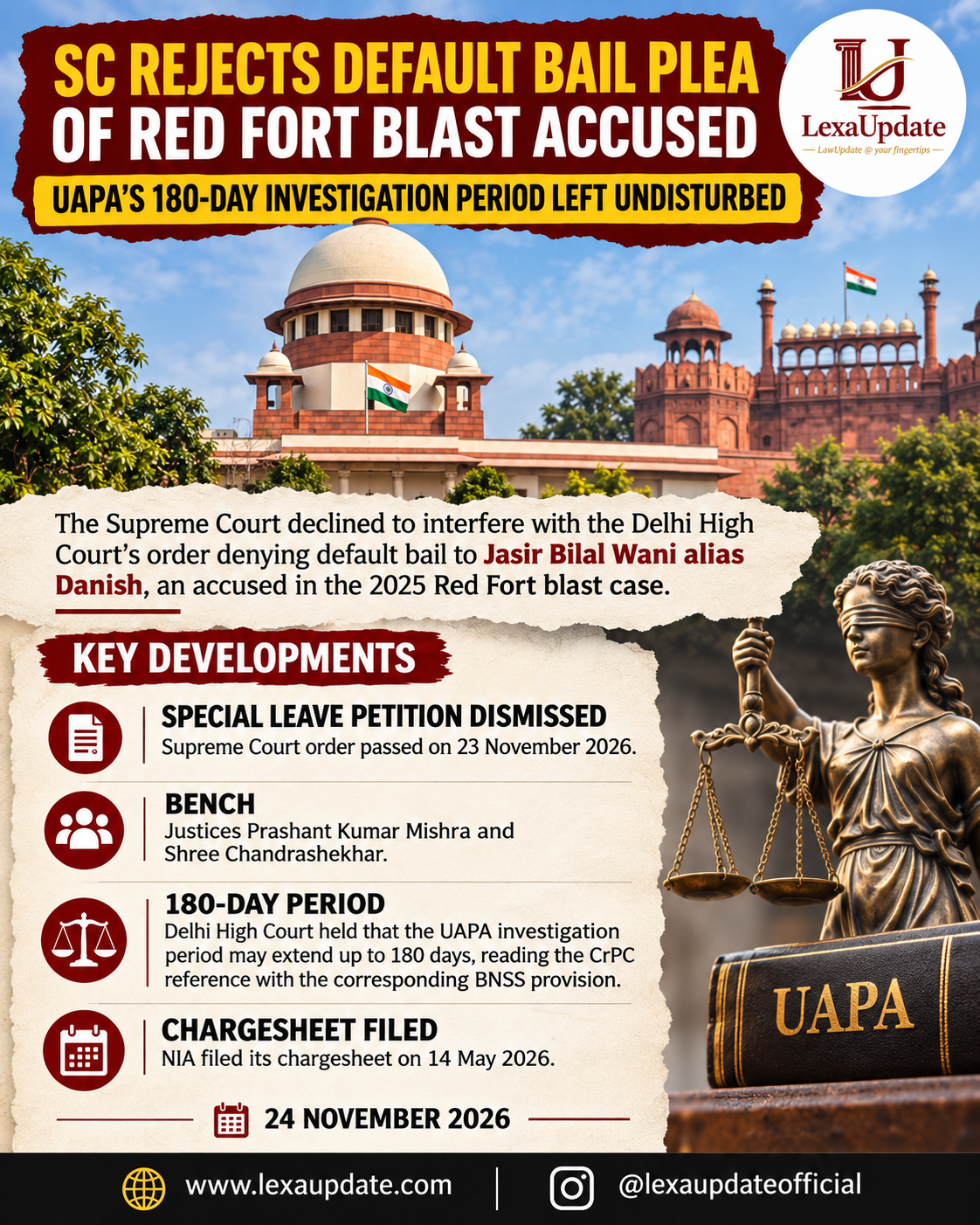
The Supreme Court of India on 23 November 2026 dismissed a special leave petition filed by Jasir Bilal Wani alias Danish, an accused in the 2025 Red Fort car‑bomb blast, thereby upholding the Delhi High Court’s order that denies him default bail.
The apex court’s two‑judge bench, comprising Justice Prashant Kumar Mishra and Justice Shree Chandrashekhar, affirmed that the Unlawful Activities (Prevention) Act (UAPA) permits an investigation period of up to 180 days, subject to the statutory conditions, and found no merit in the petitioner’s challenge.
Background and Facts
On 10 November 2025 a Hyundai i20 exploded near Delhi’s Red Fort, killing 15 people and injuring several others. The National Investigation Agency (NIA) arrested Jasir Bilal Wani on 17 November 2025, alleging that he provided technical assistance to the perpetrators, including drone modification and rocket‑making activities. The agency also linked him to Umar un Nabi, identified as the suicide bomber.
Wani sought default bail after 90 days of detention, invoking the provisions of the Code of Criminal Procedure (CrPC) as incorporated in Section 43D of the UAPA. The Delhi trial court denied the bail application on 30 March 2026, and the Delhi High Court affirmed that decision on 18 August 2026, holding that the UAPA, being a special law dealing with terrorism, allows an investigation period of up to 180 days, which supersedes the general 90‑day rule.
Submissions & Proceedings
Senior Advocate Warisha Farasat, appearing for Wani, argued that Section 43D of the UAPA merely incorporates the CrPC provisions and therefore the 90‑day default‑bail threshold should apply. She further contended that the Delhi High Court’s interpretation was inconsistent because it treated the UAPA as a law “by incorporation” in one instance and “by reference” in another, thereby depriving the accused of a timely bail opportunity.
The Union of India, represented by counsel from the Attorney General’s Office, maintained that the statutory language of the UAPA expressly authorises a longer investigation window for offences of a terrorist nature, and that the High Court’s construction was consistent with parliamentary intent.
Court's Reasoning & Directions
Justice Mishra and Justice Chandrashekhar observed that the UAPA is a special enactment designed to address grave threats to national security. Section 43D, they noted, expressly provides for an investigation period of up to 180 days, subject to the conditions laid down in the statute. The bench held that the provision does not merely import the CrPC’s 90‑day rule but creates a distinct, longer timeframe for terrorism‑related investigations.
The Supreme Court found no error in the Delhi High Court’s reasoning and consequently dismissed the special leave petition. No operative direction was issued beyond the affirmation that the accused remains in custody pending the conclusion of the investigation and trial.
Why This Case Matters
The decision clarifies the ambit of Section 43D of the UAPA, confirming that the legislature intended a 180‑day investigation period for serious terrorism offences. It signals to investigative agencies that extensions beyond 90 days are permissible, provided statutory safeguards are observed. For defence practitioners, the ruling underscores the limited scope for default‑bail applications in UAPA cases, reinforcing the need to challenge detention on grounds other than the mere expiry of the initial 90‑day period.
Key Takeaways
- The Supreme Court upheld the Delhi High Court’s denial of default bail for a Red Fort blast accused.
- Section 43D of the UAPA authorises an investigation period of up to 180 days, superseding the general 90‑day rule.
- Default bail cannot be claimed solely on the basis of the 90‑day lapse when the case falls under the UAPA.
- The decision reinforces the special‑law hierarchy, where UAPA provisions prevail over the general CrPC framework.
Case Details
| Case Name | Jasir Bilal Wani alias Danish v. State (UAPA) |
| Court | Supreme Court of India |
| Bench | Justice Prashant Kumar Mishra and Justice Shree Chandrashekhar |
| Case Citation | N/A |
| Date of Order | 23 November 2026 |
| Relevant Provisions | UAPA Sec. 43D (180‑day investigation period) |
| Next Hearing | Not specified |