
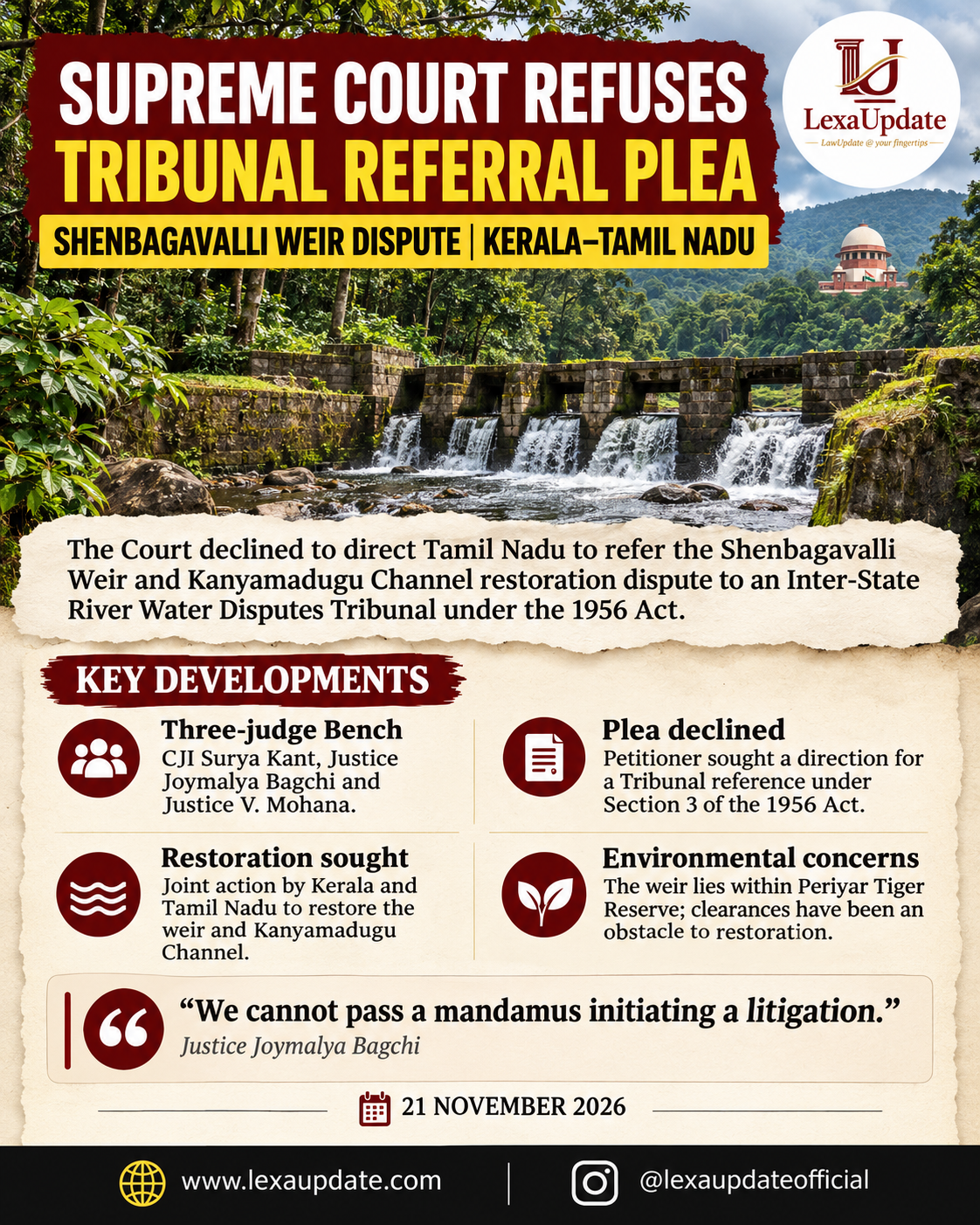
The Supreme Court of India has dismissed a public interest litigation seeking to refer the long‑standing Shenbagavalli Weir dispute between the states of Kerala and Tamil Nadu to the Inter‑State River Disputes Tribunal (ISRT). The Court held that the matter should be resolved through existing constitutional mechanisms and bilateral negotiations, rather than by invoking the Tribunal.
The order, delivered on 21 November 2026, directs the parties to continue dialogue under the framework of the Inter‑State River Water Disputes Act, 1956 and Article 262 of the Constitution, and reserves the Court’s jurisdiction to intervene only if the states fail to reach a settlement.
Background and Facts
The Shenbagavalli Weir, located on the Shenbagavalli River that flows from Kerala into Tamil Nadu, was constructed in the early 20th century to divert water for irrigation. Over the decades, differing interpretations of water‑allocation rights have led to periodic disputes. Kerala alleges that Tamil Nadu’s downstream usage and alleged encroachments have reduced the flow, affecting agricultural lands in the Kasaragod district. Tamil Nadu contends that the weir’s operation complies with the 1956 water‑sharing agreement and that any restoration work must respect its own water‑needs.
In 2025, a consortium of farmers and environmental groups filed a PIL before the Supreme Court, urging the Court to refer the controversy to the ISRT, a specialised body established under the Inter‑State River Water Disputes Act to adjudicate inter‑state river matters.
Submissions & Proceedings
Representing Kerala, counsel argued that the existing mechanisms had stalled and that the ISRT, with its technical expertise, was the appropriate forum to determine the equitable distribution of water and to order the restoration of the weir. The petitioners also highlighted alleged violations of the 1956 Act and sought a direction for the Tribunal to enforce a fresh water‑sharing scheme.
Tamil Nadu’s counsel countered that the dispute was already covered by the 1956 Act and that the Supreme Court’s intervention would be premature. They emphasized that the states were engaged in ongoing negotiations and that referral to the ISRT could exacerbate tensions. The counsel further submitted that the Court should first ensure that the parties exhaust the statutory conciliation process before invoking the Tribunal.
Court's Reasoning & Directions
The Court observed that the Inter‑State River Water Disputes Act expressly provides a step‑wise mechanism: first, the states must attempt a settlement; failing that, the matter may be referred to the ISRT. The bench noted that the parties had not demonstrated a failure of the conciliation process, and therefore the prerequisite for referral was absent.
In its order, the Court:
- Dismissed the PIL seeking immediate referral to the ISRT.
- Directed both states to continue negotiations within the framework of the 1956 Act and to submit a joint status‑report to the Court within three months.
- Stated that the Court would entertain a fresh application for referral only if the states fail to reach an agreement within the stipulated period.
- Emphasised that any unilateral restoration work on the weir must not prejudice the rights of the other state.
The judgment underscored the constitutional balance between federal cooperation and judicial oversight, reaffirming that the Supreme Court acts as a guardian of the process rather than a substitute for specialised tribunals.
Why This Case Matters
The decision clarifies the procedural threshold for invoking the Inter‑State River Disputes Tribunal, reinforcing the statutory hierarchy that favours inter‑state dialogue before adjudication. It signals to litigants that the Supreme Court will not bypass the conciliation stage, thereby preserving the Tribunal’s role as a specialised, technical forum. For water‑scarce regions, the order highlights the importance of cooperative federalism in managing shared river resources, a matter increasingly critical amid climate change and growing demand.
Key Takeaways
- The Supreme Court rejected a plea to refer the Shenbagavalli Weir dispute to the ISRT.
- States must continue negotiations under the Inter‑State River Water Disputes Act, 1956.
- A joint status‑report is to be filed within three months.
- Referral to the Tribunal remains possible only after a demonstrable failure of conciliation.
- The order preserves the constitutional balance between federal cooperation and judicial intervention.
Case Details
| Case Name | Kerala v. Tamil Nadu (Shenbagavalli Weir dispute) |
| Court | Supreme Court of India |
| Bench | Not specified |
| Case Citation | N/A |
| Date of Order | 21 November 2026 |
| Relevant Provisions | Inter‑State River Water Disputes Act, 1956; Article 262 of the Constitution of India |
| Next Hearing | Joint status‑report due within three months (by 21 February 2027) |