
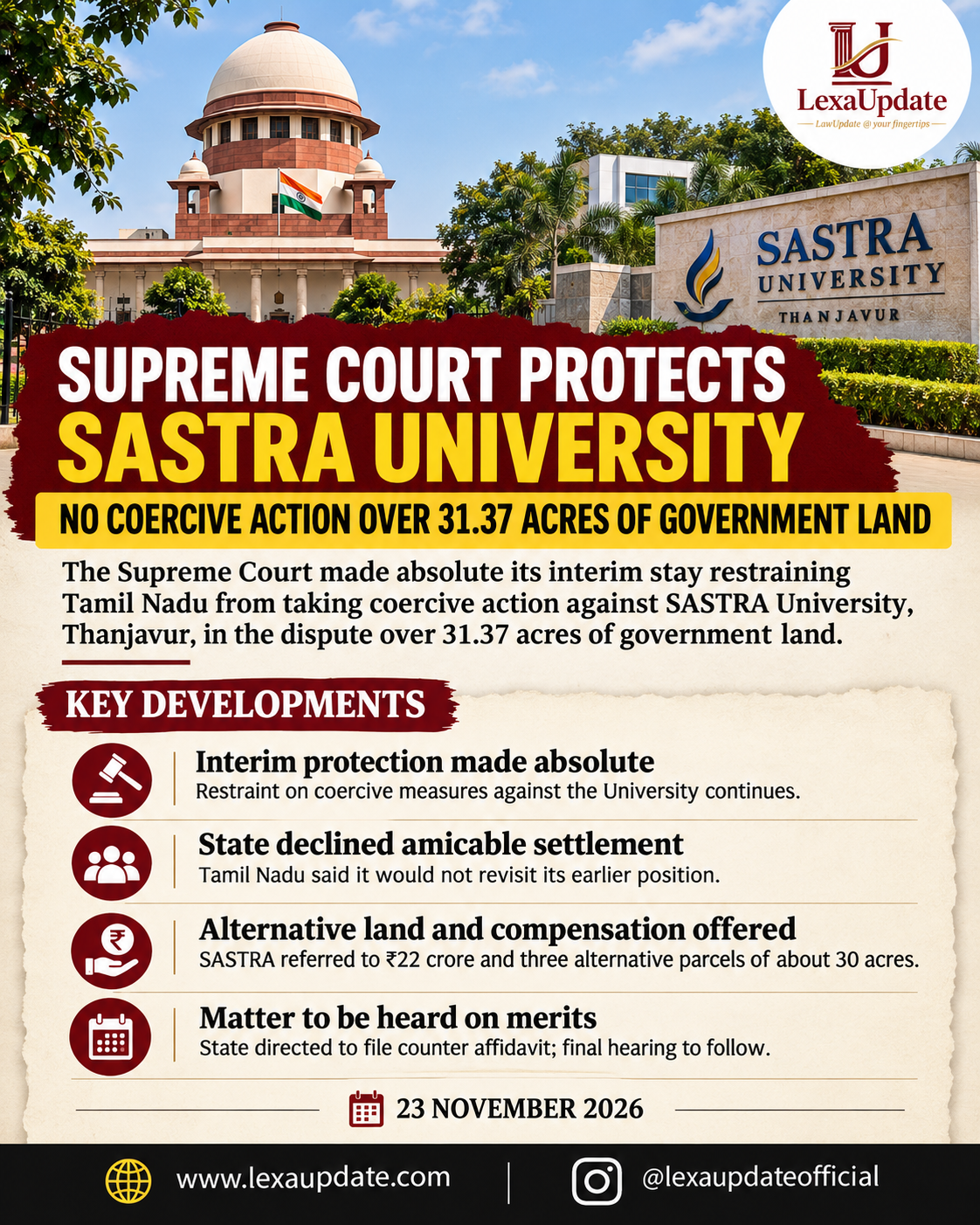
The Supreme Court of India has granted major interim relief to SASTRA University, restraining the Tamil Nadu government from taking any coercive steps against the institution over a disputed parcel of government land. A bench comprising Chief Justice of India Surya Kant, Justice Joymalya Bagchi, and Justice V Mohana made its earlier interim protection absolute, ensuring that the university remains shielded from eviction pending the final disposal of the matter.
The apex court's directive comes amidst an ongoing legal tussle concerning approximately 31.37 acres of land situated in Thirumalaisamudram village within the Thanjavur district. With the court making the stay absolute, the legal proceedings will now move forward toward a comprehensive final hearing to resolve the long-standing dispute.
Background and Facts
The genesis of the litigation dates back to the allocation of 31.37 acres of land in Thirumalaisamudram village to the State Prison Department for the establishment of an open-air jail facility. According to the Tamil Nadu government, the land was subsequently encroached upon by SASTRA University, a prominent deemed-to-be university, which allegedly raised permanent constructions and academic blocks upon the property.
In response to the alleged encroachment, the state administration initiated formal eviction proceedings invoking the provisions of the Tamil Nadu Land Encroachment Act, 1905. SASTRA University challenged these coercive measures, maintaining that the land in question is utilized for educational purposes serving the public good. The institution repeatedly proposed offering alternative land parcels of equivalent value or compensating the state exchequer at prevailing market rates. However, these proposals were rejected by the state government, which contended that accepting land swaps for alleged encroachments would establish an undesirable administrative precedent.
Submissions & Proceedings
During the proceedings before the Supreme Court, senior advocates Mukul Rohatgi and Abhishek Manu Singhvi, appearing for SASTRA University, reiterated the institution's willingness to amicably resolve the issue by providing alternative parcels of land or paying the full market valuation to prevent any financial loss to the public exchequer.
Conversely, senior advocate Jaideep Gupta, representing the State of Tamil Nadu, firmly opposed any settlement negotiations. Counsel submitted that the state intends to reclaim the entire land holding for its original public purpose and emphasized that the university is currently occupying a substantial area of government property without legal title, maintaining opposition to the alternative land proposals.
Court's Reasoning & Directions
The Supreme Court noted that while illegal encroachments cannot be lightly condoned, a measured and balanced judicial approach is warranted when educational institutions serving a broad public utility are involved. Previously, the bench had observed that the alternative proposals put forth by the university deserved sympathetic consideration, provided there was no resulting loss to the public exchequer and the state's prison projects were not compromised. Having evaluated the competing contentions, the bench confirmed its earlier stay on the Madras High Court's adverse ruling and restrained the state from executing any coercive eviction measures.
Why This Case Matters
This case highlights the complex interplay between state-owned public land management and the operational continuity of major educational infrastructure. It underscores the judiciary's role in balancing strict enforcement of land encroachment statutes against the broader societal utility of academic institutions, while carefully safeguarding public revenues through market-value assessments and alternative land swaps.
Key Takeaways
- Interim Protection Made Absolute: The Supreme Court finalized its earlier stay, barring the Tamil Nadu government from taking coercive steps against SASTRA University.
- Disputed Land Allocation: The litigation centers on 31.37 acres in Thanjavur originally earmarked for a state prison facility.
- Statutory Framework: Proceedings were initiated under the Tamil Nadu Land Encroachment Act, 1905.
- Next Steps: The matter has been formally listed for a comprehensive final hearing before the apex court.