
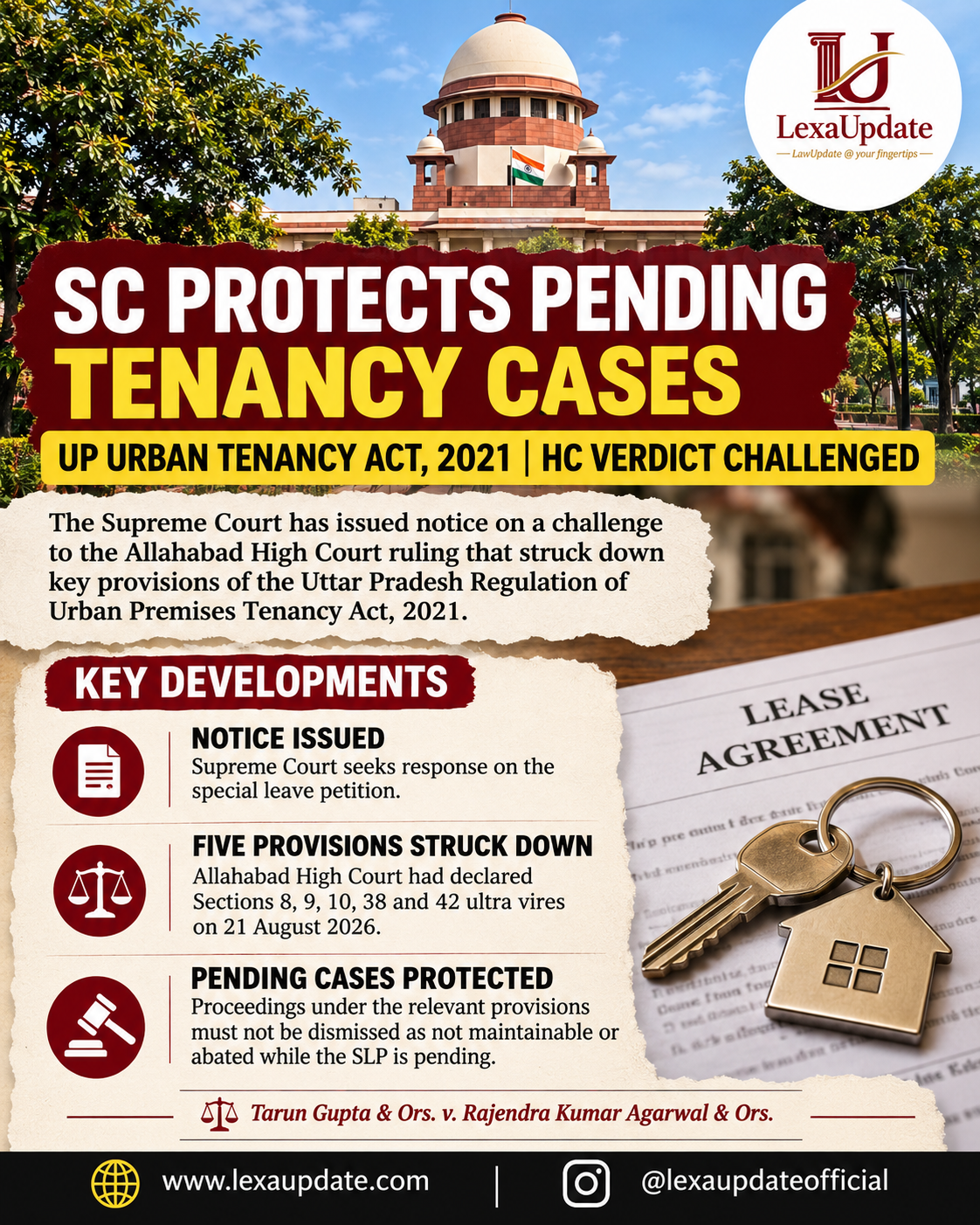
The Supreme Court of India has listed for hearing a petition that challenges the Allahabad High Court’s judgment striking down key provisions of the Uttar Pradesh Urban Tenancy Act, 2021. The apex court will also consider whether the numerous petitions pending before the High Court should be dismissed or retained.
The matter was placed before a bench on 20 November 2026, with the Court directing the parties to file further affidavits on the constitutional dimensions of the Act. An interim order on the status of the pending petitions is expected shortly after the hearing.
Background and Facts
The Uttar Pradesh Urban Tenancy Act, 2021 (the “Act”) was enacted to modernise the regulation of residential and commercial tenancies in urban areas of the state. It introduced provisions for rent fixation, security deposits, eviction procedures and a new tenancy registration authority. Tenants’ organisations contended that several clauses violated fundamental rights, particularly the right to livelihood (Article 21) and the freedom to trade and profession (Article 19(1)(g)).
In a landmark judgment, the Allahabad High Court held that the Act’s provisions on compulsory registration and unilateral rent fixation were arbitrary and infringed upon constitutional guarantees. The High Court consequently struck down those provisions and ordered the state to revert to the earlier rent‑control framework.
Submissions & Proceedings
Petitioners (Tenants’ Association of Uttar Pradesh) argued that the Act’s registration requirement created an undue burden, effectively denying tenants the right to occupy property without state interference. They also maintained that the rent‑fixation mechanism denied landlords the freedom to contract, thereby contravening Article 19(1)(g).
Respondent (State of Uttar Pradesh) contended that the Act was a reasonable legislative measure aimed at protecting vulnerable tenants and ensuring transparent rent practices. The State argued that the provisions fell within the permissible scope of the State’s police power and did not amount to arbitrary restriction.
The High Court, while agreeing with the petitioners on the constitutional infirmities, limited its order to striking down the contested provisions and refrained from commenting on the pending petitions filed by other tenants and landlords.
Court's Reasoning & Directions
The Supreme Court, in its order dated 20 November 2026, noted that the issue raises “substantial questions of law” concerning the balance between regulatory objectives and fundamental rights. The Court directed both parties to file supplementary affidavits within 30 days, specifically addressing:
- The proportionality test under Article 14.
- The impact of the registration clause on the right to livelihood.
- Whether the rent‑fixation mechanism can be calibrated to satisfy both tenant protection and landlord freedom.
The apex court also stayed the High Court’s order of dismissal of the pending petitions, pending a detailed examination of the submissions.
Why This Case Matters
The judgment will shape the future of tenancy regulation not only in Uttar Pradesh but across India, where several states are contemplating similar reforms. A definitive ruling on the constitutional validity of registration and rent‑fixation clauses could set a precedent for balancing social welfare legislation with individual economic freedoms. Moreover, the decision will affect thousands of urban tenants and landlords who rely on clear, enforceable tenancy norms.
Key Takeaways
- Supreme Court to hear challenge to Uttar Pradesh Urban Tenancy Act, 2021.
- High Court’s striking‑down of registration and rent‑fixation provisions is under review.
- Pending petitions will not be dismissed pending Supreme Court’s detailed analysis.
- The case tests the interplay between regulatory policy and Articles 14, 19(1)(g) and 21 of the Constitution.
- Outcome will influence tenancy law reforms nationwide.
Case Details
| Case Name | Tenants' Association of Uttar Pradesh v. State of Uttar Pradesh |
| Court | Supreme Court of India |
| Bench | Bench to be constituted (judges to be announced) |
| Case Citation | — |
| Date of Order | 20 November 2026 |
| Relevant Provisions | Constitution of India Articles 14, 19(1)(g), 21; Uttar Pradesh Urban Tenancy Act, 2021 (selected clauses) |
| Next Hearing | Affidavits due by 20 December 2026; substantive hearing scheduled for early 2027 |