
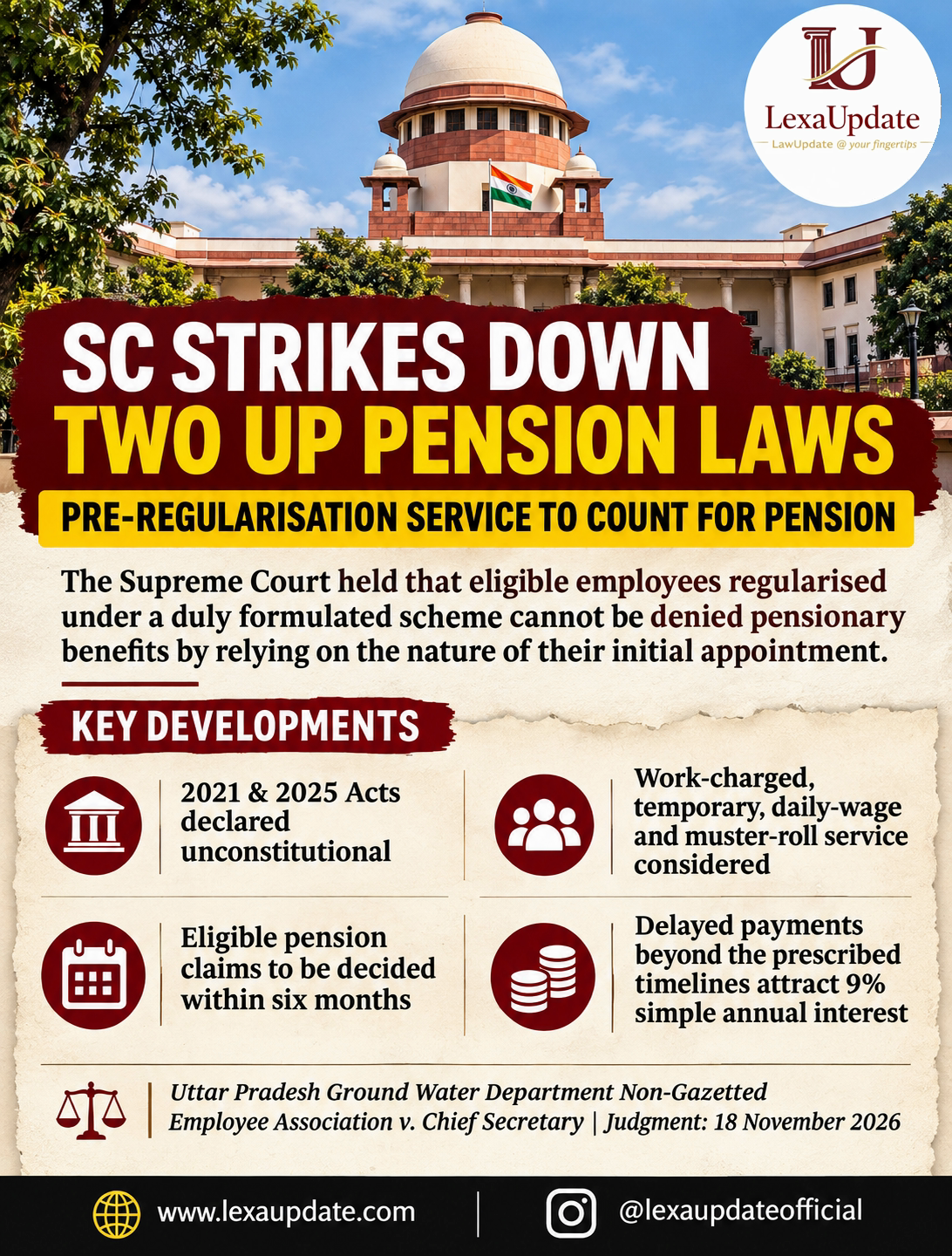
The Supreme Court of India today declared the Uttar Pradesh Qualifying Service for Pension and Validation Act, 2021 and the Uttar Pradesh Entitlement to Pension and Validation Act, 2025 unconstitutional, thereby restoring pension entitlement for employees who had been regularised after initial non‑regular appointments.
In a judgment delivered on 18 November 2026 by a bench of Justices Dipankar Datta and Satish Chandra Sharma, the Court held that a retrospective law cannot strip a vested right that arose when an employee was regularised, and directed the state to adjudicate pending pension claims within six months.
Background and Facts
The dispute stems from the 2019 Supreme Court ruling in Prem Singh v. State of Uttar Pradesh, which held that work‑charged, temporary, daily‑wage or muster‑roll service must count towards qualifying service for pension. In response, the Uttar Pradesh legislature enacted the 2021 and 2025 pension statutes, both applying retrospectively from 1 April 1961, redefining qualifying service and introducing the category of “substantive appointee”. These provisions effectively excluded pre‑regularisation service from pension calculations.
Employees and their associations, represented by the Uttar Pradesh Ground Water Department Non‑Gazetted Employee Association (Regd.) & Anr., challenged the statutes, arguing that they violated constitutional guarantees of equality, non‑discrimination and life‑and‑freedom.
Submissions & Proceedings
Applicants contended that the statutes created a “class within a class”, denying pension credit to a segment of regularised employees and thereby contravening Articles 14, 16 and 21 of the Constitution. They also argued that the legislature could not retroactively alter the status of employees without removing the legal defect identified in Prem Singh.
Responding parties maintained that the statutes were necessary to clarify pension eligibility and to rectify administrative ambiguities, and that the retrospective application was justified under the doctrine of legislative intent.
Court's Reasoning & Directions
The Court observed that regularisation erases the “birthmark” of the initial appointment, bringing the employee into the regular establishment. It held that a law enacted after regularisation cannot resurrect the pre‑regularisation status to deny pension benefits, as this would be opposed to Articles 14, 16 and 21.
Further, the Court noted that merely changing statutory definitions without eliminating the defect identified in Prem Singh is insufficient. The legislature could validate past actions only by removing the legal defect, not by re‑labeling excluded categories.
Accordingly, the Court struck down the two Uttar Pradesh statutes and issued the following directions:
- Eligible retirees or their heirs may file pension claims with full service particulars.
- Authorities must decide claims within six months of receipt and grant benefits where due.
- Pension arrears are capped at three years preceding the Prem Singh petition, except for heirs of employees who retired and died before the 2019 judgment.
- Claims rejected after a hearing must be accompanied by a reasoned order.
- Delayed payments beyond the prescribed deadlines will attract 9 % simple interest per annum.
- The State has a final six months to comply with the Court’s directions or face contempt proceedings.
Why This Case Matters
By reaffirming that regularisation erases pre‑regular appointment status, the Court protects the vested rights of a large cohort of public servants and sets a precedent against retrospective legislative amendments that undermine constitutional guarantees. The decision also clarifies the scope of Article 14’s equality principle in the context of pension eligibility.
Key Takeaways
- UP 2021 and 2025 pension laws struck down as unconstitutional.
- Regularised employees can now count pre‑regularisation service for pension.
- Claims must be adjudicated within six months; arrears capped at three years.
- Delayed payments attract 9 % simple interest.
- State faces contempt risk if it fails to comply within six months.
Case Details
| Case Name | Uttar Pradesh Ground Water Department Non‑Gazetted Employee Association (Regd.) & Anr. v. The Chief Secretary & Ors. |
| Court | Supreme Court of India |
| Bench | Justices Dipankar Datta & Satish Chandra Sharma |
| Case Citation | 2026‑11‑18 (Judgment) |
| Date of Order | 18 November 2026 |
| Relevant Provisions | Article 14, 16, 21; UP Qualifying Service for Pension and Validation Act, 2021; UP Entitlement to Pension and Validation Act, 2025; Prem Singh (2019) |