
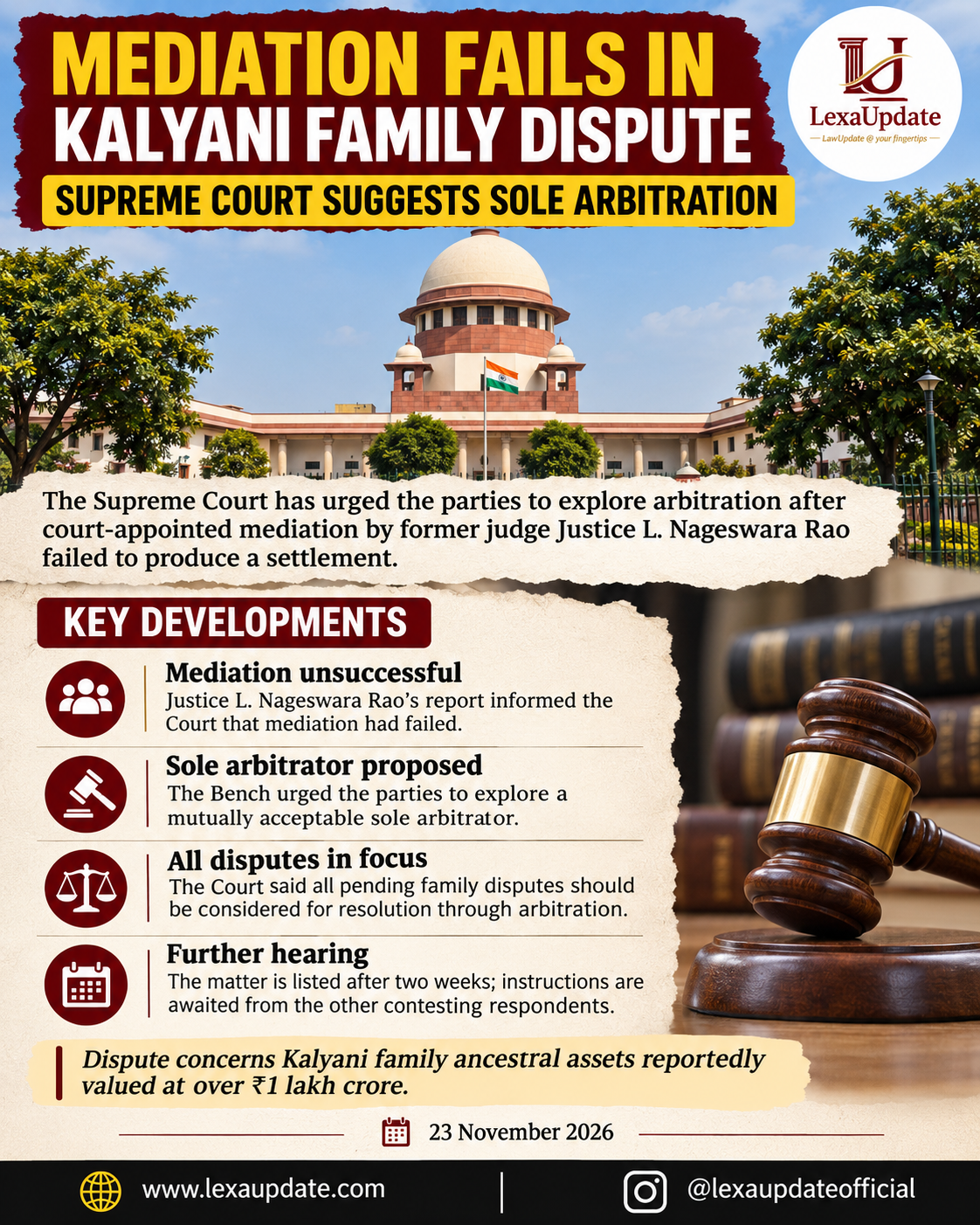
The Supreme Court of India has urged the parties to the long‑running Kalyani family dispute to explore arbitration after a court‑appointed mediation led by former Justice L Nageswara Rao failed to produce a settlement.
The three‑judge bench, comprising Chief Justice of India Surya Kant, Justice Joymalya Bagchi and Justice V Mohana, directed the litigants to consider a single‑forum arbitration and scheduled the matter for further hearing in two weeks.
Background and Facts
The dispute centres on a purported 1994 family arrangement that allegedly governs the division of assets among members of the Kalyani‑Hiremath business family. Sugandha Hiremath, sister of industrialist Babasaheb Neelkanth Kalyani, claims the arrangement mandates the transfer of shares held by Kalyani‑controlled entities in the listed specialty‑chemicals firm Hikal Limited to the Hiremath side. At present the Hiremath family controls roughly 34.84 % of Hikal, while Kalyani Investment Company Limited and BF Investment Limited hold about 34.01 %. Enforcing the alleged agreement would raise the Hiremath holding to approximately 68.85 %, conferring majority voting rights.
Babasaheb Kalyani disputes the existence, validity and enforceability of the 1994 arrangement. The litigation has since broadened to include claims over ancestral wealth, Hindu Undivided Family (HUF) assets, real‑estate holdings and shareholdings in other group companies such as Bharat Forge. Other members of the Kalyani clan, including Gaurishankar Kalyani, are also parties.
Earlier attempts at mediation before the Pune District Court collapsed. In May 2026 the Bombay High Court declined to compel mediation, observing that the process is voluntary. The Hiremath family appealed that decision to the Supreme Court, which on 13 July 2026 appointed retired Justice L Nageswara Rao as mediator for a fresh settlement effort.
Submissions & Proceedings
Senior Advocate Neeraj Kishan Kaul, appearing for one of the family members, welcomed the Court’s suggestion and indicated his client’s willingness to consider arbitration. Counsel for the petitioner sought a short adjournment to obtain further instructions from the parties. No party objected to the notion of a neutral arbitrator, although the precise mechanism for selecting such an arbitrator remains to be finalised.
Court's Reasoning & Directions
While the bench did not pass on the merits of the underlying claims, it stressed the practical advantages of resolving all pending disputes in a single arbitration proceeding rather than fragmenting the litigation across multiple courts and tribunals. The Court observed orally, “This is, after all, a family dispute. We can suggest some names to which possibly none of you should have any objection.” By proposing to supply a list of potential arbitrators, the Court signalled its willingness to facilitate a consensual, binding resolution.
The judges also reminded the parties that arbitration, unlike mediation, yields a final award that can be enforced as a decree under the Arbitration and Conciliation Act, 1996. However, they underscored that any arbitration must be predicated on the parties’ agreement; the Court can only suggest, not impose, an arbitrator.
The matter was listed for a further hearing after two weeks, at which time the Court expects the parties to either accept the suggested arbitrators or propose alternatives.
Why This Case Matters
The Kalyani family feud is emblematic of high‑value corporate family disputes in India, where shareholdings in listed entities and control of diversified conglomerates are often contested. The Supreme Court’s push for arbitration highlights a judicial trend favouring alternative dispute resolution (ADR) to curtail protracted, multi‑forum litigation that can destabilise corporate governance and affect market confidence.
Moreover, the Court’s willingness to intervene in the selection of arbitrators may set a precedent for future interventions in complex family‑business disputes, balancing the autonomy of parties with the need for efficient dispute resolution.
Key Takeaways
- The Supreme Court has suggested arbitration as the preferred mode of settlement for the Kalyani‑Hiremath family feud.
- All pending disputes, including shareholding and HUF asset issues, should be consolidated within a single arbitration proceeding.
- The Court may propose neutral arbitrators acceptable to all parties.
- Arbitration offers a binding award enforceable as a decree, unlike mediation which is non‑binding.
- The next hearing is scheduled in two weeks to finalise the arbitration framework.
Case Details
| Case Name | Sugandha Hiremath v. Babasaheb Neelkanth Kalyani & Ors. |
| Court | Supreme Court of India |
| Bench | Chief Justice Surya Kant, Justice Joymalya Bagchi, Justice V Mohana |
| Case Citation | — |
| Date of Order | 23 Nov 2026 |
| Relevant Provisions | Arbitration and Conciliation Act, 1996; Companies Act, 2013 (shareholding provisions) |
| Next Hearing | In two weeks from 23 Nov 2026 (date to be fixed) |