
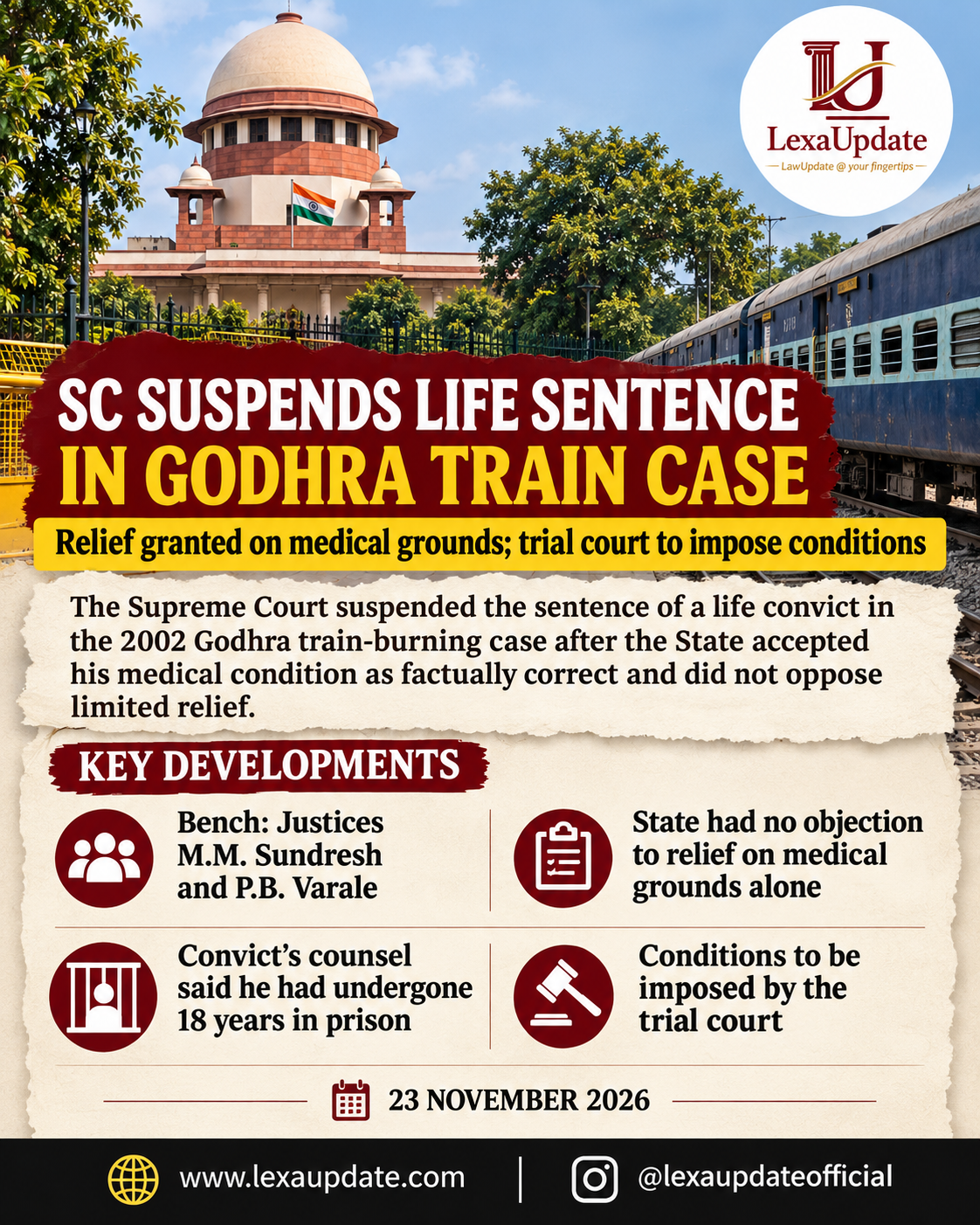
The Supreme Court of India has suspended the life sentence of Irfan Siraj Pada, a convict in the 2002 Godhra train burning case, citing his critical medical condition and a prolonged incarceration exceeding 18 years. A bench comprising Justices MM Sundresh and PB Varale issued the order after the Gujarat state administration formally submitted that it held no objection to the suspension of sentence given the appellant's failing health.
While granting interim relief on medical grounds, the apex court clarified that the suspension of the sentence does not constitute an acquittal or invalidate the underlying conviction. The primary criminal appeal challenging the conviction remains pending adjudication before the Supreme Court.
Background and Facts
The legal proceedings stem from the tragic incident on February 27, 2002, when coach S6 of the Sabarmati Express was set on fire at the Godhra railway station in Gujarat. The attack resulted in the deaths of 59 individuals, predominantly 'kar sevaks' returning from Ayodhya. The incident subsequently triggered widespread communal violence across the state.
In March 2011, a designated special trial court convicted 31 individuals for their involvement in the conspiracy and arson. The trial court imposed the death penalty on 11 convicts and sentenced 20 others to life imprisonment, while acquitting 63 remaining accused persons. On appeal, the Gujarat High Court in 2017 commuted the capital punishment of all 11 convicts to life imprisonment while upholding the life sentences awarded to the remaining 20.
Submissions and Proceedings
During the latest hearing, counsel representing the applicant pressed for suspension of sentence by highlighting the grave medical ailments suffered by the convict, coupled with the long period spent behind bars. The State of Gujarat, appearing through its counsel, acknowledged the gravity of the offences involved but adopted a pragmatic stance, stating that the government would not oppose the plea for temporary relief given the verified medical reports.
Court's Reasoning and Directions
The bench evaluated the twin factors of advanced incarceration period—having served over 18 years—and the deteriorating health status of the applicant. Noting the concession made by the state machinery, the Supreme Court exercised its discretionary jurisdiction to suspend the execution of the life sentence. The Court ensured that the suspension remains strictly tethered to health considerations without expressing any final view on the merits of the pending criminal appeal.
Why This Case Matters
This ruling reinforces the constitutional jurisprudence surrounding personal liberty under Article 21 of the Constitution of India, affirming that prolonged incarceration paired with critical illness can warrant the suspension of a life sentence pending appeal. It underscores that humanitarian considerations and healthcare rights apply even to individuals convicted of heinous offences, without compromising the final judicial determination of guilt.
Key Takeaways
- Sentence Suspended: Life sentence of Godhra train burning convict Irfan Siraj Pada suspended on medical grounds.
- Long Incarceration: The applicant had already served over 18 years in prison.
- State Stand: The Gujarat government did not contest the plea for suspension considering the health status.
- Appeal Pending: The relief is interim; the substantive criminal appeal against conviction remains pending before the Supreme Court.
Case Details
| Case Name | Irfan Siraj Pada v. State of Gujarat |
| Court | Supreme Court of India |
| Bench | Justices MM Sundresh and PB Varale |
| Date of Order | November 23, 2026 |
| Relevant Provisions | Code of Criminal Procedure (CrPC) / Bharatiya Nagarik Suraksha Sanhita (BNSS) relating to suspension of sentence pending appeal |