
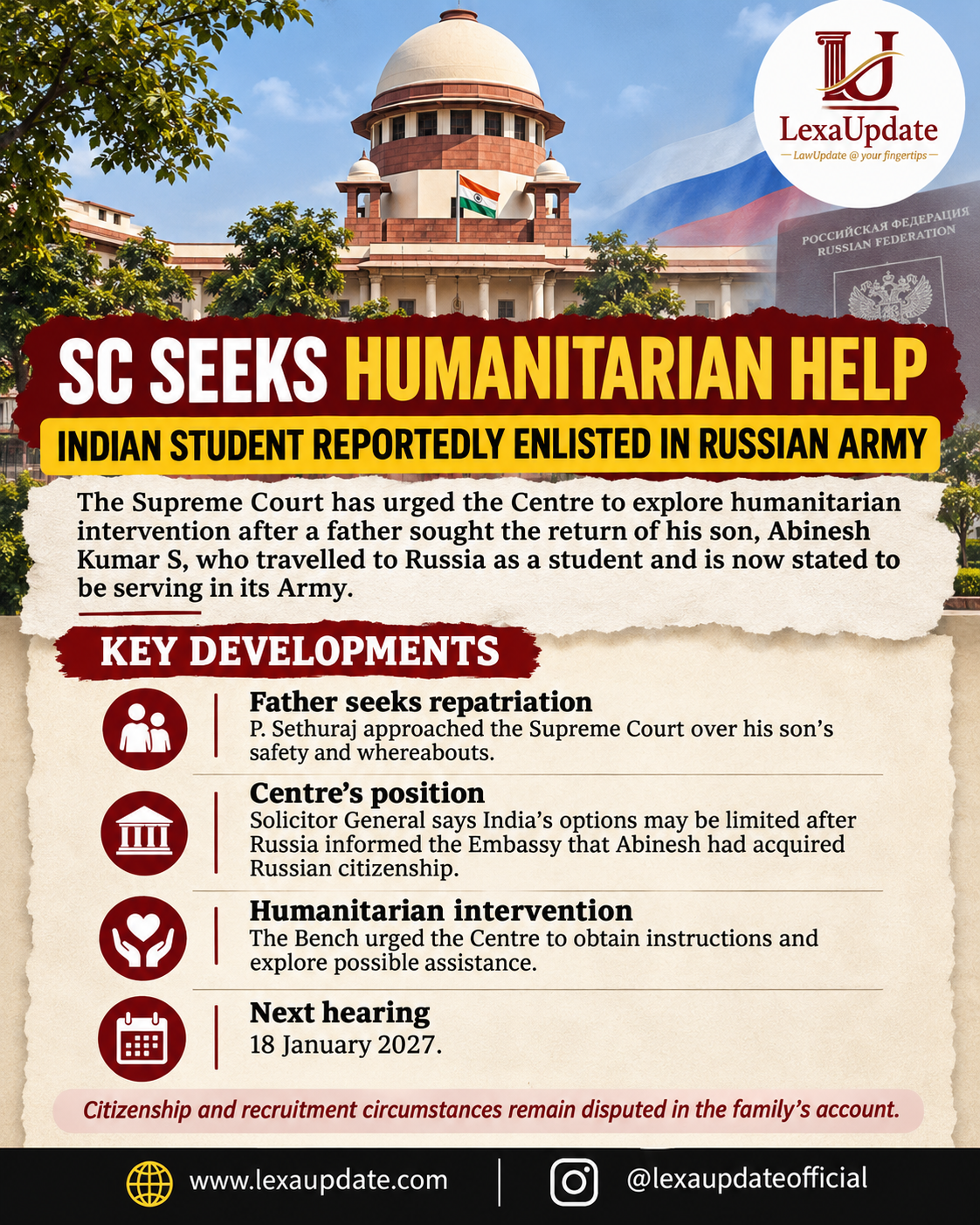
The Supreme Court of India has directed the Union Government to intervene on purely humanitarian grounds to secure the release and repatriation of an Indian national who is alleged to have enlisted in the Russian Army.
The bench, comprising Chief Justice Surya Kant, Justice Joymalya Bagchi and Justice V. Mohana, issued notice on 23 November 2026 and instructed the Solicitor General to take up the matter, with the case slated for further hearing on 18 January 2027.
Background and Facts
The petition was filed by P. Sethuraj on behalf of his younger son, Abinesh, a student who travelled to Russia on a student visa in April 2026 along with three other Indian students. According to the petitioner, the students were recruited through an Instagram‑based agent. The family last communicated with Abinesh on 19 July 2026; thereafter, all contact was lost.
Subsequent access to Abinesh’s email revealed documents that appeared to be a Russian Army identification card and a military tag. The petitioner alleges that Abinesh was coerced or misled into joining the Russian armed forces, that his Indian passport was confiscated, and that he may have been deployed to conflict‑prone areas.
The Ministry of External Affairs (MEA) approached the Indian Embassy in Moscow, which in turn sought clarification from the Russian Ministry of Defence. The Embassy attached documents indicating that Abinesh had allegedly acquired Russian citizenship, voluntarily renounced his Indian citizenship, and obtained a Russian passport.
Submissions & Proceedings
During the hearing, counsel for the petitioner highlighted the rapidity with which the alleged citizenship conversion occurred, questioning the validity of the student visa and the procedural safeguards that should have prevented such a transition. The petitioner sought a writ of mandamus directing the Union to secure his son’s release and safe return to India.
The Union Government, represented by the Solicitor General Tushar Mehta, contended that once a person acquires foreign citizenship, the scope of Indian diplomatic protection narrows. Nevertheless, the Government acknowledged the humanitarian dimension and expressed willingness to engage with Russian authorities.
Court's Reasoning & Directions
The three‑judge bench observed that the Constitution guarantees the right to life and personal liberty (Article 21) and that the State has a duty to protect its citizens abroad, especially where humanitarian concerns arise. While noting the complexities of dual‑citizenship and the legal ramifications of a voluntary renunciation, the Court emphasized that the petitioner's primary grievance pertained to the safety and welfare of his son.
Accordingly, the Court:
- Impressed upon the Solicitor General to intervene “purely on humanitarian considerations” and to obtain clear instructions from the Centre.
- Directed the Advocate‑on‑Record G.S. Makker to accept notice for the respondents and to ensure the matter appears on the cause list.
- Ordered the case to be listed for further arguments on 18 January 2027.
The Court refrained from passing any substantive finding on the legality of Abinesh’s alleged enlistment, reserving that for subsequent proceedings.
Why This Case Matters
The matter sits at the intersection of international law, citizenship law, and humanitarian protection. It raises critical questions about:
- India’s diplomatic leverage when a citizen acquires foreign nationality under contested circumstances.
- The procedural safeguards for Indian students travelling abroad for education.
- The role of the judiciary in prompting executive action on humanitarian grounds, even where diplomatic channels are already engaged.
For legal practitioners, the case underscores the importance of swift consular intervention and the potential for Supreme Court intervention when fundamental rights are perceived to be at risk abroad.
Key Takeaways
- The Supreme Court has formally asked the Union to act on humanitarian grounds for an Indian national in the Russian Army.
- The Solicitor General has been directed to seek instructions and engage with Russian authorities.
- The case will be heard again on 18 January 2027, allowing the Union to present its detailed response.
- The dispute highlights gaps in student‑visa monitoring and the need for robust consular safeguards.
Case Details
| Case Name | P. Sethuraj v. Union of India & Ors. |
| Court | Supreme Court of India |
| Bench | Chief Justice Surya Kant, Justice Joymalya Bagchi, Justice V. Mohana |
| Case Number / Citation | |
| Date of Order | 23 November 2026 |
| Relevant Provisions / Statutes | Constitution of India, Article 21 (Right to Life & Personal Liberty) |
| Next Hearing | 18 January 2027 |