
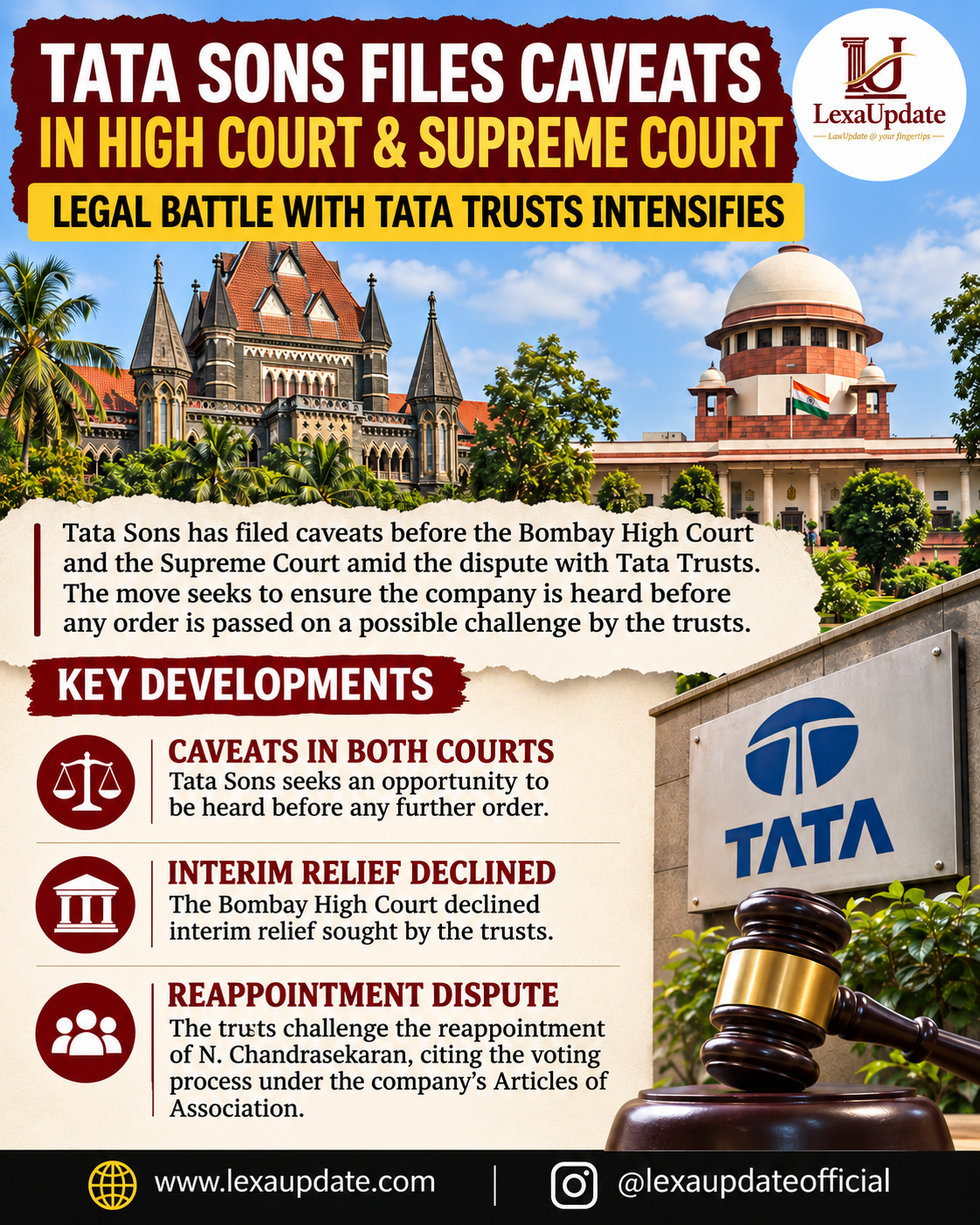
Tata Sons has filed preemptive caveats in both the Supreme Court of India and the division bench of the Bombay High Court. This legal maneuver follows an oral order by a single bench of the High Court declining to grant interim relief to the Sir Dorabji Tata Trust (SDTT) and the RD Tata Trust in their ongoing legal challenge against the reappointment of N Chandrasekaran as executive chairman.
The underlying dispute stems from sharp governance divisions within the conglomerate regarding voting thresholds, board procedures, and the application of constitutional provisions under the company's Articles of Association. By lodging caveats, Tata Sons ensures that no ex parte interim orders can be passed by higher judicial forums without granting the company an opportunity to present its case.
Background and Facts of the Dispute
The corporate standoff intensified after the board of Tata Sons passed a resolution on September 17, 2026, reappointing N Chandrasekaran for a third five-year term as executive head. The decision triggered friction between prominent stakeholders and leadership factions within the philanthropic trusts that collectively hold a majority stake in the holding company.
The controversy centers on the voting mechanism utilized during the board meeting. When the proposal to reappoint Chandrasekaran was considered under Article 104B, trust-appointed directors were split, with Noel Tata voting against the resolution and Venu Srinivasan supporting it. Harish Manwani, presiding over the meeting, treated the directors as equally divided and exercised a casting vote to push the resolution through. The trusts subsequently instituted suits in the Bombay High Court, contending that Article 121 requires a distinct affirmative majority vote of trust-appointed directors present, which cannot legally be substituted by a chairman's casting vote.
Submissions and Judicial Proceedings
Representing the plaintiff trusts, senior counsels argued that the board's reappointment decision violated mandatory governance thresholds prescribed in the Articles of Association. The trusts sought urgent interim and ad-interim reliefs, including requests to defer a crucial board meeting and to restrain the chairman from exercising a casting vote in deadlocks involving trust-nominated directors.
Opposing the interim applications, senior advocates appearing for Tata Sons defended the validity of the board resolution and the exercise of the casting vote. On November 27, 2026, Justice Abhay Ahuja of the Bombay High Court declined to grant the immediate interim reliefs sought by the trusts, permitting the scheduled board meeting to proceed while clarifying that any outcomes would remain subject to final judicial determinations. The court adjourned the primary suits for further hearings.
Court's Reasoning and Legal Scope
Under Section 148A of the Code of Civil Procedure (CPC), a caveat is a statutory mechanism enabling a party apprehending litigation to register its appearance in advance. This ensures that courts do not issue unilateral stay orders or injunctions without hearing the caveator. Anticipating that the trusts might challenge the single bench's refusal of interim relief before appellate authorities or the apex court, Tata Sons filed comprehensive caveats across relevant judicial tiers to secure immediate representation.
Why This Case Matters
This high-stakes corporate litigation underscores critical principles of corporate governance, internal board dynamics, and the interpretation of voting thresholds within India's largest conglomerates. The outcome of this dispute will have far-reaching implications for the balance of power between promoter trusts and executive leadership, setting vital precedents on board deadlocks, casting votes, and compliance with constitutional corporate documents.
Key Takeaways
- Preemptive Legal Action: Tata Sons filed caveats in the Supreme Court and the Bombay High Court to prevent any ex parte interim rulings against it.
- Board Meeting Progression: The Bombay High Court refused to defer the scheduled board meeting or restrict the chairman's casting vote, subject to final orders.
- Core Legal Question: The litigation hinges on whether a chairman's casting vote can override specific affirmative voting mandates under Article 121 of the Articles of Association.
- Next Judicial Date: The Bombay High Court has scheduled the next substantive hearing for January 2027.
Case Details
| Case Name | Sir Dorabji Tata Trust & Anr. v. Tata Sons Pvt. Ltd. |
|---|---|
| Court | Bombay High Court / Supreme Court of India |
| Bench | Justice Abhay Ahuja (Single Bench, Bombay HC) |
| Case Citation / Number | Pending Institution (Caveat Filings) |
| Date of Order | November 27, 2026 |
| Relevant Provisions | Section 148A of the Code of Civil Procedure (CPC); Articles 104B and 121 of the Articles of Association |
| Next Hearing | January 21, 2027 |