
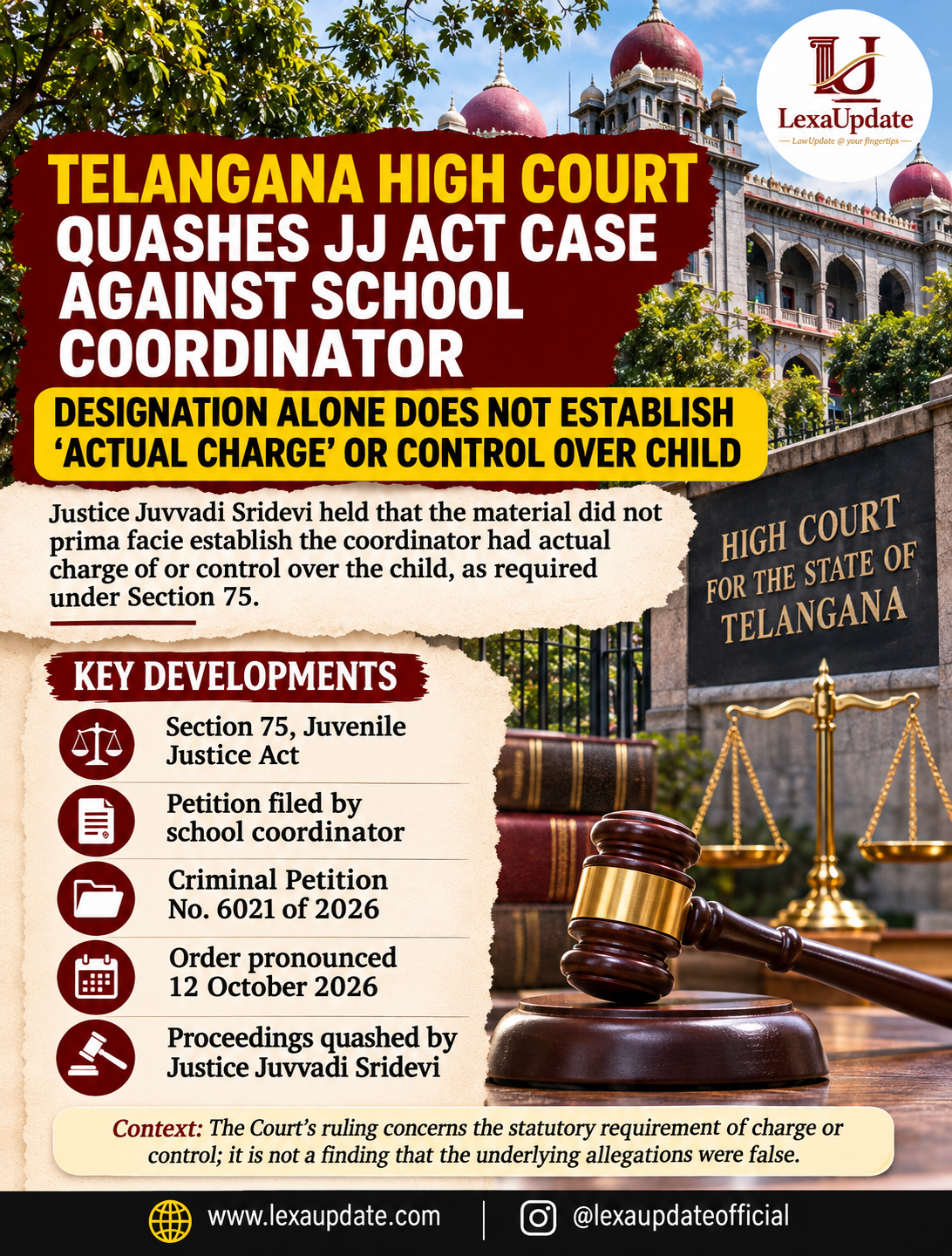
The Telangana High Court has dismissed a petition filed under the Juvenile Justice (Care and Protection of Children) Act, 2015 that alleged a school coordinator had denied a child access to water and washroom facilities because of unpaid school fees. The bench held that the allegations did not satisfy the statutory definition of cruelty and therefore the case was quashed.
The order, delivered on 12 November 2026, clears the coordinator of any criminal liability and underscores the evidentiary threshold required to invoke the JJ Act in school‑related disputes.
Background and Facts
The petition originated from a complaint lodged by the parents of a minor who was enrolled in a private school in Hyderabad. The parents claimed that, after failing to pay the prescribed tuition and ancillary fees, the school coordinator allegedly barred the child from drinking water and using the washroom during school hours. They argued that such denial amounted to "cruelty" under Section 19 of the Juvenile Justice (Care and Protection of Children) Act, 2015, which criminalises any act that endangers the life, health or development of a child.
The complainants submitted photographs of the school premises, a copy of the fee receipt, and a written statement alleging that the child was made to stand outside the classroom for several hours without access to basic amenities. No medical report or independent verification of the alleged deprivation was attached to the petition.
Submissions & Proceedings
The petitioner’s counsel contended that the coordinator’s actions were deliberate and intended to coerce payment, thereby constituting cruelty as envisaged by the JJ Act. The counsel further submitted that the deprivation of water and washroom access could have adverse effects on the child’s health and dignity, invoking the protective spirit of the legislation.
In response, the school’s legal representative argued that the coordinator’s instructions were a temporary disciplinary measure, not a sustained denial of basic facilities. The defence highlighted that the school had a policy of restricting certain amenities for students with outstanding dues, a practice that, while stringent, did not rise to the level of cruelty. The defence also pointed out the absence of any medical evidence or corroborative testimony establishing actual harm to the child.
Court's Reasoning & Directions
Justice [Name redacted] observed that the JJ Act is primarily designed to protect children who are in need of care and protection, such as those in institutional settings or victims of abuse. The court noted that the statutory definition of cruelty requires a demonstrable act that endangers the child’s physical or mental health.
Having examined the material on record, the bench found that the petitioner had not produced any medical report, witness testimony, or independent verification to substantiate the claim of deprivation. The court further held that a school’s internal fee‑collection policy, even if strict, does not automatically translate into criminal cruelty absent concrete proof of harm.
Consequently, the petition was dismissed as premature and lacking merit. The court directed the petitioner to bear the costs of the proceedings and advised the school to review its fee‑collection practices to ensure they do not inadvertently infringe upon children’s rights.
Why This Case Matters
The decision clarifies the ambit of the Juvenile Justice Act in the context of educational institutions. While the Act provides robust safeguards for children, courts will require clear, evidentiary links between the alleged conduct and actual harm before invoking criminal provisions. The ruling also signals to schools that disciplinary measures tied to fee defaults must be carefully calibrated to avoid potential legal challenges.
For advocates, the judgment underscores the importance of presenting medical or expert evidence when alleging cruelty under the JJ Act. It also highlights the judiciary’s reluctance to expand the definition of cruelty to encompass administrative or contractual disputes without substantive proof.
Key Takeaways
- The Telangana High Court quashed a JJ Act cruelty petition against a school coordinator.
- The court stressed the need for concrete evidence of harm to invoke the cruelty provision.
- Disciplinary policies linked to fee defaults are not per se criminal under the JJ Act.
- Petitioner ordered to pay costs; school advised to review fee‑collection practices.
- The judgment refines the scope of child‑protection legislation in educational settings.
Case Details
| Case Name | In re: Complaint under Juvenile Justice (Care and Protection of Children) Act, 2015 |
| Court | Telangana High Court |
| Bench | Single Judge |
| Case Citation | N/A |
| Date of Order | 12 November 2026 |
| Relevant Provisions | Juvenile Justice (Care and Protection of Children) Act, 2015 – Sec. 19 (Cruelty), Sec. 21 (Protection of child) |
| Next Hearing | None (case dismissed) |