
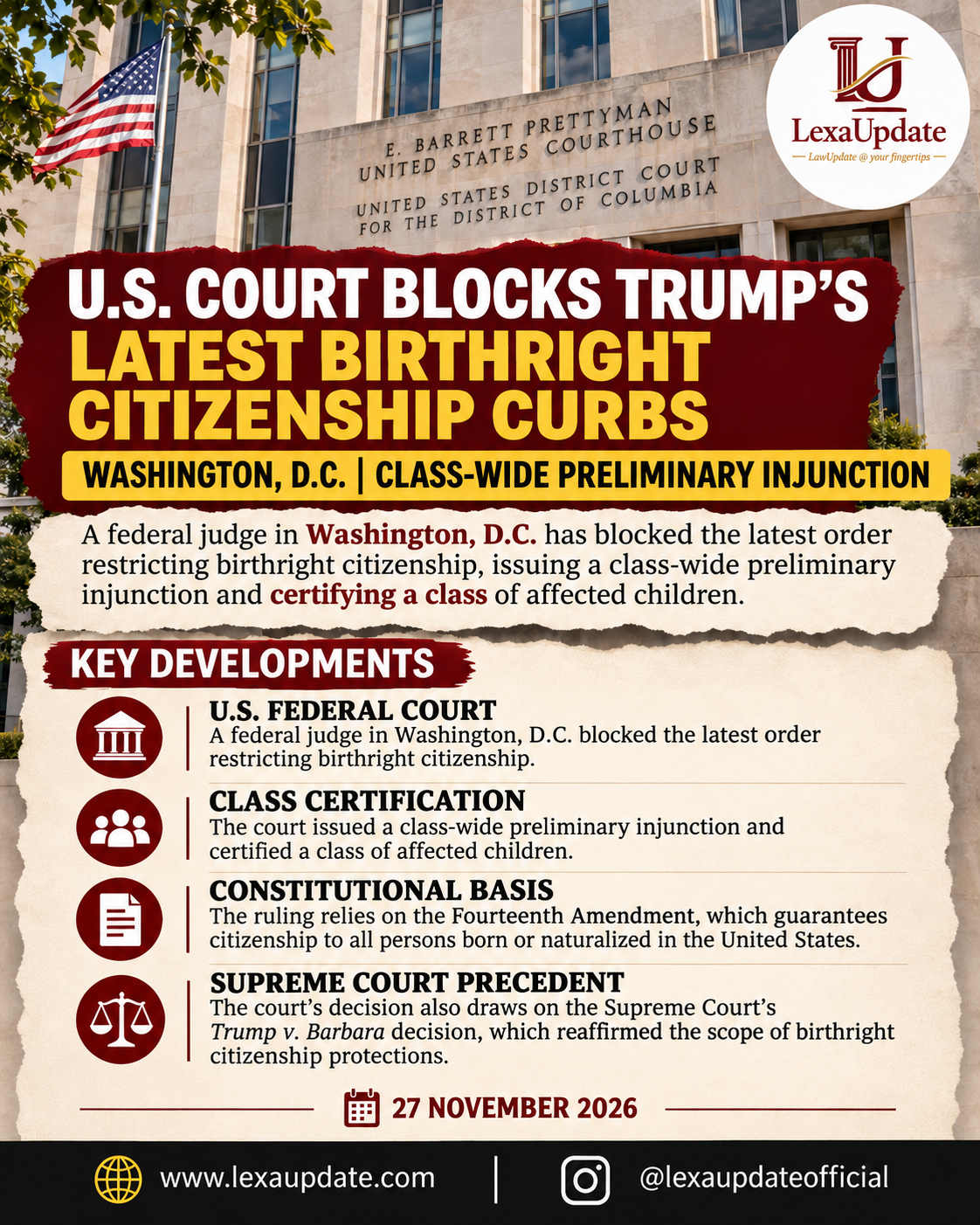
U.S. District Court Judge Christopher Cooper has issued a decisive ruling that blocks the Trump administration's latest executive order aimed at limiting birthright citizenship for children born on U.S. soil to non‑citizen parents. The judge held that the children remain "subject to the jurisdiction of the United States" and therefore are constitutionally guaranteed citizenship under the Fourteenth Amendment.
The decision follows a series of legal challenges by civil‑rights organisations and comes after the Supreme Court earlier this year rejected a similar Trump‑initiated restriction. With the district court’s injunction, the administration’s policy is temporarily halted, and the executive order cannot be enforced pending further appellate review.
Background and Facts
In August 2026 President Donald Trump signed an executive order that sought to create a federal citizenship list and direct the Department of Homeland Security and the U.S. Postal Service to verify the citizenship status of individuals receiving mail‑in ballots. A specific provision targeted "birth tourism" and children born to parents who were not permanent residents, diplomatic staff, or classified as "alien enemies," arguing that such children should be excluded from automatic citizenship under the Fourteenth Amendment.
The order sparked immediate lawsuits filed by a coalition of civil‑rights groups, including the American Civil Liberties Union, on behalf of children who would be affected. Plaintiffs contended that the order contravenes the Constitution’s clear language that all persons born or naturalised in the United States, and subject to its jurisdiction, are citizens.
Submissions & Proceedings
Representing the plaintiffs, counsel argued that the Fourteenth Amendment’s Citizenship Clause is unambiguous and that the executive order attempts to rewrite constitutional law without legislative authority. They cited Supreme Court precedent, notably Wong Kim Ark v. United States (1898), which affirmed that birthplace alone confers citizenship regardless of parental status.
The government, through the White House, maintained that Congress had intended a narrower reading of the Amendment and that the order merely clarified eligibility for voting in federal elections. White House spokeswoman Lauren Bis described the district court’s ruling as “activist” and asserted that the order aligns with prior Supreme Court analysis.
Court's Reasoning & Directions
Judge Cooper concluded that the executive order oversteps presidential authority and violates the Constitution. He emphasized that the phrase "subject to the jurisdiction thereof" includes children born to non‑citizen parents who are physically present in the United States, thereby granting them citizenship automatically.
The judge issued an injunction prohibiting the administration from implementing any portion of the order that would deny citizenship or affect voting rights based on parental immigration status. He ordered the Department of Homeland Security to cease compilation of a federal citizenship list and directed the Postal Service to refrain from any verification scheme that discriminates on the basis of parentage.
Why This Case Matters
The ruling reinforces the entrenched constitutional principle that birthright citizenship cannot be altered by executive action alone. It underscores the judiciary’s role in checking executive overreach, particularly in areas traditionally reserved for Congress. For immigration advocates and voting‑rights groups, the decision provides a critical safeguard against policies that could disenfranchise millions of U.S.–born children of immigrant families.
Moreover, the case highlights the continuing legal battles over the scope of presidential power in immigration and election administration, setting a precedent for future challenges to similar executive directives.
Key Takeaways
- The U.S. District Court has permanently blocked the Trump administration’s birthright citizenship restriction.
- The Fourteenth Amendment’s Citizenship Clause remains the controlling authority on who is a U.S. citizen at birth.
- The executive order’s provisions requiring a federal citizenship list and mail‑in ballot verification are enjoined.
- The decision reaffirms judicial oversight of executive actions that attempt to modify constitutional rights.
- Further appeals are expected, but the injunction remains in force pending higher‑court review.
Case Details
| Case Name | Rights groups v. United States (D.D.C.) |
| Court | U.S. District Court for the District of Columbia |
| Bench | Judge Christopher Cooper |
| Case Citation | Not yet reported |
| Date of Order | 26 November 2026 |
| Relevant Provisions | U.S. Constitution, 14th Amendment (Section 1) |
| Next Hearing | Appeal pending; date not set |